
Journal Selection Service for Publication
Selecting the right journal is important to ensure that your paper gets published. Often, papers are rejected because the research topic is outside the scope of the journal, or is aimed at a different target audience. With our specialised Journal Selection service, our experts individually go through your manuscript and recommend the top most suitable journals for you.
Our expert’s recommendation of 3-5 best suited journals A detailed Journal Selection report to explain the selection Easier decision-making with additional information about the shortlisted journals
How our Journal Selection Service works
Choose the service plan that best suits your needs
Our expert performs a 4-step filter process
You get a detailed report:
Our 4-step Journal Selection filter process:
Editage’s publication experts sift through almost 35,000 journals to recommend the right ones for your manuscript.
Scope of each journal
Your specifications
Desired impact factor & target readership
Manuscript type
Journal selection report sample:
Our journal selection report will help you finalize a target journal for your paper. It has been strategically compiled considering the scope, impact factor range, and indexing requirements best suited for your paper in its current form, keeping your personal preferences in mind
Sample report
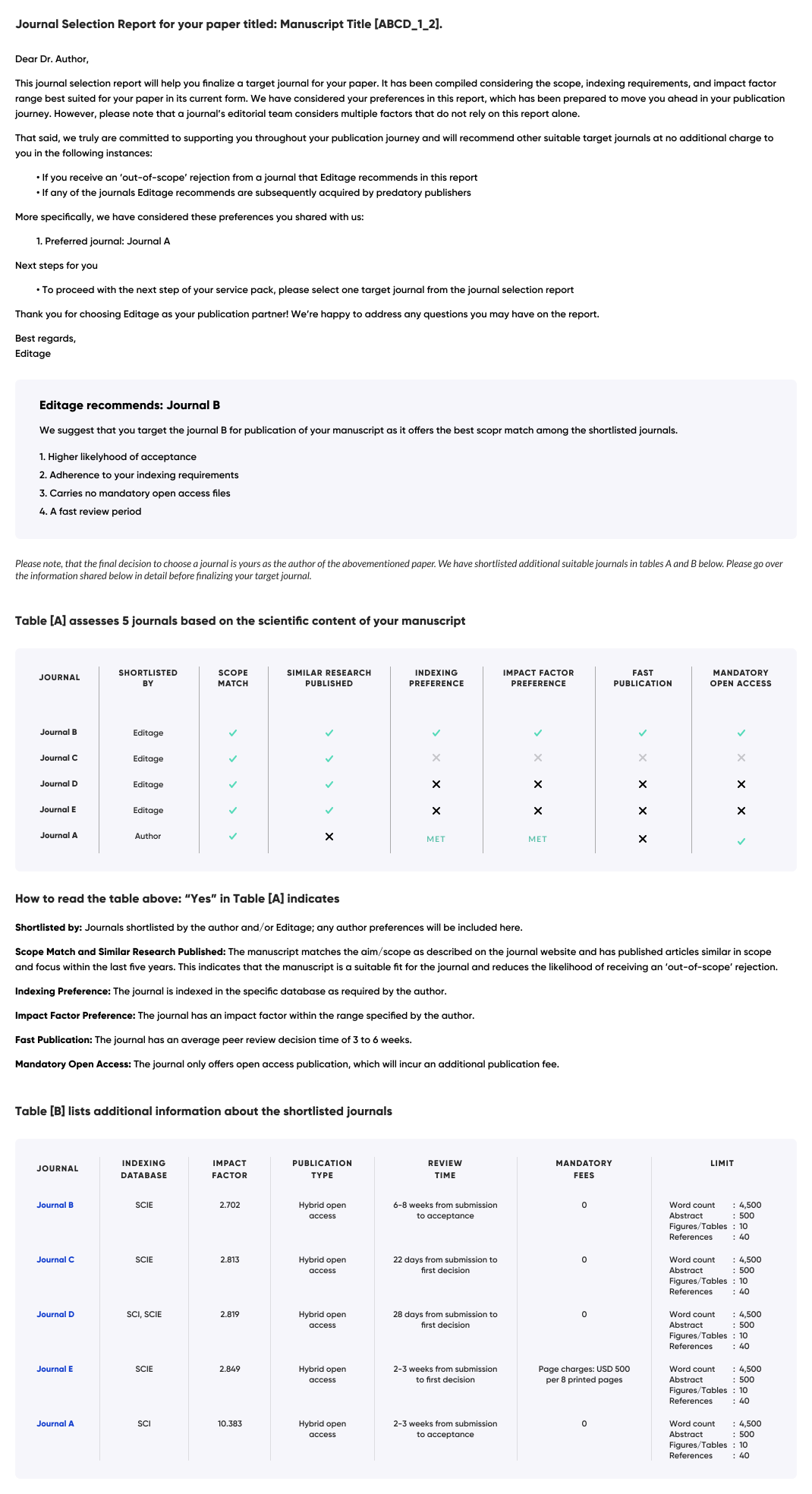
Section 1 - Recommmended journals list

Section 2 - What we recommend
Editage recommends: Journal B
We suggest that you target the journal B for publication of your manuscript as it offers the best scope match among the shortlisted journals.- Higher likelyhood of acceptance
- Adherence to your indexing requirements
- Carries no mandatory open access files
- A fast review period
Please note, that the final decision to choose a journal is yours as the author of the above mentioned paper.
Editage will recommend other suitable target journals if…
- If you receive an ‘out-of-scope’ rejection from a journal that we recommended in this report.
- If any of the journals we recommend are subsequently acquired by predatory publishers.
Maximize your chances of publication by letting Editage match you with the most appropriate journals according to your requirements and nature of research. Our experts team hold extensive experience in peer-reviewing for international journals including SCI, SSCI, Web of Science, Scopus, etc.
With our all services packs, save up to 60%
Buy Journal Selection service as part of our Publication Support Packs and ensure a worry free submission journey.
Silver Pack
Budget publication-support package
Journal Selection
Premium Editing
Artwork Formatting
Journal Submission
Plagiarism Check
Resubmission Support
Pre-submission Peer Review
Gold Pack
Popular
Popular
End-to-end publication-focused support for up to two journals
Journal Selection
Premium Editing
Artwork Formatting
Journal Submission
Plagiarism Check
Resubmission Support
Pre-submission Peer Review
Platinum Pack
High-end publication support, including a complete techical review
Journal Selection
Premium Editing
Artwork Formatting
Journal Submission
Plagiarism Check
Resubmission Support
Pre-submission Peer Review
Accelerate your publication journey
3 Reasons why authors choose Editage’s Journal Selection Services
20+ Years of academic publishing experience
Over two decades, publication experts at Editage have partnered with 800,000+ researchers and enabled them to publish in top ranking journals. Our journal selection service leverages this experience and understanding of the scholarly publishing industry to accelerate the critical journal selection stage and improve your paper’s chances of publication success.Journal selection by publication experts
Identifying and selecting appropriate journals for your research as well as sifting potentially predatory journals can be tedious. Editage’s Journal Selection Service ensures that your research finds suitable, verified, and peer reviewed journals through careful assessment by experts in your subject area who have experience working with leading international journals.An array of publication support services
A professional journal selection service can minimize the chances of receiving scope-based rejection from target journals. Our publication experts have also identified other reasons for rejection like gaps in research design or a weak literature review, and developed specialized publication packages, inclusive of journal selection, to overcome such hurdles and fast-track your publication journey.
Frequently Asked Questions
- 01
Do you guarantee publication?
Publication depends largely on the quality of your research and is a subjective decision that the journal editor takes based on several factors. Therefore, we cannot guarantee publication. However, by helping you understand and follow publication protocols and by offering Premium Editing and Pre-submission Peer Review services*, we help you increase your chances of publication.*Pre-submission Peer Review is only available with the Platinum pack or a Custom pack where you opt for this component. - 02
What if I receive a rejection from the journal you recommend?
If our expert hasn't been able to deliver the service within the scope of service, then we will refund the amount back to you. The panel of experts will help you identify journals most suitable for your manuscript. If you have a specific preference in terms of impact factor and the journals recommended are a risk then our expert will highlight it for you. - 03
What do you deliver if I choose this service?
We will deliver a report outlining the pros and cons of each journal that is recommended for your manuscript. - 04
Do you offer post service support?
This is a one time service offered and there are no re-selection rounds. However, if you have question for our expert about tje journals we recommend, you can always get back to us. - 05
Who selects the journal?
Our panel of experts comprises of experienced researchers who themselves have published manuscripts in several journals and have experience with reviewing journals for specific SAs - 06
I need a high impact factor journal? Can you suggest some?
While we can try to meet your expectation of high impact factor journals, the experts would be able to advise some journals that are most suitable to your manuscript. - 07
Why is journal selection important?
Selecting the right journal not only maximizes your chances of getting published but also ensures that it reaches the right audiences and gets the attention it deserves. This is where professional journal selection services like the one offered by Editage can prove useful as they provide recommendations based on a comprehensive evaluation of your manuscript and individual preferences. - 08
What is included in the journal selection report?
Our professional journal selection report usually comprises a comprehensive assessment of appropriate journals and provides a list of recommendations based on factors like –
• scope of the journal and the target audiences it caters to
• the publication’s readership, circulation and reach (regional or international)
• analysis of the citation index of papers published in the journal
• checking if the journal is peer-reviewed and the average time taken for the review process
• the submission process and cost involved
• submission lead time and frequency of publication (quarterly, annual) - 09
Does the journal selection service include submitting the journal?
Our journal selection service does not include journal submission assistance. However, we do offer both Journal Selection and Journal Submission as part of our Publication Support Packs. Click here for more information on the available service plans. - 10
What are the different plans available under the journal selection service?
While you can opt for Journal Selection as a single service, we recommend using the service as part of our Publication Support Packs which comprises customized publication solutions to suit every need.
The Silver Pack is great for those on a budget and offers the following services
•Journal Selection
• Premium Editing
• Artwork Formatting
• Journal Submission
• Plagiarism Check
The Gold Pack offers end-to-end publication support for a maximum of 2 journals and includes
• Journal Selection
• Premium Editing
• Artwork Formatting
• Journal Submission
• Plagiarism Check
• Resubmission support
The Platinum Pack offers a comprehensive technical review and high-end publication support including –
• Journal Selection
• Premium Editing
• Artwork Formatting
• Journal Submission
• Plagiarism Check
• Resubmission support
• Pre-submission peer review support
Click here to select and sign up for the Publication Support Pack of your choice. - 11
How do you choose experts for the journal selection service?
The team of expert subject-matter experts who work on journal selection reports are typically experienced researchers and peer reviewers. They have extensive experience with evaluating journals since they themselves have published manuscripts in leading international journals and understand what to look for when choosing the right publication. - 12
How do I get started with journal selection service?
Getting started with Editage’s journal selection service is simple. All you have to do is select a service pack specific to your requirements and submit your manuscript for evaluation. Click here to get started. - 13
What if I am not satisfied with the journal selection report delivered by you?
We are committed to supporting you throughout your publication journey and will recommend other suitable target journals at no extra cost if
• You receive an ‘out-of-scope’ rejection from a journal that Editage recommends
• Any of the journals we recommend are subsequently acquired by predatory publishers - 14
What are two important considerations when selecting a journal for publication?
While several factors need to be considered when selecting a journal for submission, the two essential things to remember are
• The scope of the publication - Journals are usually very specific about their subject area and a manuscript that does not match their area of interest is usually rejected. Therefore, it is important to ensure that the topic being addressed in the manuscript lies within the scope of the publication. • Readership and circulation - Reaching the right target audience is important for your work to get the recognition it deserves. Assessing if a journal has healthy readership and circulation is an important factor to consider when choosing a journal for publication.
Our team comprises physicians, PhDs, MDs, postgraduates, engineers, and even journal peer reviewers who are not only technically competent but also have a deep understanding of the nuances of your subject.
| ⏰ Turnaround time | 3 Days |
|---|---|
| 💲 Rate | $149 |
| ✏️ Feedback Areas | 3-5 best suited Journal recommendations |
| 📄 Document types | All Document Types |
| 🪄 Available Benefits | Detailed Journal Selection Report |
What our users say
Editage has not only helped me in proofreading my articles but also successfully guided me in the selection of journals. Great service! The comments f...
Read more Tiago Freire, Lecturer
Xi'an JiaoTong-Liverpool University
Its really a high quality editing service and I'm quite pleased about the work. If an author is seeking qualified writing and publication support, thi...
Read more Ugur Erdemir , Associate Professor
Istanbul University
Without Editage, I cannot imagine that I could publish two articles and complete my Ph.D. course. A great job and a great cost-benefit. I have tried o...
Read more Hirohisa Shimura , Adjunct Professor
Temple University Japan Campus
Thank you very much for the Editage team. Actually, this is the first time to become the corresponding author. The acceptance of this manuscript is so...
Read more Obie Farobie,
Impact factor - 5.039 of Journal
Great service! The comments from the editor really help me guide my writing and how I shape my argument. It is one of the best features of this servic...
Read more Dr. Luigi Schiavo, Nutrizionist, , Published in: PLOS
Second University of Naples. Impact factor - 4.942 of Journal
I was supported by Editage team through the whole process of preparing the manuscript. Thank You!
Mariusz Sieminski
Impact Factor - 3.339 of Journal
Meet our experts
*Disclaimer: All third-party trademarks (including logos and icons) of journals / publishers, etc. referred to on this website remain the property of their respective owners. Use of third-party trademarks does not indicate any affiliation, sponsorship with or endorsement by them. Any references to third-party trademarks is to identify the corresponding services and shall be considered fair use under The Trademarks Law. We are not implying that purchasing this service will ensure publication in any journal.