Duplicate Publications vs Simultaneous Submissions: Guide to Publication Ethics
Key Takeaways
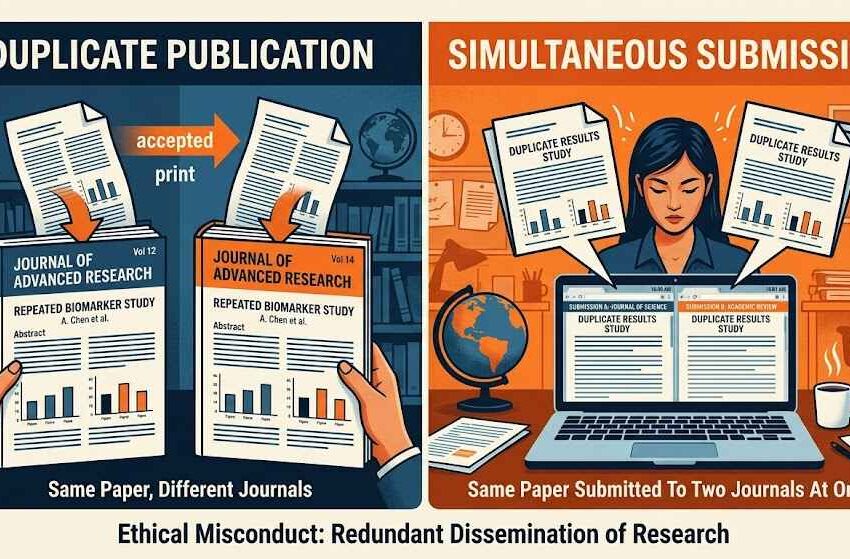
✓ Duplicate publication = republishing previously published work without permission or disclosure
✓ Simultaneous submission = submitting the same work to multiple journals without telling editors
✓ Both are serious ethical violations that damage research integrity and your career
✓ Detection is increasingly likely through automated plagiarism software and peer reviewer knowledge
✓ Consequences are severe including retraction, loss of funding, institutional sanctions, and career damage
✓ Transparency is your best defense by disclosing all related work to editors upfront
✓ Exceptions exist but are limited and require explicit editor approval and proper attribution
✓ One manuscript, one journal at a time is the ethical standard
✓ Multiple papers from one dataset are acceptable only with separate research questions and full disclosure
In this article, you’ll learn
- What is Duplicate Publication?
- Key Characteristics of Duplicate Publication
- What is Simultaneous Submission?
- Key Characteristics of Simultaneous Submission
- Duplicate Publication vs Simultaneous Submission: Quick Comparison
- Why Duplicate Publication is Problematic
- Why Simultaneous Submission is Problematic
- What Do Journal Editors and Ethical Guidelines Say?
- When is Republication Actually Permitted?
- ⚠️ Critical Requirements for All Republications:
- Dos and Don’ts for Authors: Duplicate Publication
- Managing Multiple Papers from the Same Dataset
- Dos and Don’ts for Authors: Simultaneous Submission
- Exceptions: When Simultaneous Submission is Allowed
- Real-World Consequences of Violations
- Detecting Duplicate Publications and Simultaneous Submissions
- Get Help With Publication Ethics
- Common Questions About Publication Ethics
- Best Practices for Ethical Submissions
What is Duplicate Publication?
Duplicate (or redundant) publication occurs when a paper that is substantially similar to a previously published work by the same author(s) is submitted to another journal without:
- Acknowledging the original source
- Obtaining permission from the original copyright holder
- Disclosing the prior publication to the editor
Key Characteristics of Duplicate Publication
| Aspect | Details |
| Overlap in Content | Same dataset, findings, and core results as original paper |
| Visual Changes | May have new title, modified abstract, or reorganized sections—but underlying data remains identical |
| Copyright Issues | Violates copyright held by original publisher (not typically by authors) |
| Intentionality | Can be unintentional but is still an ethical violation |
| Detection | Increasingly caught through plagiarism detection software and automated screening |
What is Simultaneous Submission?
Simultaneous submission (also called multiple or dual submission) refers to the practice of submitting the same manuscript to two or more journals at the same time without informing journal editors of the concurrent submissions.
Key Characteristics of Simultaneous Submission
| Aspect | Details |
| Timing | Manuscript is under active consideration at multiple journals simultaneously |
| Disclosure | Done without the knowledge or consent of journal editors |
| Intent | Often used to speed up publication timeline |
| Distinction | Different from duplicate publication—the work hasn’t been published yet |
| Risk | Could result in copyright disputes if multiple journals accept and attempt to publish |
Duplicate Publication vs Simultaneous Submission: Quick Comparison
| Factor | Duplicate Publication | Simultaneous Submission |
| Timing | Submitted after previous publication | Submitted before any acceptance |
| Publication Status | Original work already published | Original work not yet published |
| Copyright Issues | Major—violates existing copyright | Potential—if multiple journals accept |
| Detection Difficulty | Easier to catch | Harder to detect |
| Ethical Category | Self-plagiarism & fraud | Breach of good faith submission |
| Primary Harm | Distorts research record; wastes resources | Wastes peer review resources |
Why Duplicate Publication is Problematic
Republishing research without permission or acknowledgment creates serious consequences:
1. Copyright Violation
- In most cases, copyright belongs to the publisher, not the author
- Republishing without permission is a legal violation
- Can expose authors to legal action
2. Distorts Scientific Evidence
- Researchers may unknowingly count the same results twice
- Inflates empirical findings in meta-analyses and systematic reviews
- Leads to flawed conclusions in policy-making and clinical decisions
- Compromises the integrity of scientific literature
3. Self-Plagiarism
- Using your own previously published material without attribution is still plagiarism
- Violates academic integrity standards
- Damages credibility and reputation
4. Wastes Editorial Resources
- Editors and peer reviewers invest time evaluating duplicate submissions
- Diverts limited journal resources from novel research
- Slows down the publication of original work
5. Denies Other Authors Publication Opportunities
- Takes up competitive journal space
- Reduces opportunities for emerging researchers
- Reduces diversity in published research
6. Sign of Poor Scholarship
- Indicates marginal contribution to the field
- Suggests lack of originality or new insights
- Raises questions about researcher integrity
Why Simultaneous Submission is Problematic
While some researchers argue it speeds up publication, journals view it as unethical for these reasons:
1. Copyright & Publication Disputes
- If multiple journals accept the same manuscript, copyright conflicts arise
- Journals expect exclusive consideration during review
- Can lead to accusations of bad faith submission
2. Wastes Peer Review Resources
- Multiple reviewers evaluate identical work simultaneously
- Significant investment of expert time and effort
- Peer review is a voluntary service; wasting it is unethical
- Slows innovation by diverting reviewer capacity
3. Undermines Journal Trust
- Publishers invest in screening, review, and production
- Simultaneous submissions suggest authors lack confidence in the process
- Damages the author-journal relationship
4. Increases Burden on Researchers
- Managing multiple revisions for the same manuscript across journals
- Responding to conflicting reviewer feedback
- Coordinating withdrawals becomes complicated
What Do Journal Editors and Ethical Guidelines Say?
Major publishers and international ethics organizations have created explicit policies against these practices:
Major Organizations with Clear Policies:
| Organization | Excerpts from Policy |
| International Committee of Medical Journal Editors (ICMJE) | “Authors should not submit the same manuscript, in the same or different languages, simultaneously to more than one journal.”
“When authors submit a manuscript reporting work that has already been reported in large part in a published article or is contained in or closely related to another paper that has been submitted or accepted for publication elsewhere, the letter of submission should clearly say so and the authors should provide copies of the related material to help the editor decide how to handle the submission” |
| Committee on Publication Ethics (COPE) | “Submitting a paper to multiple journals simultaneously or submitting an already published paper to another journal are both unethical practices in academic publishing.” |
| Nature Publishing Group | “Authors submitting a contribution to a Nature Portfolio journal who have related material under consideration or in press elsewhere should upload a clearly marked copy at the time of submission, and draw the editors’ attention to it in their cover letter. Authors must disclose any such information while their contributions are under consideration by a Nature Portfolio journal – for example, if they submit a related manuscript elsewhere that was not written at the time of the original Nature Portfolio journal submission.” |
| Elsevier | “As with plagiarism, duplicate submission may take several forms: literal duplication, partial but substantial duplication, or even duplication by paraphrasing. Some journals have editorial policies that prohibit or discourage the publication of numerous papers based on the same research.” |
| PLoS | “If related content is found to be too similar to the PLOS submission, or if a duplicate submission is discovered, we will reject the manuscript.
Duplicate content discovered after publication will be addressed depending on the degree of overlap. The journal may issue a correction or a retraction as appropriate.” |
| American Chemical Society | “ACS strongly discourages concurrent submissions.” |
Standard Journal Requirements:
- Manuscript screening: Many require authors to submit copies of related or older articles and disclose these in the cover letter
- Overlap thresholds: Some journals specify maximum allowable text overlap (e.g., 25%)
- Verbatim content: Identical sentences from previous work must be cited
- Transparency: Authors must disclose all related submissions to editors
When is Republication Actually Permitted?
Ethical guidelines allow republication only in these specific cases:
1. Complete Paper Following Preliminary Report
- Expanded paper based on abstract, poster, or conference presentation
- Significant new data or analysis included
- Much larger scope than preliminary version
2. Guideline Papers
- Professional society or governmental guidelines
- Need to reach broad, varied readership
- Guidelines naturally require wider dissemination
3. Substantially Re-analyzed Work
- New interpretation of existing findings
- Different audience than original publication
- Fresh perspective or methodology applied
4. Translations
- Original paper translated for international audience
- Full citation and permission acknowledged
- Adds value through accessibility
5. E-print Repositories (Physics, Math, Computer Science)
- Fields like physics permit ArXiv and similar repositories
- Work can be posted before journal submission
- Standard practice in these disciplines
⚠️ Critical Requirements for All Republications:
Even when republication is permitted, authors must:
| Requirement | Why It Matters |
| Obtain copyright holder permission | Publishers own copyright for a lot of academic content |
| Get approval from both editors | Original journal editor must consent to republication |
| Full transparency | Clearly state that work is republished or based on prior publication |
| Complete citations | Provide full reference to original publication |
| Written documentation | Keep records of all permissions and approvals |
Dos and Don’ts for Authors: Duplicate Publication
✅ DO:
- Do disclose all related papers to the journal editor at submission
- Include copies of similar or related manuscripts
- Provide full citations in cover letter
- Do cite your own work when quoting from previous publications
- Use quotation marks
- Keep quotes brief (no more than a few sentences)
- Always provide proper attribution
- Do seek editor approval before using data from previous work
- Contact editor before submission
- Clearly explain how new manuscript differs
- Wait for written permission
- Do obtain written permissions if republishing is necessary
- Get copyright holder consent
- Document all approvals
- Preserve records for reference
❌ DON’T:
- Don’t replicate content from any of your previously published papers
- No copying sections, paragraphs, or substantial portions
- Paraphrase and provide citations instead
- Don’t make minor cosmetic changes to bypass detection
- Changing title, abstract, or keywords alone isn’t sufficient
- Reordering sections still constitutes duplicate publication
- Software will detect substantial similarity
- Don’t offer preliminary reports to media without journal permission
- Don’t discuss unpublished results in press releases
- Don’t share findings with companies or agencies without consent
- Don’t hide related submissions from editors
- Always disclose in cover letter
- Be transparent about overlapping research
- Don’t publish the same dataset under different framing without disclosure
- Multiple papers from one dataset are acceptable IF:
- Each addresses separate, important research questions
- Papers are cross-referenced
- Editor has been informed in writing
- Multiple papers from one dataset are acceptable IF:
Managing Multiple Papers from the Same Dataset
If you’re writing more than one manuscript from a single study:
| Step | Action |
| 1. Ensure Different Questions | Each paper must address separate, important research questions |
| 2. Cross-Reference | Manuscripts should reference each other |
| 3. Notify Editors | Inform journal editors about multiple papers in cover letter |
| 4. Provide Documentation | Include copies of all related papers with submissions |
| 5. Maintain Transparency | Be clear about data overlap in Methods section |
| 6. Avoid “Salami Slicing” | Don’t artificially split one paper into multiple weak publications |
Dos and Don’ts for Authors: Simultaneous Submission
✅ DO:
- Do submit to one journal at a time
- Wait for decision before submitting elsewhere
- Respect the review timeline
- Do get written consent from all co-authors before withdrawing
- Ensure agreement before changing submission plans
- Document approvals in writing
- Do contact the first journal if you want to submit elsewhere
- Request official withdrawal in writing
- Be professional and courteous
- Explain reason for withdrawal
- Do preserve withdrawal documentation
- Keep formal notification from editor
- Save all correspondence
- Present proof to new journal if requested
- Do disclose related papers if submitting similar work to different journals
- Explain how papers differ in content and scope
- Provide copies of related manuscripts
- Inform all journal editors
❌ DON’T:
- Don’t submit to multiple journals simultaneously
- Standard submission means exclusive consideration
- Violates publisher expectations and policies
- Don’t withhold information about concurrent submissions
- Silence is not consent
- Editors assume exclusive consideration unless told otherwise
- Don’t assume verbal consent from editors
- Get explicit written approval
- Don’t rely on email alone—confirm in writing
- Don’t submit to multiple conferences with overlapping dates
- Exception: Only when organizers explicitly allow it
- Don’t forget to withdraw from the first journal
- Leaving a manuscript “under review” while submitting elsewhere is dishonest
- Always formally withdraw before new submission
Exceptions: When Simultaneous Submission is Allowed
Very limited circumstances permit concurrent submission:
- Joint Publication Agreement
- Editors of 2+ journals agree in advance
- Coordinated decision to publish together
- Rare but allowed for important work benefiting the public
- Conference Paper Submissions
- Multiple conferences with overlapping submission periods
- Only if conference guidelines explicitly authorize it
- Must disclose all concurrent submissions
Real-World Consequences of Violations
For Your Career:
- Retraction of published articles
- Loss of grant funding
- Institutional sanctions
- Damaged professional reputation
- Difficulty publishing in future
- Peer distrust and isolation
For the Scientific Record:
- Distorted research findings
- Flawed systematic reviews and meta-analyses
- Misinformed clinical and policy decisions
- Loss of public trust in science
Legal Consequences:
- Copyright infringement claims
- Institutional investigations
- Career termination in severe cases
Detecting Duplicate Publications and Simultaneous Submissions
Modern tools make detection increasingly likely:
| Detection Method | How It Works |
| Plagiarism Detection Software | Turnitin, iThenticate, and similar tools scan databases of published work |
| Paperpal Preflight/CrossRef Screening | Automated checks during manuscript submission |
| Editor Expertise | Subject-matter experts recognize duplicate findings |
| Reviewer Knowledge | Peer reviewers often know the field and recent publications |
| Data Mining | Algorithms identify identical datasets across multiple papers |
| Open Science Platforms | Preprint servers and repositories create audit trails |
The Bottom Line: Modern detection is sophisticated. Getting caught is increasingly likely, not unlikely.
Get Help With Publication Ethics
Understanding publication ethics is one thing and implementing it correctly is another. Many researchers benefit from professional guidance in:
- Journal selection strategies
- Manuscript preparation and revision
- Ensuring compliance with publication ethics
- Understanding journal-specific policies
- Managing multiple manuscript submissions
Consider exploring publication support services that can help you navigate these complex guidelines and avoid costly mistakes.
Common Questions About Publication Ethics
Q: Can I publish the same research in different languages?
A: Yes, with proper disclosure and permissions. Translations are recognized exceptions IF you:
- Obtain permission from the copyright holder and original journal editor
- Clearly state that the work is a translation
- Provide full citation to original publication
- Add value through translation for new audience
- Always disclose this to the second journal in your cover letter.
Q: What if I want to submit a manuscript rejected by one journal to another?
A: This is completely acceptable and encouraged. You can submit to new journals without notifying the previous one. However, if a manuscript is still “under review,” you should withdraw it formally before submitting elsewhere.
Q: Is it okay to reuse my own methods section?
A: No. Even reusing your own methods without citation is problematic. Either:
- Paraphrase and provide self-citation, or
- Use quotation marks with proper attribution Keep reused text brief and acknowledge the source.
Q: What counts as “substantially similar”?
A: Journals consider papers substantially similar if they:
- Use the same or overlapping dataset
- Present the same primary findings
- Have similar conclusions and implications
- Share more than 20-30% identical wording (varies by journal)
Minor variations in title, abstract, or keywords don’t make duplicate work acceptable.
Q: Can I submit a manuscript rejected by a journal to another journal immediately?
A: Yes. Once a manuscript is officially rejected (not under review), you can submit it anywhere. There’s no waiting period. However, consider incorporating feedback and improving the manuscript before resubmission.
Q: What should I do if I accidentally discover I’ve violated these guidelines?
A: Contact the journal editor immediately and honestly:
- Disclose the situation yourself
- Take responsibility
- Propose a solution (retraction, correction, etc.)
- Self-reporting is viewed more favorably than being caught
- Demonstrates integrity and may reduce consequences
Q: How do I handle a situation where my co-authors disagree about submission strategy?
A: All co-authors must agree on submission decisions. If disagreement exists:
- Discuss and reach consensus before submitting
- Document the agreement in writing
- Include all authors’ consent in submission
- If consensus can’t be reached, don’t proceed until resolved
Q: Can I submit to predatory journals to bypass these rules?
A: Strongly discourage this. Predatory journals:
- Don’t provide legitimate publication records
- Won’t be recognized by institutions or funding agencies
- Damage your reputation when discovered
- Don’t advance your career
- May violate funder policies
Submit to legitimate, peer-reviewed journals instead.
Q: What’s the difference between self-plagiarism and appropriate reuse of your own methods?
A: The difference between self-plagiarism and appropriate reuse is as follows:
- Self-plagiarism: Using substantial portions of your own work without attribution
- Appropriate reuse: Briefly describing your standard methodology with proper self-citation
- Rule of thumb: If you copy more than a few sentences verbatim, you’re in self-plagiarism territory
Best Practices for Ethical Submissions
| Practice | Implementation |
| Keep detailed records | Document all submissions, rejections, and withdrawals |
| Create a submission tracker | Spreadsheet showing where, when, and status of each manuscript |
| Read journal policies | Before submission, review each journal’s publication ethics guidelines |
| Draft transparent cover letters | Disclose any related submissions or prior publications |
| Communicate with editors | When in doubt, ask. Editors appreciate proactive communication |
| Get co-author agreement | Written consent from all authors before submission decisions |
| Wait for decisions | Don’t submit elsewhere until you have formal rejection or withdrawal confirmation |
| Use plagiarism checkers | Run your manuscript through detection software before submission |
| Cite your own work properly | Always attribute your own previous publications |
| Stay updated | Regularly review guidelines from ICMJE, COPE, and your target journals |
This article was originally published on November 2, 2013, and revised on May 05, 2026.
Bibliography
- Elsevier. Ethical Guidelines for Journal Publication.[Accessed: Aug 10, 2011] Available from: http://www.elsevier.com/wps/find/intro.cws_home/ethical_guidelines.
- BMJ Publishing Group. Scientific Misconduct. [Accessed: Aug 10, 2011] Available from: http://resources.bmj.com/bmj/authors/editorial-policies/scientific-misconduct.
- Nature Publishing Group. Guide to Publication Policies of the Nature Journals. [Accessed: Aug 10, 2011] Available from: http://www.nature.com/authors/policies/publication.html.
- Sage Publications. Ethics and Responsibility. [Accessed: Aug 10, 2011] Available from: http://us.sagepub.com/en-us/nam/ethics-responsibility.
- PloS.org. PLoS Editorial and Publishing Policies.[Accessed: Aug 10, 2011] Available from: http://www.plosone.org/static/policies.action.
6. ACS Publications.Ethical Guidelines to Publication of Chemical Research.[Accessed: Aug 10, 2011] Available from: http://pubs.acs.org/userimages/ContentEditor/1218054468605/ethics.pdf. - International Committee of Medical Journal Editors. Uniform Requirements for Manuscripts Submitted to Biomedical Journals: Writing and Editing for Biomedical Publications.[Accessed: Aug 10, 2011] Available from: http://www.icmje.org/recommendations/
- The International Society for Medical Publication Professionals.Good Publication Practice for Communicating Company Sponsored Medical Research: The GPP2 Guidelines.[Accessed: Aug 10, 2011] Available from: https://ismpp.memberclicks.net/gpp2
- Council of Science Editors.CSE’s White Paper on Promoting Integrity in Scientific Journal Publications, 2009 Update.[Accessed: Aug 10, 2011] Available from: www.councilscienceed-itors.org/files/public/entire_whitepaper.pdf.
- Committee on Publication Ethics.Code of Conduct for Journal Editors. [Accessed: Aug 10, 2011] Available from: http://publicationethics.org/files/Code_of_conduct_for_journal_editors_Mar11.pdf.
- Morse JM, 2007. Duplicate Publication. Qualitative Health Research, 17(10): 1307–1308.
12. Society for Industrial and Applied Mathematics. Plagiarism, Duplicate Publication, and Other Suspected Author, Editor, or Referee Misconduct. [Accessed: Aug 10, 2011] Available from: http://citeseerx.ist.psu.edu/viewdoc/download?doi=10.1.1.220.5979&rep=re…. - Roig M. Avoiding Plagiarism, Self-plagiarism, and Other Questionable Writing Practices: A Guide to Ethical Writing. [Accessed: Aug 10, 2011] Available from: http://www.cse.msu.edu/~alexliu/plagiarism.pdf
- Editorial, 2009:Combating Plagiarism. Nature Photonics, 3; 237. [Accessed: Aug 10, 2011] Available from: http://www.nature.com/nphoton/journal/v3/n5/full/nphoton.2009.48.html.
- World Association of Medical Editors. Publication Ethics Policies for Medical Journals. [Accessed: Aug 10, 2011] Available from: http://www.wame.org/resources/publication-ethics-policies-for-medical-journals.
- Committee on Publication Ethics. What to Do If You Suspect Redundant (Duplicate) Publication. [Accessed: Aug 10, 2011] Available from: http://publicationethics.org/files/u2/01B_Redundant_Published.pdfand http://publicationethics.org/files/u2/01A_Redundant_Submitted.pdf.
- Society for Industrial and Applied Mathematics. Authorial Integrity in Scientific Publication. [Accessed: Aug 10, 2011] Available from: http://www.siam.org/journals/plagiarism.php.
- Torgerson DJ, Adamson J, Cockayne S, Dumville Jo, Petherick E, 2005. Submission to Multiple Journals: A Method of Reducing Time to Publication? British Medical Journal, 330(7486):305–307.
- Association for Computing Machinery. Policy on Prior Publication and Simultaneous Submissions. [Accessed: Aug 10, 2011] Available from: http://www.acm.org/publications/policies/sim_submissions/.
- Elsevier. Decision Trees: Multiple, Duplicate, Concurrent Publication/Simultaneous Submission. [Accessed: Aug 10, 2011] Available from: http://www.elsevier.com/wps/find/editorshome.editors/3_Multiple_publication.