11 Commonly Confused Elements of a Research Paper
Desk rejections are becoming increasingly common, and authors sometimes wonder where they went wrong. Was it an issue of formatting? Was there accidental plagiarism? Why did the paper not clear desk checks? Of course, desk rejections can be minimized by checking for formatting and plagiarism. But what if the problem lies elsewhere?
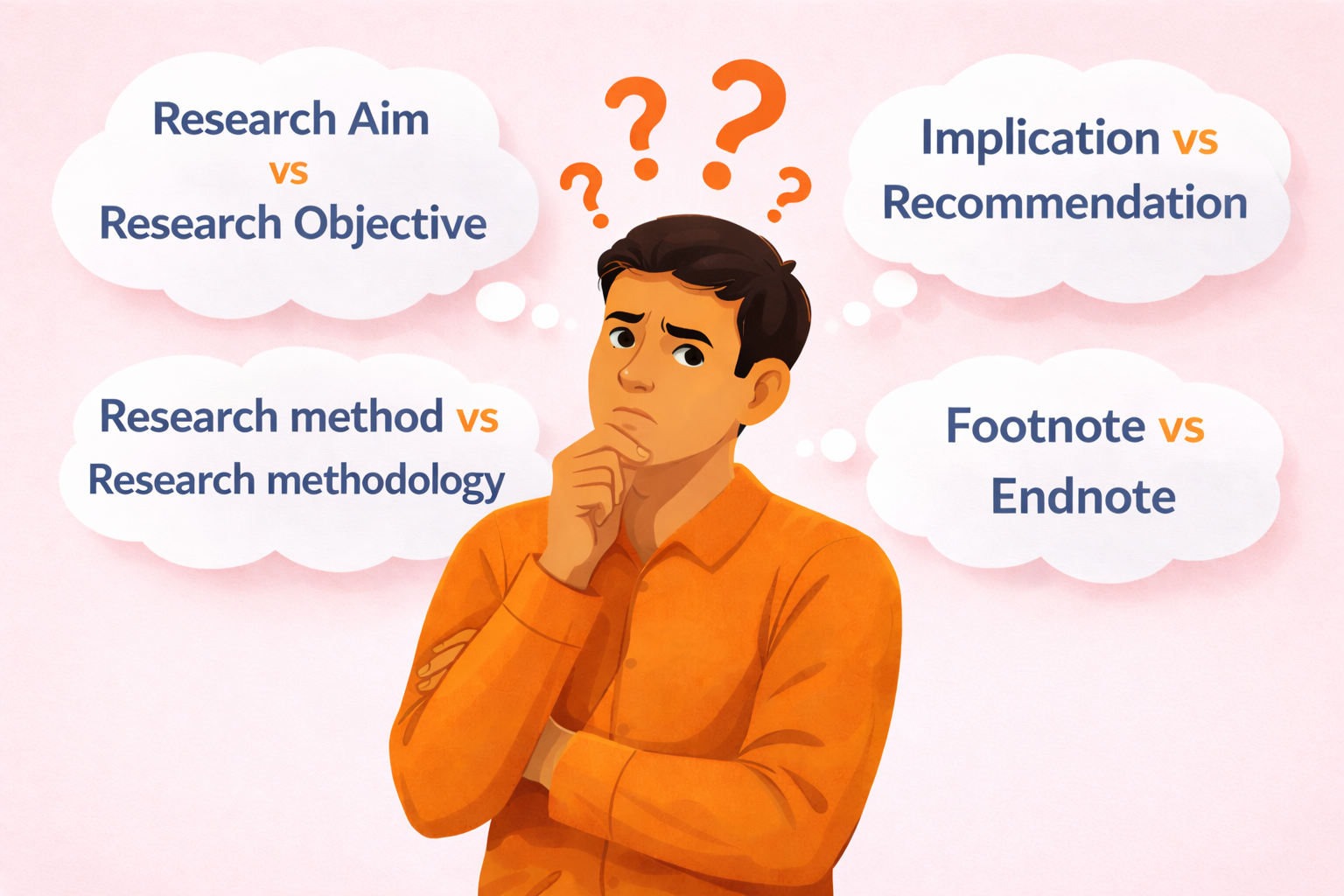
To write an impressive manuscript, you must first understand why each section of the manuscript is written, i.e., the purpose it serves and what it contains. However, researchers often find it difficult to understand the difference between some parts of a manuscript and are unsure whether they are interchangeable or serve distinct purposes. They ponder upon questions like:
- Is the “aim” of a research different from its “objectives”?
- Are the “implications” and “recommendations” of a research the same?
- What’s the difference between a “citation” and a “reference”?
Do you have such questions on your mind, too? Well, you’re about to find answers to them! This article lists the differences between some of the most commonly confused elements of a research paper.
1. Difference between abstract and introduction in research papers
2. Difference between research aim and research objectives
3. Difference between Introduction and Statement of the problem
4. Difference between study background and literature review
5. Difference between research question and research problem
6. Difference between research methods and research methodology
7. Difference between Results and Discussion sections
8. Difference between figure captions, legends, and labels
9. Difference between implications, limitations, and recommendations
10. Difference between citations, references, and bibliography
11. Difference between footnotes and endnotes
1. How is the “Abstract” of your research paper different from the “Introduction?”
An abstract is a summary of a research paper. It contains the most essential details of your research, including the findings, methods, and conclusion [1]. It is meant to help readers, who are often busy scientists, decide whether they should read the entire article. Abstracts can be especially useful in the case of paywalled articles. It also helps journal editors to determine whether articles should be forwarded to the peer review stage.
Now let us understand what purpose the Introduction serves. The Introduction is the beginning of your research paper and provides background for your research topic, helping the reader understand the motivation for conducting the study. It sets the context for your research by introducing the research topic, providing a brief overview of previously published literature, identifying the gaps or problems that existing research has failed to address, and finally introducing the problem that you intend to solve, ideally via an explicit ‘aim’ statement at the end of the introduction—more on this in the next section!
The abstract is written to give readers a sneak peek into your research and engage their interest, and so it should briefly encapsulate the entire study; the Introduction, meanwhile, is written to provide specific context for the research question being explored, particularly for readers who may not be familiar with the specific subfield of your work.
One notable difference that you must keep in mind is that the abstract includes the methods and results of your research but the Introduction does not.
2. How is the “aim” of your research different from its “objectives”?
The aim of a study states the outcome that you hope to achieve from your study. It is a broad statement of the overall goals of your study and indicates where you hope to reach at the end of your research. The aim of your research encapsulates what you wish to find out or prove through your research [2]. On the other hand, research objectives lay down the steps, that is, the specific or direct actions that you will take to achieve your aim. The objectives of your research lay down specific milestones or stages that you will reach in order to accomplish your goals. While the aim is a broad goal that you wish to accomplish, the objectives are small, precise steps that will guide you through your research path. In other words, the aim of your research paper states what you wish to achieve and the objectives indicate how you will achieve them, by identifying specific steps or milestones. Depending on the type of document you are writing, you might need to provide an aim, objectives, or both.
The following example will help you understand the two terms better.
Aim: To determine the antioxidative effect of XXX plant extract.
Objectives:
(1) To test reactive oxygen species generation in the XXX cell line following treatment with XXX plant extract.
(2) To determine the activity of antioxidant enzymes SOD and CAT in a rat model following treatment with XXX plant extract.
3. What is the difference between the “Introduction” and the “problem statement” of your research?
The Introduction is the first section of a research paper and provides background for the study. The purpose of an Introduction is to engage the readers and give them the essential background information they need to understand the aim of your study. The Introduction includes the study background and the research question.
A problem statement, on the other hand, is an essential part of a research proposal, which is written to acquire funding for your research. It is a brief explanation of an issue, a condition, or a situation that you wish to study [3]. It helps in identifying the purpose of your project by highlighting the gap between an ideal situation and the reality, and why it is important to bridge that gap. Clearly defining the problem that your research will address is essential to convince the funders that your project is worth funding.
Writing a problem statement comes at a much earlier stage in your research journey, after you have chosen the area in which you would like to conduct your research (or the gap you would like to address through your research) and are seeking research funding. In contrast, the Introduction is written after you have completed your research and are presenting your findings for publication.
In summary, the Introduction provides background information, includes a literature review, explains the purpose of your study, and states the research question, whereas the problem statement gives an overview of the specific problem that your research will address.
4. How is the “background of a study” different from a “literature review”?
Both study background and the literature review talk about the existing knowledge in a research area and help identify the gaps that need to be addressed. However, there are significant distinctions between them.
The study background is the first part of the Introduction section, which introduces the research topic and sets the context of your research. It is usually followed by the literature review, which provides a critical analysis of the literature on your research topic.
The background of a study is written to state the significance of your research while the literature review is written to evaluate the progress of knowledge in your research area. While the study background is written in a short and concise manner, the literature review is relatively detailed, although it should be focused on only that literature that is needed to provide context and motivation for your research question. Both of them eventually lead readers to gaps in research that have remained unaddressed. We can say that the background broadly introduces the topic of your research while the literature review tracks the existing knowledge in the field and helps identify the exact gaps in research that your study will address.
Note: Some journal guidelines specifically ask authors to write the literature review as a separate section in the paper instead of including it in the Introduction. It’s best to check the guidelines of your target journal before you write this section.
5. Is your “research question” the same as your “research problem”?
A research problem is a broad issue that you would like to address through your research. It identifies a theoretical or a practical difficulty, doubt, or an area of concern that requires thought and investigation. It is an anomaly, a limitation, or a troubling question in the real world that needs to be addressed. You can break your research problem into smaller questions that will help you move towards solving the problem.
Now let us understand what a research question is. A research question is the specific concern that you will answer through your research. It is derived from your research problem but is based on your study design. When you narrow down your research problem to a specific idea that points towards a feasible way to investigate or address your research problem, you get your research question. Specifying your research question is the first step in the direction of actually solving your research problem. You can then formulate the aim of your study based on your research question and accordingly decide the objectives of your research.
6. What is the difference between “research methods” and “research methodology”?
“Research methods” and “research methodology” are two distinct but commonly confused terms. Research methodology is a broad set of principles that help researchers choose which methods they should use to conduct their experiments. In contrast, research methods are the actual techniques and procedures used in research work. They are based on the choice of research methodology, which thus encompasses not only the methods but also the logic or reasoning behind using them. Depending on the nature of your research, the research methodology could encompass the use of either qualitative or quantitative data [4]. You would then accordingly choose different methods of research like observation, surveys, interviews, laboratory experiments, etc.
7. “Results” and “Discussion” –What’s the difference?
The Results and Discussion sections are dedicated to the most important aspect of your research work—your research findings! The Results section presents the findings of your study generated as a result of the methods you chose to use. These should include a brief textual explanation of the study findings, supported by data presented in tables, figures, diagrams, or other non-textual elements.
The Discussion section, on the other hand, summarizes and interprets your findings at length. All comments, explanations, and interpretations related to your results belong in the Discussion. For instance, if you observe a consistent pattern or a fluctuation in your findings, you can mention it in the Results, but speculation or assumptions regarding the reason for these observed phenomena should be included in the Discussion.
Note that the Results section presents but does not interpret the study findings and the Discussion interprets but does not re-state the findings. Also, whether the Results and Discussion should be two separate sections depends on the nature of your findings or the requirements of your target journal. Both elements could be clubbed under one section, “Results and Discussion.” or the Results could stand alone as one section followed by the Discussion, where you talk about the implications of your findings in addition to sharing your final comments.
8. Do “figure captions,” “labels,” and “legends” mean the same thing?
Typically, the Results section of a manuscript includes tables, figures, and other non-textual elements that illustrate the findings of the research. Captions, labels, and legends are used to identify and provide details about such illustrations. These terms refer to distinct elements that serve differing purposes and cannot be used interchangeably.
- Captions are the titles or headings of figures, tables, or illustrations and tell the reader what a particular table or figure contains.
- Legends, on the other hand, are brief descriptions of figures or tables and often indicate how to interpret the information presented in the corresponding illustrations. They are descriptive and talk more about the data presented in tables or figures to facilitate understanding of the data.
- Labels are part of the figure or illustration and are used to name the components of a diagram. They are used to identify each element of the illustration.
All three of these elements are required for a figure, table, or illustration to be complete and comprehensible, independent of the main text of the manuscript.
9. What is the difference between “implications,” “limitations,” and “recommendations for future research”?
Research implications, limitations, and recommendations are important components of the Conclusion section, which summarizes your findings and sums up the essence of your research. Let us understand how each of these three terms differs from the other.
Implications are the conclusions that you have drawn from your research project. They suggest how the findings of your research can be useful, e.g., for further research and policy making. Through your implications, you can demonstrate how your research can be applied in real-life policy and practices [5].
Limitations are intended to help the reader understand the context in which the findings should be interpreted and applied. They list the shortcomings of your research, which may be based on several reasons, such as the unavailability of required resources, inefficient research design or method used, or lack of access to advanced instruments and apparatus. Disclosing the limitations of your research will help create an impression that your approach is realistic and you have a complete understanding of your research topic, as well as ensure that the scope of the applicability of the findings is clear.
Recommendations are suggestions drawn from your research for a specific course of action for subsequent research. Once you have listed the limitations of your research, you can suggest ideas for future research based on the questions or gaps that your study could not address. You can also recommend other aspects of your research topic which would be interesting to work on and would constitute pioneering research questions. This can be helpful not only for your own future research but also for other interested researchers looking to contribute to the field.
10. What is the difference between “citations,” “references,” and a “bibliography?”
While conducting your research, you may have used previously published work to build upon an idea or to conduct further research on a topic. Citations and references are both used to credit those authors whose works you may have referred to.
A citation is made when you pick exact ideas from the work of other researchers, either in the form of quotes or paraphrased statements. Citations are included in the main body of the paper wherein the source of the information is cited alongside the statement. References and the Bibliography both refer to a list, usually at the end of the manuscript, of all the books, articles, documents, videos, interviews, and other sources that you may have used to gather the necessary information for your work. Each source cited in an article must be mentioned in the reference list and each reference must be represented by a citation in the main body of the article. In contrast, a bibliography [6] is a collection of all materials used to gather information or to research a topic, and all items in a bibliography need not necessarily be cited in the main text.
11. What is the difference between “footnotes” and “endnotes”?
We know that authors sometimes cite the source of their information alongside the statements in which that information is presented (this is called a citation). They might also want to add comments or explanations to a sentence that they have written. However, adding such details in the middle of the paper might disrupt the flow of writing and even make it difficult for readers to follow the flow of thought. Authors therefore use footnotes and endnotes [7] to convey such important but supplementary details.
Footnotes refer to comments or explanatory notes when they are added at the bottom of a page. The sentence or word where explanation is needed is marked with a symbol or a superscripted number, and the relevant footnote, marked with the same symbol or number, can be found at the bottom of the page.
Just like footnotes, endnotes are a way of adding supplementary information to the main text and they are also marked with a superscripted number. The only difference is in the placement of the explanation. For endnotes, the correlating information is added at the end of the article. Footnotes can be useful for quickly identifying the source of information with a glance at the bottom of the page. Endnotes, on the other hand, help de-clutter the page and help maintain flow while reading.
Final Thoughts
The bottom line is that each section of the manuscript serves a distinct purpose and highlights a different aspect of your research. Therefore, before you start drafting your manuscript, a clear understanding of what purpose each section serves will help avoid mistakes. Use this handy list as a go-to guide to draft your next research paper without being stumped by similar terminologies.
Get an expert-driven pre-submission check, plagiarism check, and comprehensive formatting. Check out Editage’s Desk Rejection Shield Service and clear that first hurdle in journal publishing!
References
1. Difference Between an Abstract and an Introduction https://www.differencebetween.net/language/difference-between-an-abstract-and-an-introduction/
2. Aims and objectives – what’s the difference? https://patthomson.net/2014/06/09/aims-and-objectives-whats-the-difference/
3. Organizing academic research papers: The research problem/question https://library.sacredheart.edu/c.php?g=29803&p=185918
4. Qualitative research methods: Types, analysis + examples https://www.questionpro.com/blog/qualitative-research-methods/
5. Difference Between Implications and Recommendations in Researchhttps://www.differencebetween.com/difference-between-implications-and-recommendations-in-research/
6. What is Bibliography: Meaning and Types of Bibliography and Example https://www.editage.us/blog/bibliography-what-is-bibliography-meaning-types-and-example/
7. Footnotes or endnotes? https://libguides.usc.edu/writingguide/notes
Originally published on July 17, 2019. Revised on February 24, 2026