2026 AI Guidelines from JAMA: A Comprehensive Overview for the Busy Medical Researcher

A lot has happened since large language models (LLMs) and chatbots became mainstream in academia (Figure 1). Remember how in late 2022 and early 2023, researchers began publishing papers listing ChatGPT as a co-author? At least four such papers were published! However, close on the heels of this happening, many publishers, as well as organizations such as the Committee on Publication Ethics (COPE) and World Association of Medical Editors (WAME), were quick to update their editorial policies to explicitly ban listing AI models as authors. Science was one of the few journals initially responding with outright bans on all AI-generated content, while bodies like the International Committee of Medical Journal Editors (ICMJE) shifted the consensus by May 2023 toward mandatory disclosure of AI assistance. Despite these frameworks, a 2024 study1 highlighted marked policy fragmentation across publishers.
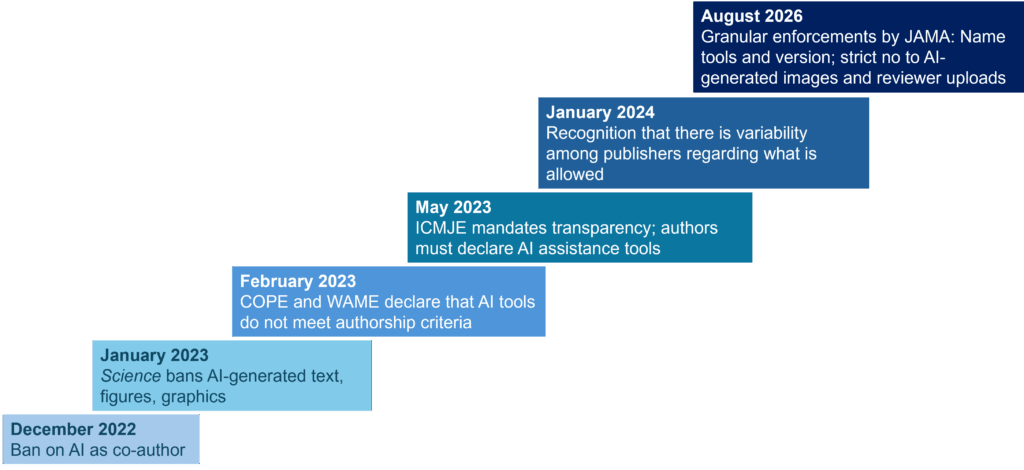
As of August 2026, updated guidelines from JAMA2 now reject generic disclosures in favor of specific tool and version declarations, explicitly prohibit AI-generated graphics, and forbid peer reviewers from uploading confidential manuscripts to external AI tools to protect data privacy. In this article, we will take a close look at what these updated guidelines are and what they mean for a busy medical researcher.
JAMA’s policies on AI use from 2023 to 2026
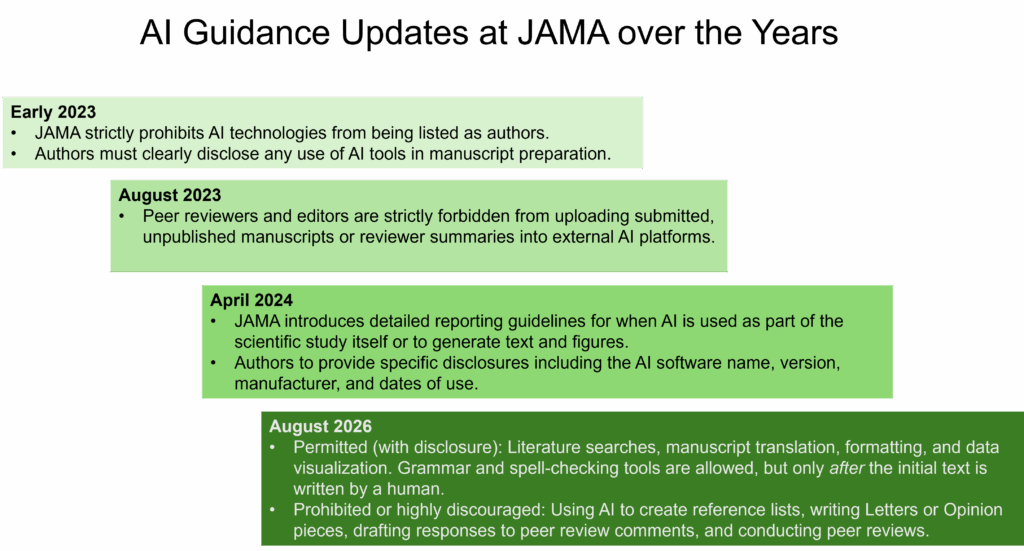
The capabilities of LLMs are increasing rapidly, and the concomitant implications in academic writing and publishing will keep changing. Editors and authors alike need to be up to speed. Since the emergence of advanced LLMs, the JAMA Network has rapidly adapted its editorial policies to protect scientific integrity while acknowledging the utility of these new tools. Over the past few years, the guidance has evolved from simple authorship bans to comprehensive frameworks detailing how and where AI can be used in the medical publication process (Figure 2).
2023
In 2023, JAMA introduced its first generative AI guidance, prohibiting AI tools from being listed as authors, requiring transparency/disclosure for any text-refinement or technical tool usage.3 The policy was then updated to prohibit reviewers from uploading confidential manuscripts to AI tools.4
2024
JAMA published more detailed recommendations for authors and researchers, formalizing reporting and disclosure requirements.5 Detailed reporting guidelines were provided for when AI is used as part of the scientific study itself or to generate text and figures. Authors were now required to provide specific disclosures (in the Acknowledgment or Methods sections), including the AI software’s name, version, manufacturer, and manner of use.
2026
JAMA updated the guidance it had already issued before because editors were seeing a rise in submissions with plausible-looking but fabricated or nonexistent citations, as well as a jump in AI-assisted opinion pieces and letters from authors without actual expertise in the topic.2 Moreover, disclosure rates remained low despite the growing used of AI.
What has changed? The core shift is that certain previously “discouraged” or ambiguous categories have become absolute no-nos. These flat prohibitions are for use in references/citations, opinion-type manuscript drafting, and clinical images/video/audio.
What has not changed? Authors remain fully responsible for all content, AI-assisted or not.
A comprehensive guide to the 2026 AI guidelines from JAMA
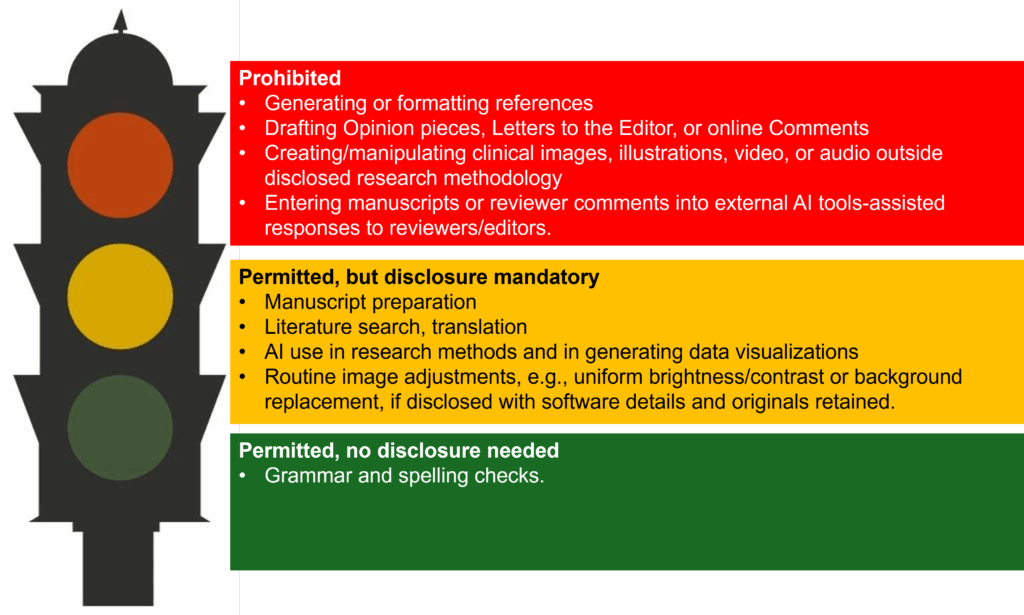
Below is a breakdown of the acceptable and prohibited uses according to the updated August 2026 JAMA Network editorial policies.2 The strict rule that LLMs and chatbots cannot be listed as co-authors remains. Human authors must assume full responsibility for the accuracy, completeness, and integrity of all submitted content, including any sections assisted by AI. Figure 3 provides a quick look at the dos and don’ts.
1. Permitted uses without disclosure
Authors can use standard writing tools to refine their work without formal disclosure, provided the original text was drafted by a human. Standard grammar, syntax, and spelling checks (e.g., those built into standard word processors or basic spelling tools) do not require disclosure in the manuscript.
2. Permitted uses requiring specific disclosure
AI can assist in several aspects of manuscript preparation and research, but its use must be explicitly declared, typically in the Methods or Acknowledgments section. Disclosures must include (i) the tool name, (ii) version, (iii) manufacturer, and (iv) a description of what the AI did.
- Content revision and translation: Using AI to translate text, rewrite paragraphs for clarity, or format the manuscript.
- Literature and code: Using AI to conduct literature searches, summarize background literature, or generate statistical/analytical code. Authors must verify all AI-generated summaries and specify exactly what code was generated.
- Methodological use: Using AI as part of the actual study design (e.g., using an AI model to analyze clinical data). This must be rigorously detailed in the Methods section and follow all applicable reporting guidelines.
3. Strictly prohibited uses
The updated guidance establishes hard boundaries where AI use is completely banned across all JAMA Network journals, regardless of whether the author intends to disclose it.
- Bibliographic references: Authors must not use AI to generate, format, or manage reference lists due to the high risk of inaccurate or nonexistent citations.
- Opinion and correspondence: AI cannot be used to draft Opinion manuscripts, Letters to the Editor, or online Comments. These must represent the human author’s original intellectual reasoning.
- Rebuttals: Authors are strictly prohibited from using AI to draft responses to peer reviewer and editor comments.
- Peer review: Peer reviewers and editors are strictly forbidden from uploading submitted manuscript text, figures, or their own review summaries into generative AI platforms.
- Clinical media: AI-generated or AI-manipulated clinical images, illustrations, video, and audio are banned. The only exception is if the AI tool itself is the explicit subject of the formal research design (e.g., a study testing an AI radiograph reader).
Permitted adjustments to figures
Standard, uniform digital adjustments (like changing brightness/contrast across an entire image) or replacing a non-clinically relevant background with a solid color are allowed. Authors must describe the software used in the figure legend and provide the original, unedited files for review.
AI-generated graphic visualizations of original research data (like charts or graphs) are permitted as long as the software name and version are clearly identified in the figure legend.
Why do these guidelines this matter to you as a researcher?
The 2026 AI Guidelines from JAMA aim to reinforce the basic aspects of critical thinking, creativity, and writing that must be preserved, while discouraging actions that jeopardize scientific integrity. I would go as far as saying these should be used as a guide when submitting to any journal you might want to submit your manuscript to, not just those in the JAMA Network.
Have you found yourself with the following thoughts? Now you will know what to do (or not do)!
I’m short on time. Let me just ask ChatGPT for references!
Many researchers are unaware of the tendency of LLMs to hallucinate facts and fabricate citations. Researchers trust the results that an LLM will spit out, failing to critically verify AI outputs. Remember that fake references pollute the scientific record and taint the researcher’s credibility. Instead, you should use credible reference management and literature search tools and verify every citation.
I need to submit more papers faster. Let AI write some sections for me!
The convenience of AI-assisted writing threatens to overwhelm the peer-review system and lower the overall quality of published literature. A recent preprint on arXiv6 estimates that by end December 2025, 89%–90% of full-text biomedical papers on PubMed Central showed signs of LLM-assisted writing. Alarmingly, AI use was found to be the highest in the Discussion and Abstract (~67%)—exactly where interpretation and framing happen! Handing over what makes you a researcher (critical thinking) to a tool can erode your critical skills and turn you into yet another contributor to AI slop! Restrain yourself from the urge to get a tool to generate chunks of text.
I used AI to help write or translate, or visualize data.
That is fine as long as you disclose the necessary details (tool name, version, manufacturer, description of what the AI tool did) and verify the output.
If I disclose my use of AI, editors/reviewers will judge me!
Authors fear that disclosing their use of AI use might lead to biased and unfavorable editorial decisions. However, they should realize that editors recognize the usage–disclosure gap, which means that editors are now actively watching for undisclosed AI use. Getting caught for not disclosing is worse for your reputation than disclosing upfront.
OK, but what exactly am I supposed to disclose?
Now that publishers are updating their policies, knowing what is to be disclosed is now as basic as knowing authorship criteria! Even if you are publishing in a non-JAMA journal, the 2026 updates by JAMA are a good place to inform yourself on these very aspects. You should declare the name of the tool used, along with the version and manufacturer, as well as a detailed description of what the AI tool did.
I’m not paid for my efforts as a peer reviewer. Let ChatGPT do it for me!
The confidentiality point is the one most likely to be breached unknowingly. Just asking an LLM to “summarize this manuscript for me” or “provide feedback on this manuscript” is a grave violation because it poses a risk for the unpublished manuscript to enter the public domain.
Closing thoughts
Despite the early unease surrounding generative AI in 2022, the question is no longer about whether you should use such tools as a researcher. The updated guidelines by JAMA draw the line where verification is impossible (references, images, confidentiality of an unpublished manuscript) while leaving options open wherever accountability is still traceable to a human. Until the next set of updates, happy writing and publishing!
References
1. Ganjavi C et al. Publishers’ and journals’ instructions to authors on use of generative artificial intelligence in academic and scientific publishing: bibliometric analysis. BMJ 2024;384:e077192
2. Flanagin A et al. Updated guidance for author use of AI in medical publication. JAMA Published online August 10, 2026. doi:10.1001/jama.2026.16613
3. Flanagin A et al. Nonhuman “authors” and implications for the integrity of scientific publication and medical knowledge. JAMA. 2023;329(8):637–639. doi:10.1001/jama.2023.1344
4. Flanagin A et al. Guidance for authors, peer reviewers, and editors on use of AI, language models, and chatbots. JAMA. 2023;330(8):702–703. doi:10.1001/jama.2023.12500
5. Flanagin A et al. Reporting use of AI in research and scholarly publication—JAMA Network Guidance. JAMA. 2024;331(13):1096–1098. doi:10.1001/jama.2024.3471
6. Holzwarth L et al. Most biomedical publications show signs of LLM-assisted writing. https://arxiv.org/abs/2608.10715