AMA Style Guide 11th Edition: Citations, Reference, and General Formatting Guidelines
Knowledge-sharing and collaboration is no longer restricted to only the scientific community. A lot of lay people and non-specialists are interested in verified research works, especially in the medicine and health-related fields. And why should they not be? Any medicine-related investigation has real-world effect, and people are always curious about it. So, having an authoritative format for writing research papers and citing sources is useful. It simplifies the review process for journals while simultaneously attracting lay readers.
Among the various style guides, here’s one that’s less talked about.
AMA Style Guide 11th Edition General Formatting Rules
What is AMA Style Guide?
If you want to publish in any journal under The American Medical Association (AMA), the AMA style guide is your go-to source for writing and formatting research papers. Popularly used in the fields of Medicine and Health Sciences, the AMA style guide lets students, researchers, and professionals in health-related fields to communicate their work effectively. This style guide has evolved over the years and is currently in its 11th edition [1]. You will see that it provides guidelines on page layout, citation and reference formatting, figure and table preparation, and clinical trial registration and reporting among other things. This guideline is necessary to
- ensure uniformity in how a study is presented,
- attribute your research ideas to accurate sources,
- make is easy for readers to verify sources, and
- depict biological data, drug mechanisms, and other anatomical details with scientific accuracy.
AMA Style Guide 11th Edition General Formatting Rules
Let’s first understand the general rules for formatting under AMA, which are quite lenient! What they ask for is consistency and not much else. So, keep these pointers in mind:
- Use an easily readable font like Times New Roman (12 pt)
- Keep double line spacing throughout the manuscript: the title page, abstract, manuscript body, and reference list
- A one-inch page margin is recommended on all sides
- Let the first line of all paragraphs be indented
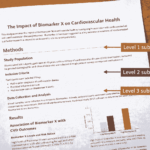
- Use clear headings for all sections (abstract, introduction, methods, results, discussion, conclusions, references); write them in bold and align them on the left side of the page
- Write the abstract within 150 to 250 words; don’t include citations but provide an overview of the study’s objective, methods, key findings, and conclusions.
- If the journal asks for a separate Title Page, include the following information in order:
- research paper title (centered and written in bold),
- running head (shortened title of 40 or less characters),
- names of contributing authors,
- highest educational degrees of authors,
- contact information (e.g., e-mail addresses), and
- institutional affiliations.
AMA Citation Style
Superscript citations within text
In terms of citing sources, AMA recommends the simplest format of all: superscript numbers (like this4). The citations should be placed as close to the information from the source as possible in a sentence. For example, you can place it after the author’s name or after a quotation from the source. See below example:
“Darwin’s theory of evolution4 is based on the principle of survival of the fittest…”
Basically, the superscript number should clearly indicate the part of the source you want to highlight for the readers to refer to. Also, write the citations after a punctuation mark like a comma, semicolon, or period.
How to cite multiple works
What if you’ve to cite multiple sources? AMA allows you to use “en dash” to indicate a range of sources; inconsecutive sources must be separated by commas. Don’t keep any space between the numbers. Example below:
Here’s how you cite multiple sources in AMA2–5,9,12
Every source you cite should have a corresponding entry under the reference list at the end of the manuscript. But how do you format the reference list? Let’s see what AMA guidelines say.
AMA Reference List Format
How to write the reference list in AMA
The reference list should be placed on a separate page at the end of your manuscript. Write the heading “References” in bold and start listing the works you have cited in the main text in the order of their appearance. Each work should be mentioned in the list only once; if you need to repeat the citation, use the same number again.
Before we look at specific formats for different types of sources, here are some general rules to note:
- Journal titles are abbreviated in the reference list entry
- The article title is written in sentence case, i.e., the first letter of the only the word and proper nouns are capitalized
- When writing the authors’ names, the surname is followed by the initials (no period separates the initials)
- You can list up to 6 authors. If a work has more than 6 authors, mention the names of the first 3 authors followed by “et al.”
Reference entry format with examples
The table below shows the format for common reference types in AMA.
|
Journal article |
|
|
Format |
Author’s last name Initials. Title of the article. Abbreviated Journal Name. Year;Volume(Issue):Page range. DOI or URL. |
| Example |
Koopmans RJ, Shrimpton SJ, Roberts GT, Musker AJ. Dependence of pellet shape and size on pressure drop in H2O2 thrusters, J. Propul. Power 2014:30(3):775–789. https://doi.org/10.2514/1.B35072 |
|
Book |
|
|
Format |
Author’s surname Initials. Book Title: Subtitle. Publisher’s name; Year of publication. |
|
Example |
Davis NJ, McCormick JC. Liquid Rockets and Propellants. 2nd ed. Academic Press; 1960, pp. 589–616. https://doi.org/10.2514/5.9781600864759.0589.0616 |
|
Blog on a website |
|
|
Format |
Author’s last name Initials. Page title. Name of the Website. Published Month Day, Year. Accessed Month Day, Year. URL. |
| Example |
Nair N. The power of framing in medical research communication: Why it matters. Editage Insights. July 31, 2025. Accessed February 13,2026. https://www.editage.com/insights/the-power-of-framing-in-medical-research-communication-why-it-matters |
|
Video |
|
|
Format |
Creator’s names. Title of the video. Name of the website. URL. Published Month Day, Year. Accessed Month Day, Year. |
| Example |
Dawson JR, Pavlo SE, Jones MZ. Sedation dosage for minor procedures in children. Everything Medicine. https://www.everythingmedicine.com/sedation-dosage-for-minor-procedures-in-children Published August 9, 2022. Accessed December 5, 2025 |
|
Website |
|
|
Format |
Name of the website. Page title. Website URL. Published Month Day, Year. Accessed Month Day, Year |
| Example |
Paediatric Health Simplified. Monitoring emotional well-being in toddlers. www.paediatrichealthsimplified.com Published May 19, 2020. Accessed April 14, 2023 |
Give more time for your research, spend less time formatting! Check out Editage’s Manuscript Formatting Services and get professional support for journal formatting.
Reference
1. AMA Manual of Stylehttps://academic.oup.com/amamanualofstyle