Infographic: Key rules for lab safety



A 2022 study of chemistry students in the US and India revealed several lapses in basic lab safety, despite 97% of the participants having received training on safety procedures.[1] Although laboratories and institutions are responsible for ensuring lab safety, and there are lab safety regulations at the local, state, and federal levels, individual scientists also have a duty to promote a safety-conscious culture in the lab. This entails more than just complying with the rules; it requires a firm dedication to safeguarding oneself and others by working diligently, cautiously, and safely in the laboratory. The infographic below lists 10 basic yet important safety rules that every researcher needs to adhere to at all times.
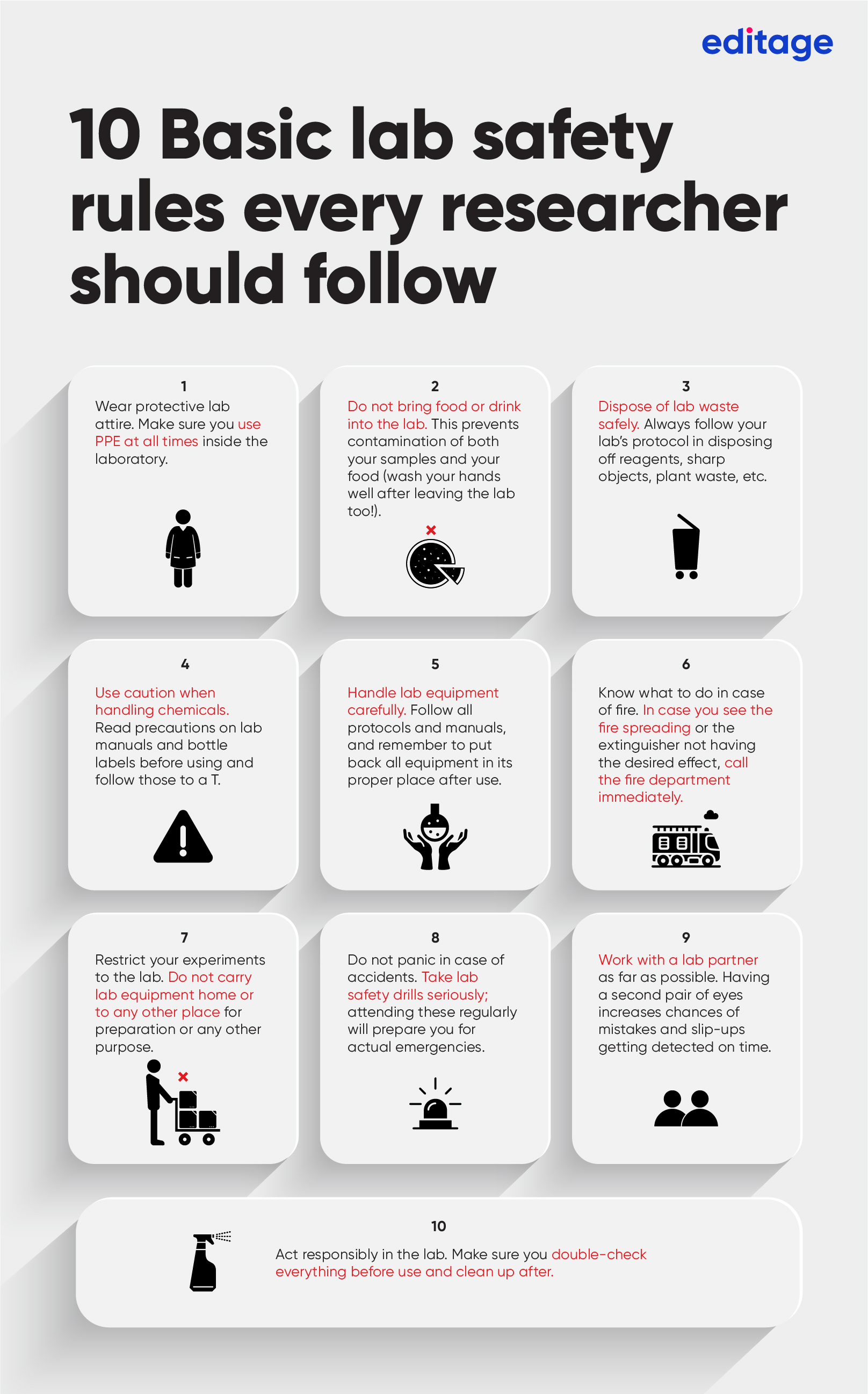
| Rule No. | Title / Theme | Key Instruction | Additional Details |
|---|---|---|---|
| 1 | Protective attire | Wear protective lab attire | Use PPE at all times inside the laboratory |
| 2 | Food & drink | Do not bring food or drink into the lab | Prevents contamination of samples and food; wash hands after leaving |
| 3 | Waste disposal | Dispose of lab waste safely | Follow lab protocols for reagents, sharps, plant waste, etc. |
| 4 | Chemical safety | Use caution when handling chemicals | Read precautions on manuals and labels; follow strictly |
| 5 | Equipment handling | Handle lab equipment carefully | Follow protocols and return equipment to proper place after use |
| 6 | Fire safety | Know what to do in case of fire | If fire spreads or extinguisher fails, call the fire department immediately |
| 7 | Lab boundaries | Restrict experiments to the lab | Do not take equipment home or elsewhere |
| 8 | Responsibility | Act responsibly in the lab | Double-check everything before use and clean up afterward |
| 9 | Emergency behavior | Do not panic in case of accidents | Take safety drills seriously to prepare for emergencies |
| 10 | Teamwork | Work with a lab partner when possible | A second pair of eyes helps detect mistakes early |
[1] Sonawane, S. et al. Evaluating and promoting chemical safety awareness in the chemical sciences. J. Chem. Educ. 100, 2, 469–478 (2023). https://pubs.acs.org/doi/10.1021/acs.jchemed.2c00102

10 lab safety rules that every scientist should follow.pdf