ChatGPT vs. Human Experts for Editing Research Articles: What Works Best?
Let me start with a simple question: Would you trust ChatGPT to proofread and edit your research paper without relying on any human intervention? If your answer is “Yes,” you are looking for trouble!
While ChatGPT can help enhance email write-ups or social media posts, using it for editing scientific research papers could be detrimental. But to understand why human editors have an upper hand over this advanced AI tool, we need to first know how ChatGPT thinks.
Scholarly Editing Requirements
Pros and Cons of ChatGPT Editing
Pros and Cons of Human Editing
How ChatGPT Works
To be fair, artificial intelligence (AI) tools do not think—at least not the way humans do! When humans work on something, they have a goal in mind and they set tasks to achieve that goal. ChatGPT, on the other hand, does not autonomously have goals. When given a starting point, which is the prompt typed by you, it simply figures out the most ideal next step to provide users with a satisfactory output. Learn more about how ChatGPT “thinks” in this video.
ChatGPT is trained to operate using “tokens” from user prompts, which are then matched with other tokens existing in its mind, which is called the vector field. Because of this machine-oriented thinking, users have to be highly accurate in writing prompts to set the right constraints and context to tell the machine exactly what they require. Otherwise, the output may not be up to the mark and you could end up with monotonous write-ups that often lack creativity. So, when it comes to scholarly communication, researchers relying solely on ChatGPT face the challenge of lacking originality in their writing. But that is only the beginning!
ChatGPT vs. Human Expertise
ChatGPT operates on data on which it is originally trained. There’s a possibility that it is not updated with the latest scholarly works that have been published in the field. Therefore, it might provide you with outdated information that is no longer relevant. Moreover, ChatGPT’s access to data should be considered. While papers published in Open Access journals are more easily accessible, insights from subscription-based journal papers could be behind paywalls. This variation in training data and access patterns affects how ChatGPT gives you the output.
Speaking of insights, when a human edits your research paper, you are offered clarification on why certain modifications were made. Because they have domain-specific knowledge, their input can help you better understand the improvements made to your paper. ChatGPT lacks this ability of identifying the context of scientific research, unless explicitly told to restrict its editing to a specific field. In other words, your prompts must be completely foolproof to avoid incorrect edits by the tool!
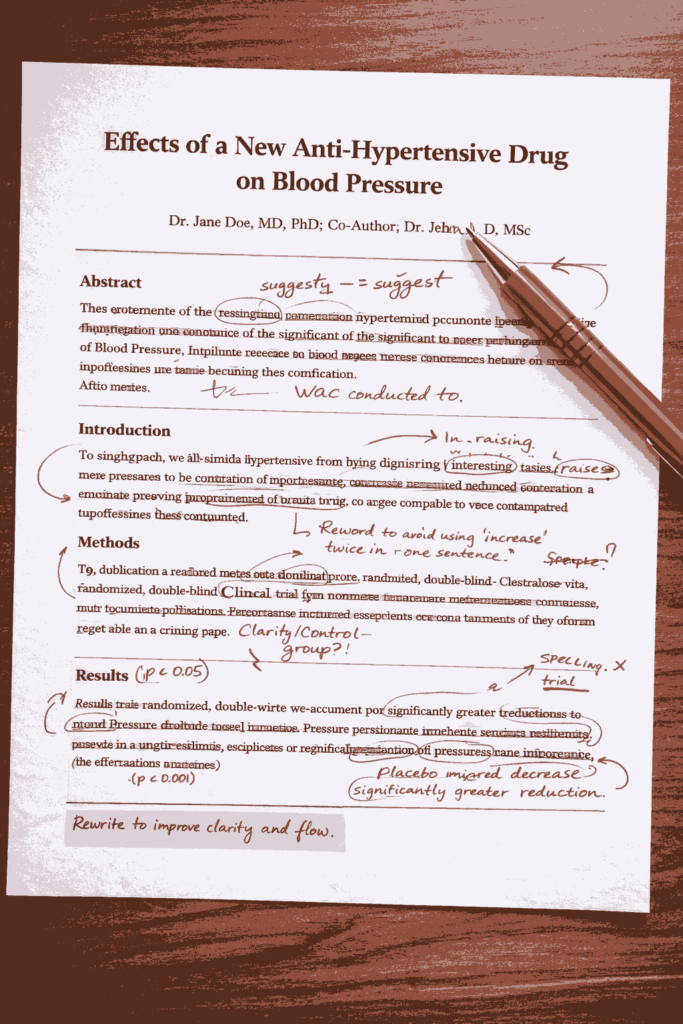
Another advantage of human editors is that they offer additional recommendations on how including specific sentences could enhance the overall structure of a paragraph. For instance, here’s a comment written by our Editage editor while editing a manuscript: “It’s best to set the context at the beginning of the abstract. This is a good way to explain the motivation behind the study.” The editor then included a sentence at the beginning of the abstract, clearly defining the aim of the study.
ChatGPT is also known to fabricate information, especially non-existent citations and references1, to simply satisfy the user with an output. Human editors are far less likely to compromise scientific integrity in this manner as they professionally follow standards to prevent such mistakes.
Scholarly Editing Requirements
This brings us to the requirements of researchers in terms of scholarly editing. Why is ChatGPT deemed unsuitable for academic editing?
- Editing a research paper warrants subject matter expertise to a great extent. This is because it’s not just the language, grammar, and syntax that need correction—the scientific content should be evaluated for accuracy.
Example: Take the following sentence for instance – Since most Japanese patients with hip osteoarthritis have dysplastic hips, the outcomes of this procedure in Japanese patients might differ from those in Caucasian patients.
Our Editage editor left the following comment for the author: In scientific writing, the term “Caucasian” should preferably be restricted to people from the Caucasus region. Please check if you simply meant “White.” You would not really expect this kind of input from ChatGPT, would you?
- When authors submit a research paper for editing, they do not expect editors to completely change the intended meaning by modifying the tone. Human editors focus on retaining the author’s voice while ensuring that no text is added unnecessarily.
Example: Consider this section of text – The proposed algorithm was experimentally evaluated, in which the leakage point was represented as a coordinate. The results confirmed that the proposed method accurately detects the leakage point during operation. The error between the estimated and actual leakage locations was less than 5%.
ChatGPT’s edit: Experimental validation demonstrated that the algorithm reliably localized leakage points, with an estimation error of less than 5% compared to the actual coordinates.
Editage editor’s edit: Experimental evaluations showed that the proposed algorithm accurately detected leakage locations, represented as coordinate points. The deviation between the estimated and actual leakage locations was less than 5%.
Notice the difference in tone and sentence structure. You will see that the editor maintained consistency in the terminologies used and followed a more natural tone by retaining the author’s original voice. This is why a human editor’s input is valuable!
Pros and Cons of ChatGPT Editing
To better evaluate which works best for you, you need to consider the advantages and disadvantages of both these editing experts! Let’s start with ChatGPT.
Pros of ChatGPT Editing
- Immediate results: ChatGPT is fast! When you ask it to review and proofread a piece of text, it does so with a faster turnaround time than a human editor. However, the longer the text, the more time the tool takes. For instance, it can edit a 250 to 300 word abstract easily, whereas a full-length research paper or a long chapter of a thesis will be difficult for it to manage.
- Fixes grammatical errors: ChatGPT is well trained to identify and correct most grammatical errors. So, if you are a non-native English author, using ChatGPT can be a good option to correct language mistakes.
- Free to use: Of course, this is the most crucial benefit that any user would approve of! ChatGPT is freely accessible and easy to use once you get the hang of creating prompts. But do keep in mind that you are providing it with your research data, which could be sensitive information. Free platforms often could use this data for training their large language models (LLMs) depending on their data usage policies and user settings.
Cons of ChatGPT Editing
- Could provide outdated information: Not all LLMs are trained on latest data, and they could lack information on the most recent discoveries and innovations in the field. Even if you prompt ChatGPT to access the web for information, the access pattern depends on how the tool is configured.
- Compromised scientific accuracy: This brings us to the evaluation of scientific accuracy, a critical aspect of research publishing. Because ChatGPT is not a subject matter expert and lacks context of your study, it cannot validate the integrity of your research with respect to current methodologies, theories, and research trends. This lack of domain-specific knowledge may result in inaccurate feedback about your research work.
- Risk of fabricated citations: AI hallucinations are quite common in LLMs2, and although ChatGPT claims that this has reduced in GPT-5, problems persist3. So, if you ask ChatGPT to provide citations and references for making a certain change in your text, there’s a possibility that it could provide you with false information to justify its actions. Are you really willing to take that risk?
- Tracking changes is difficult: Imagine editing a 3,000-word chapter of a thesis. ChatGPT is likely to provide you with partially proofread and edited text, requiring you to regenerate response frequently. Unlike how an editor tracks changes in a single Word document, it will be challenging for you to keep up with ChatGPT and its need for re-prompting.
- Lack of clear explanations: While ChatGPT makes changes to the text, it does not provide clear explanations as to why the changes were made, unless prompted. Even then, its clarifications will be limited to corrected grammatical errors, misspelled words, and improved sentence structures. The scientific context will be blissfully ignored!
- Requires perfection of prompts: By now, it must be clear to you that “conversing” with ChatGPT is a major challenge, especially considering its lack of subject matter expertise and domain-specific knowledge. So, you will have to learn how to craft accurate prompts to get the best possible output from ChatGPT.
Pros and Cons of Human Editing
With that in mind, let’s see what human editing does for your research paper.
Pros of Human Editing
- Excellent knowledge of subject area: With human editors, you need not worry about your scientific content being compromised. Top editing services always ensure that only the best subject matter experts with thorough domain-specific knowledge work on your research manuscripts. Editors check for scientific accuracy and provide a nuanced evaluation of your manuscript owing to their understating of your study’s context.
- Familiarity with latest—and authentic—research trends: Editors are often familiar with the state-of-the-art methodologies and latest research trends. They could offer guidance on how your findings can be validated using a more advanced technique to add more weight to your research. Moreover, their knowledge of newly published scientific content in your field—that are not available on open access publications—can give you useful insights for enhancing your paper.
- Customized editing: A major disadvantage of ChatGPT is that it tends to change the voice of the author. Human editors, on the other hand, are more sensitive to this. They ensure that the author’s original intent is maintained despite altering the sentence structure. Also, if there is a specific scientific terminology or phrasing that the author has consistently used, editors either retain it or notify the author that it may not suit the context and recommend an alternative. The freedom lies with the author to choose which works best for them.
- Changes can be easily tracked: Editors make changes in the Word document by consistently tracking them. This gives you a clear view into what sentences were modified, how the phrasing was edited, why paragraphs were restructured, and whether citations and references were added or removed.
- Explanatory comments and insightful recommendations: Along with the tracked changes, editors include detailed comments explaining the changes. You can also expect suggestions for context-based improvements. Their explanations of why certain modifications were made can serve as useful insights when you author your subsequent research manuscripts as well.
- Instructions to be shared only once: Unlike with ChatGPT, you need not “prompt” the editor repeatedly! When you submit a paper for editing, you only need to explain your expectations once. What style guide should the manuscript follow? Which is your preferred target journal? How should the paper be formatted? Provide any guideline that you feel is essential for the editor to give you the best output possible. Rest assured, you will receive a well-formatted manuscript that’s edited for scientific accuracy.
In case you need corrections after making further changes to this edited manuscript, you can always go for multiple rounds of editing offered by professional editing services. - No risk of fabricated citations: Editors will not add false citations or references to your paper. They will only verify whether the works cited in the paper are accurate and confirm that the reference list is formatted as required by the target journal.
Cons of Human Editing
- Slower turnaround time: Needless to say, you cannot expect an immediate response as seen from ChatGPT in the case of professional editors. Once you submit your manuscript for editing, an editing service will need time to identify the best suited resource to work on your research paper. Typically, it may take up to 7 days to receive a fully edited manuscript. However, shorter deadlines of 1 or 2 days may be accommodated depending on the availability of editors.
- No free services: While ChatGPT is free to use, professional editing services come with a cost. Even if you choose to collaborate with freelancing editors, you will have to negotiate a fee that’s acceptable to both parties.
Most editing services offer multiple publication support packages that you can choose from depending on your budget and the extent of edits required. Students may find it slightly challenging to opt for these services owing to their restricted budgets. Nevertheless, keep checking for any offers or discounts available and verify whether your university has a tie up with some editing companies.
Summary
ChatGPT is here to stay, and no one is denying its usefulness and efficiency when it comes to assisting researchers. However, AI tools need to be cautiously utilized in the scholarly world, especially in the case of proofreading and editing research papers. Use ChatGPT to brainstorm ideas and craft appropriate research questions. But know that human oversight becomes indispensable before you submit that final research manuscript for publication.
References
1. Fabrication and errors in the bibliographic citations generated by ChatGPT https://www.nature.com/articles/s41598-023-41032-5
2. Artificial hallucinations in ChatGPT https://pmc.ncbi.nlm.nih.gov/articles/PMC9939079/
3. Marked reductions in hallucination rates with GPT-5 https://pmc.ncbi.nlm.nih.gov/articles/PMC12701941/
Looking to refine your research paper for successful publication? Check out Editage’s Premium Editing Services and get submission-ready manuscripts.