How to use AI responsibly in research
Key takeaway: Artificial intelligence (AI) can be used responsibly in research, specifically literature reviews, methodology, and writing, by
- Not using AI to replace human expertise
- Not outsourcing decision-making to any AI tool
- Critically reviewing any AI tool’s output
- Clearly disclosing what AI tools you used and for which tasks
Artificial intelligence (AI) isn’t a future academic concept anymore – it is a present reality. Tools powered by large language models (LLMs) such as ChatGPT, Bard, Claude, and domain-specific AI platforms are reshaping how researchers discover literature, structure methods, and draft manuscripts. For early to mid-career academics, the opportunities are enormous: save time on tedious tasks, enhance clarity of writing, and accelerate idea generation. But alongside these benefits come significant ethical, methodological, and scholarly challenges that must be navigated responsibly.
In this article, we look beyond the hype to outline practical, evidence-based guidance on responsible AI use across three core areas of scholarship: literature review, research methods, and academic writing.
How to use AI for literature reviews?
AI tools can be integrated to semi-automate the literature review processes, for tasks such as screening/scanning published research as well as extraction of the main points from vast bodies of work. These capabilities show promise for improving efficiency in what is traditionally an exhaustive and time-consuming process. In principle, AI can be a powerful ally in literature reviews, which form the backbone of academic research from planning to publication.
However, AI in literature review carries serious accuracy and integrity risks that include
- AI hallucinations,
- bias
- incomplete coverage.
How can I use AI for my literature review responsibly?
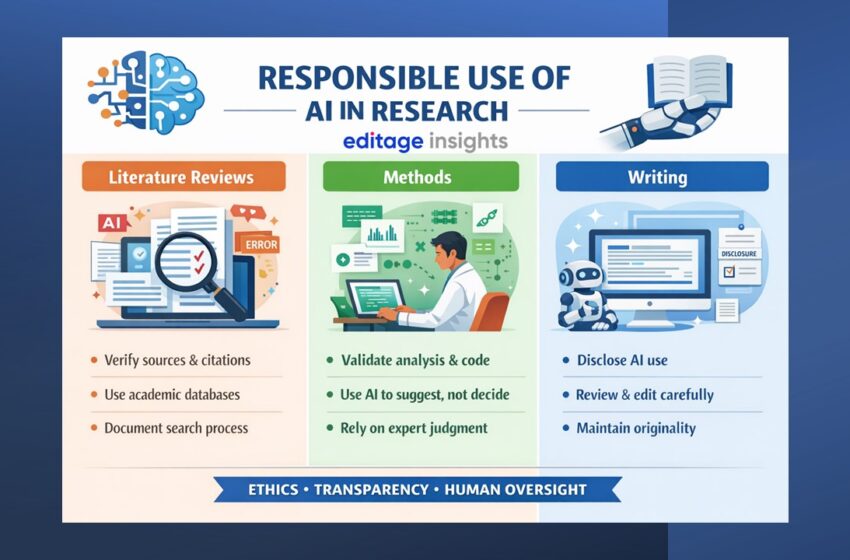
- Use AI to augment but not replace traditional systematic searching. Turn to AI for initial brainstorming, but always validate with dedicated academic databases (e.g., Scopus, PubMed, Web of Science).
- Maintain traceable records of search strings, databases queried, and inclusion criteria — whether you used AI or not. This transparency strengthens reproducibility.
- Never incorporate AI-generated citations at face value; verify each reference manually.
How can AI be used in my study’s methodology?
AI’s role in research methods extends beyond literature discovery. It can help with tasks like organizing research questions, suggesting analytical frameworks, or generating code snippets for data processing. But these tools are not neutral; they embody built-in assumptions and training biases that can influence outcomes.
Further, generative AI is actively being explored for research synthesis automation, including systematic reviews and meta-analyses. Some studies are testing how domain-specific LLMs could assist with technical stages like screening and extraction, potentially saving time and supporting consistency.
Despite these advances, AI should not be entrusted with core methodological decisions:
- AI models lack true understanding of research context. They predict useful text based on patterns in data, not empirical judgment.
- There’s no guarantee that AI-suggested analytical strategies align with best practices in your field.
- Unvetted AI use in methods can propagate unexamined assumptions, leading to flawed analyses.
How can I use an AI tool responsibly as part of my methodology?
- Use AI as a discussion partner, not a decision-maker. For example, ask it to suggest alternative frameworks or help phrase methodological rationales, but always base final choices on expert judgment and established standards in your discipline.
- Employ domain-specific tools for tasks like statistical programming, but validate every output, checking code logic, assumptions, and results against benchmarks or expert review.
How can AI tools be used for manuscript writing
The most visible area of AI use is writing. AI can be incredibly useful for overcoming writer’s block, refining prose, or restructuring sections. Yet this convenience comes with clear ethical boundaries and integrity requirements.
Academic communities and institutions increasingly emphasize that AI outputs must be transparent, accountable, and verifiable. Many universities now require disclosure of AI use in academic work. Some journals and editorial bodies are also developing guidelines on how AI involvement should be reported and managed.
What’s the best way to use AI for writing a research paper?
- Use AI for brainstorming, turning rough notes into a draft, and polishing grammar, tone, and word choice.
- Avoid unverified content. Generative AI content should never be included without human verification of accuracy and relevance. AI cannot take responsibility for research content, interpretation, or errors.
- Acknowledge AI use: If AI shaped your text beyond minor editing, consider disclosing how you used it, especially where institutional or journal guidelines require it.
- Verify that you have permission to use AI. Check your university and target journal for specific guidelines regarding AI use in your academic writing.
Because of these boundaries, many researchers find it valuable to use AI for iterative refinement: generating a draft and then revising it based on domain expertise, peer feedback, and deep engagement with the material.
Ethics, Integrity, and Future Directions
Ethical frameworks for AI research use emphasize transparency, accountability, and human oversight. Researchers must retain responsibility for every component of their work. AI tools can assist, but they cannot replace scholarly judgment. As AI evolves, so too will community norms and editorial policies. Early and mid-career academics have a unique opportunity to influence these norms by modeling responsible, transparent, and critical AI engagement. Doing so will not only protect academic integrity but also harness the potential of AI in ways that enhance scholarly contributions without undermining them.
AI is now part of the scholarly ecosystem. Used thoughtfully, it can expand research productivity and clarity. But responsible use, grounded in human expertise, ethical transparency, and methodological rigor, is essential to ensure that AI remains a tool that amplifies, not replaces, the core values of academic research.