Which tense to use in the Materials and Methods section?
Choosing the right verb tense in a research paper is one of the most common challenges for academic writers, especially for researchers writing in English as a second language. While tense errors may seem minor, they can confuse reviewers and undermine the clarity of your manuscript. This guide focuses specifically on tense usage in the Materials and Methods section, one of the most tense-sensitive parts of any research paper.
Why Verb Tense Matters in Academic Writing
Verb tense signals when an action occurred and how it relates to the present moment. In scientific writing, using the wrong tense can make your methodology appear incomplete, speculative, or inconsistent: all red flags for peer reviewers. Getting tenses right is not just a grammar exercise; it is a matter of scientific precision.
The Two Key Tenses in the Materials and Methods Section
The Simple Past Tense
The simple past tense describes a completed action that happened at a specific, defined point in time. It is formed with the past form of the verb. For regular verbs, this means adding -ed (e.g., analyzed, collected, prepared); irregular verbs have their own distinct past forms (e.g., chose, ran, grew).
In the Materials and Methods section, the simple past is the default tense for virtually every sentence. Because all procedures were finished before the paper was written, every action like selecting materials, performing steps, applying techniques, and recording measurements belongs in the simple past.
Structure: Subject + past verb + object/complement
Examples:
- “The rice variety IR 8 was chosen for the experiment.”
- “Ripe fruits of six apple varieties were selected for analysis.”
- “Samples were centrifuged at 3,000 rpm for 10 minutes.”
- “Participants were recruited from three outpatient clinics.”
- “Data were analyzed using SPSS version 26.”
The Past Perfect Tense
The past perfect tense describes an action that was completed before another past action. It is formed with had + the past participle of the verb (e.g., had been stored, had been exposed, had been washed).
In the Methods section, this tense becomes necessary when describing a preparatory or preliminary step (something that was done in advance of the main procedure). It makes the sequence of events unambiguous, which is essential for reproducibility.
Structure: Subject + had + past participle + object/complement
Examples:
- “The seeds had been exposed to ultraviolet radiation for four hours before sowing.”
- “The solution had been stored at –20°C for 48 hours prior to use.”
- “All instruments had been calibrated against a standard reference before measurements began.”
- “The cell cultures had been passaged three times before the drug was introduced.”
Use the past perfect sparingly, only when the sequence of events is not already obvious from words like “before,” “prior to,” or “following.” If a transitional phrase already makes the order clear, the simple past alone is sufficient.
Tense Rules for the Materials and Methods Section
Use the Simple Past as Your Default
The Materials and Methods section describes work that was carried out before the paper was written. Because the research is complete at the time of writing, the simple past tense is the natural and correct choice throughout this section.
This section is an account of your actions—what you did and how you did it—not a plan or a proposal. Common sub-elements that take the simple past include:
- Selection of materials: the specific substances, organisms, tools, or equipment you chose
- Preparation steps: how samples or subjects were prepared before the main experiment
- Experimental procedures: the sequence of steps followed during the study
- Analytical methods: the techniques and instruments used to collect or analyze data
- Statistical approaches: the software or methods applied to process results
When to Use the Past Perfect Tense
Sometimes, your experiment involved a preliminary step that happened before the main procedure. In these cases, the past perfect tense (“had + past participle”) is appropriate, because it clearly signals that one action was completed before another began.
- ✅ “The seeds had been exposed to ultraviolet radiation for four hours before sowing.”
- ✅ “The solution had been stored at –20°C for 48 hours prior to use.”
Tenses to Avoid in The Methods Section
The Materials and Methods section describes what was done, not what will be done, and not what is being done as the reader reads. Two tenses to avoid:
- Future tense (“will be analyzed”): This is appropriate for a study protocol or grant proposal, not a completed research paper. Using future tense in this section implies the work has not yet been done.
- Present tense for procedural steps (“samples are centrifuged”): This can create ambiguity about whether you are describing a general protocol or your specific actions. Reserve the present tense for describing established, widely accepted methods that readers are expected to follow themselves.
Tense Usage in the Introduction vs. Methods: A Key Distinction
A common source of confusion is the shift from the Introduction to the Methods section. Here is why the tenses differ:
- The Introduction uses the present tense because it describes the current state of knowledge in the field: facts and findings that are still considered true today. For example: “Climate change affects crop yield in tropical regions.”
- The Materials and Methods uses the past tense because it describes your specific actions in a specific past experiment. For example: “Seedlings were grown under controlled greenhouse conditions.”
This distinction reflects a deeper principle: the Introduction tells the reader what is known; the Methods tells the reader what you did.
Quick-Reference Summary
- Simple past → use for all completed actions, procedures, selections, and measurements
- Past perfect → use when one step was completed before another began
- Present tense → acceptable for citing well-established reference methods by name
- Future tense → avoid entirely in a completed research paper’s Methods section
Should I use passive or active voice in the Materials and Methods section?
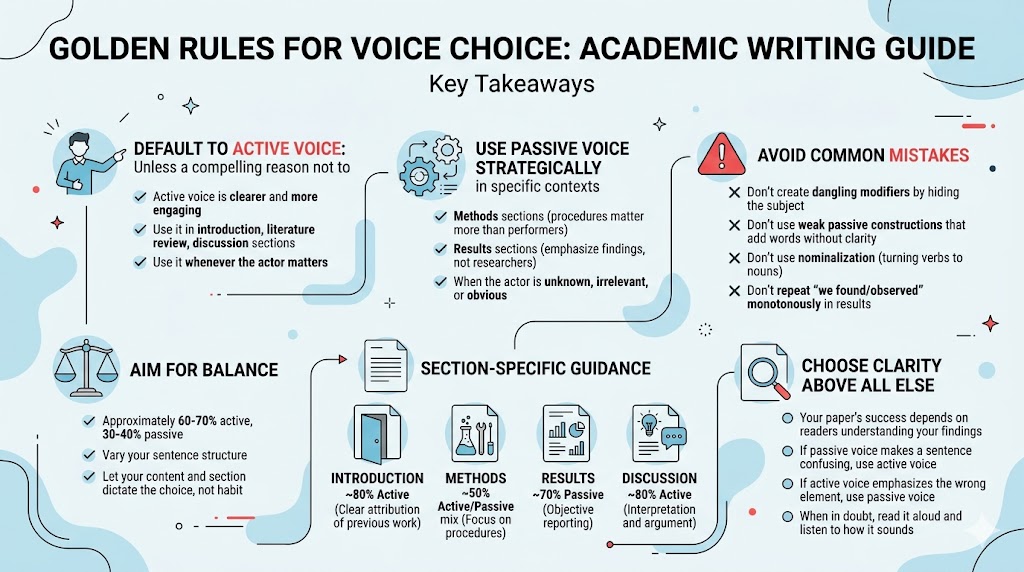
Both are acceptable, but passive voice is often used in the Materials and Methods section of scientific writing. Passive constructions (“samples were analyzed,” “data were collected“) shift the focus onto the procedure itself rather than onto who performed it, which reinforces the objectivity and reproducibility that peer reviewers look for. That said, many journals and style guides now actively encourage a mix, or even prefer active voice for clarity. Always check your target journal’s author guidelines before defaulting to one or the other.
Can I use first person (“I” or “we”) in the Materials and Methods section?
Yes, and it is increasingly acceptable to do so. Phrases like “We selected,” “We measured,” and “We recruited” are clear, direct, and widely used in modern scientific writing, particularly in journals that follow APA style or that explicitly encourage active voice. The key is consistency: if you use first person in the Methods section, apply it consistently throughout the paper. Avoid mixing “I collected samples” in one sentence with “samples were then analyzed” in the next without a clear reason for the shift. If your journal’s guidelines do not specify, first person is generally safe and is often clearer than convoluted passive constructions.