How to use active and passive voice in research writing: Examples and tips
In this article, you’ll learn about
- Active vs Passive Voice: Definition and Quick Comparison
- What Is Active Voice?
- What Is Passive Voice?
- Common Misconceptions About Voice Choice
- Common Mistakes with Passive Voice
- Active vs Passive Voice in Different Sections of a Research Paper
- How to Choose Active Vs Passive Voice: Decision Framework
- Practical Checklist: Reviewing Your Manuscript for Voice Balance
- Discipline-Specific Voice Conventions
- Examples of Revision: From Passive to Balanced Voice
Choosing between active and passive voice is one of the most common challenges researchers face when writing manuscripts. The confusion stems from a misleading myth that has dominated academic writing for decades: “Always use passive voice to sound objective.”
The reality? Both voices are essential tools in scientific writing, and knowing when to use each one can significantly improve your manuscript’s clarity, impact, and publication success. Most modern high-impact journals—including Nature, Science, and NEJM—now explicitly encourage active voice for better readability.
This guide provides section-by-section guidance on voice usage, practical examples from biomedical research, and a framework for making the right choice every time.
Active vs Passive Voice: Definition and Quick Comparison
Before diving deeper, here’s what you need to know:
| Aspect | Active Voice | Passive Voice |
| Definition | Subject performs the action | Subject receives the action |
| Structure | Subject + Verb + Object | Subject + (was/were) + Verb (past participle) + (by + Agent) |
| Focus | Emphasizes who performed the action | Emphasizes the action or object acted upon |
| Clarity | Direct, concise, engaging | Indirect, formal, objective |
| Word Count | Generally shorter | Generally longer |
| Tone | Assertive, responsible | Detached, objective |
| Example | We identified 47 novel mutations in the BRCA1 gene. | 47 novel mutations in the BRCA1 gene were identified. |
What Is Active Voice?
Active voice places the subject at the beginning of the sentence as the performer of the action. The structure is straightforward: Subject + Action + Object
This construction makes it immediately clear who is doing what, which is why readers find it easier to follow.
Active Voice Examples
- We collected serum samples from 150 patients with type 2 diabetes.
- The research team analyzed gene expression using RNA-seq methodology.
- We observed a significant reduction in tumor size after six weeks of treatment.
- Researchers documented adverse events in 12% of the trial participants.
- We administered the vaccine to 500 healthy adults aged 18-65.
Why Active Voice Works Better in Most Contexts
Clarity and Directness
Active voice tells readers exactly who did what. In “We administered the vaccine,” it’s immediately clear that the research team performed the action. This directness reduces cognitive load and helps readers focus on your findings rather than decoding sentence structure.
Conciseness
Active voice typically requires fewer words. Compare:
- Active: We measured blood glucose levels every 4 hours. (8 words)
- Passive: Blood glucose levels were measured every 4 hours. (8 words)
However, when the passive version omits the agent:
- Passive: Blood glucose levels were measured every 4 hours by trained technicians using calibrated glucometers. (14 words)
- Active: Trained technicians measured blood glucose levels every 4 hours using calibrated glucometers. (12 words)
Accountability and Authority
Active voice emphasizes author responsibility. When you say “We found,” you’re taking ownership of the discovery. This strengthens your credibility and makes your argument more persuasive.
Engagement
Active voice creates a narrative flow that keeps readers engaged. Your manuscript becomes a story of discovery rather than a passive observation of events.
When Active Voice Might Not Be Appropriate
While active voice is generally preferred, overusing it can create problems:
- Makes writing sound overly personal or subjective in some disciplines
- Can emphasize the researcher instead of the research itself
- May seem inappropriate in highly formal or conservative fields
- Can lead to repetitive sentence structures if not varied with passive constructions
What Is Passive Voice?
Passive voice shifts focus from the doer of the action to the action itself or the recipient of the action. The structure is: Subject + (is/are/was/were) + Verb (past participle) + (by + Agent)
Often, the agent is omitted entirely when it’s obvious or irrelevant.
Passive Voice Examples
- Blood samples were collected at baseline and week 12.
- The APOE4 genotype was identified as a significant risk factor.
- Patients were randomized to receive either drug A or placebo.
- Adverse events were documented and reported to the safety committee.
- The RNA was extracted using TRIzol reagent and quantified by spectrophotometry.
Strategic Uses of Passive Voice
When the Action Matters More Than the Actor
In methods sections, your readers care about what was done, not necessarily who did it. Passive voice keeps the focus on the procedure:
- Passive: Tissues were fixed in 4% paraformaldehyde for 24 hours, then rinsed with PBS.
- Here, the emphasis on proper fixation technique is appropriate.
When the Object or Result Is More Important Than the Researcher
If your paper’s focus is on a drug’s effects, keep the drug as the subject:
- Passive: Metformin was shown to improve insulin sensitivity within 8 weeks.
- Active: We demonstrated that metformin improved insulin sensitivity within 8 weeks.
- The passive version emphasizes the drug’s properties over the researchers.
When the Actor Is Unknown or Obvious
- Genotyping was performed using the Illumina platform. (Clear who did it—the lab)
- Patient consent was obtained prior to enrollment. (Standard procedure, actor is obvious)
For Objectivity in Results Reporting
Passive voice can create the impression of unbiased observation:
- Passive: An inverse relationship was observed between age and antibody response.
- This phrasing suggests findings hold true regardless of who conducted the research.
To Maintain Formality in Specific Sections
Certain journals and disciplines expect formal tone. Passive voice contributes to this:
- The hypothesis was tested using multivariate logistic regression.
Common Misconceptions About Voice Choice
Myth #1: “Passive Voice Is Grammatically Incorrect”
Reality: Passive voice is a grammatically valid, fundamental English construction. The notion that it’s “incorrect” stems from style guide recommendations to minimize it, not from grammar rules.
Major journals like Nature and Science use passive voice extensively in methods sections. The issue isn’t correctness—it’s appropriateness for context.
Myth #2: “Always Use Passive Voice in Scientific Writing”
Reality: This outdated advice causes manuscripts to become wordy and unclear. Modern scientific writing encourages a strategic mix.
When Nature reviewed their author guidelines, they found that active voice improved readability without sacrificing objectivity. The journal now explicitly states: “Nature journals prefer authors to write in the active voice.”
Myth #3: “Using ‘We’ or ‘I’ Makes Your Writing Subjective”
Reality: Using first-person pronouns with active voice actually increases clarity and doesn’t reduce objectivity. Consider:
- Passive: A significant correlation was found between LDLC levels and cardiovascular events. (Vague—who found it?)
- Active: We found a significant correlation between LDLC levels and cardiovascular events. (Clear and accountable)
The second sentence is more objective because readers know exactly who conducted the analysis.
Myth #4: “One Voice Is Better Than the Other”
Reality: The most effective scientific writing uses both voices strategically. The question isn’t which voice is better, but which voice serves your purpose in this specific sentence.
Common Mistakes with Passive Voice
Problem #1: Dangling Modifiers
A dangling modifier occurs when an introductory phrase modifies the wrong subject, usually because you’ve hidden the actual actor.
❌ Incorrect (Dangling Modifier): To determine whether patients developed resistance, the drug concentration was measured weekly.
This sentence suggests the drug developed resistance, not the patients. The implied subject (the researchers) doesn’t match the modifier’s intended meaning.
✅ Correct: To determine whether patients developed resistance, we measured the drug concentration weekly.
Another Example: ❌ After completing the trial, safety data were analyzed by the biostatistician. (Suggests the safety data completed the trial)
✅ After completing the trial, the biostatistician analyzed the safety data.
Problem #2: Nominalization (Turning Verbs Into Nouns)
Nominalization weakens writing by replacing strong verbs with noun forms, often combined with weak verbs like “was,” “were,” or “conducted.”
❌ Weak (Nominalization + Passive): Genotyping of cases was carried out using whole-genome sequencing.
The strong verb “genotype” has become the noun “genotyping,” and the sentence uses the weak verb phrase “was carried out.”
✅ Stronger (Active): We genotyped cases using whole-genome sequencing. (8 words vs. 10)
More Examples:
❌ Assessment of cognitive function was performed using the MMSE. ✅ We assessed cognitive function using the MMSE.
❌ Collection of blood samples was done at baseline and week 12. ✅ We collected blood samples at baseline and week 12.
Problem #3: Hiding Responsibility With Double Passives
❌ Double Passive (Confusing): Mutations were identified and were determined to be pathogenic.
✅ Clearer: We identified mutations and classified them as pathogenic.
Problem #4: Excessive Nominalizations in Active Voice
You can also create weak sentences while using active voice by relying on nominalizations:
❌ Weak (Nominalization + Active): We obtained measurements of new serum biomarkers. (Should be “measured,” not “obtained measurements”)
✅ Stronger: We measured new serum biomarkers.
Active vs Passive Voice in Different Sections of a Research Paper
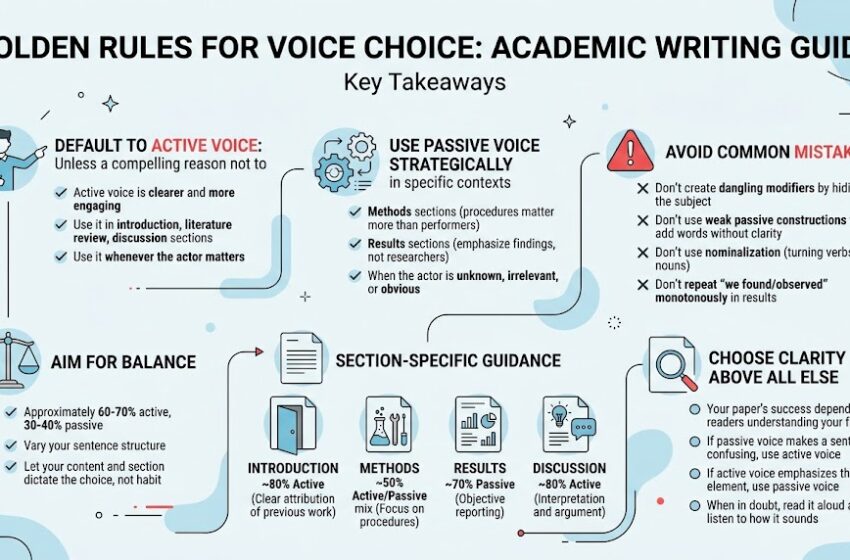
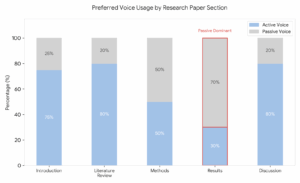
Introduction Section: Prefer Active Voice
Why: The introduction discusses what previous researchers found and what you’re investigating. Active voice makes it clear who contributed what to the field.
❌ Weak (Passive): Previous work has been done on the role of inflammation in Alzheimer’s disease. A link between TNF-α and cognitive decline was established. The mechanisms underlying this relationship remain unclear.
✅ Stronger (Active): Previous researchers have investigated the role of inflammation in Alzheimer’s disease. Several studies established a link between TNF-α and cognitive decline. However, the mechanisms underlying this relationship remain unclear.
The active version makes it clear which researchers contributed what, helping readers track the state of knowledge in your field.
Guidance:
- Use active voice when attributing findings to specific researchers or studies
- Use active voice when presenting your study’s purpose and hypotheses
- Active voice helps readers transition from previous work to your novel contribution
Literature Review Section: Prefer Active Voice
Why: Readers need to understand each researcher’s contribution. Passive voice obscures this information.
❌ Passive (Vague): The relationship between gut microbiota composition and inflammatory markers was examined. Dysbiosis was associated with elevated IL-6 and TNF-α levels.
✅ Active (Clear Attribution): Zhang et al. examined the relationship between gut microbiota composition and inflammatory markers. They found dysbiosis associated with elevated IL-6 and TNF-α levels.
Guidance:
- Name the researchers or their institution at the start of sentences
- Clearly state what each study found or contributed
- Save passive voice for describing well-established facts everyone knows
Methods Section: Acceptable Passive Voice
Why: The methods section emphasizes procedures and protocols rather than who performed them. Passive voice is appropriate here because the focus is on reproducibility, not attribution.
✅ Passive (Appropriate): Eligible participants were aged 18-65 years with confirmed type 2 diabetes. Blood samples were collected after an overnight fast and centrifuged at 3,000 × g for 10 minutes. Plasma was stored at −80°C until analysis.
The focus is on what was done and how, not who did it.
✅ Active (Also Acceptable): We recruited eligible participants aged 18-65 years with confirmed type 2 diabetes. We collected blood samples after an overnight fast, centrifuged them at 3,000 × g for 10 minutes, and stored plasma at −80°C until analysis.
Active voice works equally well if it doesn’t burden the reader with unnecessary detail about the researchers.
Guidance:
- Focus on procedures, not performers
- Use passive voice when the agent is obvious (trained technicians, standard equipment, etc.)
- Switch to active voice if it clarifies the procedure
- Avoid excessive passive constructions that make methods hard to follow
Results Section: Prefer Passive Voice
Why: Results should appear objective and unbiased. The findings matter more than the researchers who obtained them.
❌ Active (Too Much Emphasis on Researchers): We observed that patients receiving the active treatment showed a 45% reduction in viral load compared to controls. We noted that this difference was statistically significant (p < 0.001). We detected no serious adverse events in either group.
The repeated “We” sounds repetitive and emphasizes the researchers rather than the findings.
✅ Passive (Appropriate for Results): Patients receiving the active treatment showed a 45% reduction in viral load compared to controls (p < 0.001). No serious adverse events were detected in either group.
This phrasing emphasizes the results themselves and creates the impression of objective reporting.
Guidance:
- Use passive voice to report findings without emphasizing the researchers
- This creates the impression that results are facts, not interpretations
- Avoid excessive repetition of “we found” or “we observed”
- Passive voice is particularly appropriate when comparing groups or reporting statistics
Discussion Section: Prefer Active Voice
Why: The Discussion section interprets findings and positions your work within the broader field. Active voice clarifies who proposed what interpretation and strengthens your argument.
❌ Weak (Passive): The elevated IL-6 levels observed in our study are consistent with previous findings. A link between systemic inflammation and cognitive decline has been established. Our data suggest a novel mechanism by which TNF-α may affect neuroplasticity.
✅ Stronger (Active): Our elevated IL-6 levels are consistent with previous findings. Multiple studies have established a link between systemic inflammation and cognitive decline. Our data suggest a novel mechanism by which TNF-α may affect neuroplasticity.
Active voice is more persuasive in the discussion because you’re making arguments, not just reporting facts.
Guidance:
- Use active voice when interpreting your results
- Use active voice when proposing mechanisms or implications
- Use active voice when contrasting your findings with previous work
- Active voice strengthens your scientific argument
How to Choose Active Vs Passive Voice: Decision Framework
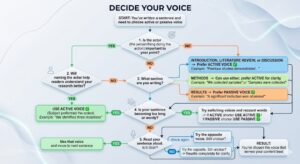
Use this framework when deciding which voice to use in any sentence:
Step 1: Ask “Who is doing the action?”
- If it’s important, use active voice
- If it’s obvious or unimportant, passive voice is acceptable
Step 2: Ask “What is the focus of this sentence?”
- Focus on the actor? → Active voice
- Focus on the action or object? → Passive voice
Step 3: Ask “What section am I writing?”
- Introduction, Literature, Discussion → Prefer active
- Methods, Results → Passive acceptable, active also fine
- Always avoid excessive use of either
Step 4: Check for clarity and conciseness
- Read the sentence aloud
- Can the reader immediately understand what happened and why?
- Does it fit the surrounding sentences?
- If not, try the other voice
Practical Checklist: Reviewing Your Manuscript for Voice Balance
Use this checklist when revising your draft:
Introduction Section
- Active voice dominates (70%+ of sentences)
- Each attribution clearly states who found what
- No excessive passive voice creating vagueness
- Smooth transition from previous work to your study
Methods Section
- Procedures are clearly described
- Reader can understand what was done (doesn’t matter who did it)
- No dangling modifiers
- Consistent voice within procedure descriptions
Results Section
- Findings are presented objectively
- Passive voice used for main result statements
- No vague actor hiding responsibility
- Statistical findings reported without researcher emphasis
Discussion Section
- Active voice dominates (70%+)
- Your interpretations are clear
- Comparisons to other work show active attribution
- Arguments are persuasive
Overall Manuscript
- Approximately 60-70% active voice, 30-40% passive voice
- No paragraph uses only one voice
- Variety prevents monotonous reading
- Word count is reasonable (no unnecessary passive constructions adding length)
Discipline-Specific Voice Conventions
Voice preferences vary across biomedical disciplines:
Molecular Biology & Genetics
- Preference: Active voice in results and discussion
- Example: We identified three novel mutations in the EGFR gene that predicted treatment response.
- Reasoning: Discovery-focused research emphasizes the findings and researchers’ insights
Clinical Medicine & Patient Studies
- Preference: Balance of both voices
- Example: We enrolled 200 patients with hypertension, and blood pressure was measured at baseline and week 12.
- Reasoning: Clinical work often emphasizes patient-centered findings and standardized procedures
Epidemiology & Public Health
- Preference: Passive voice more common
- Example: Risk factors were identified through multivariate logistic regression analysis.
- Reasoning: Focus on population-level patterns rather than individual researchers
Biochemistry & Experimental Methods
- Preference: Passive voice in methods, active in interpretation
- Example: Proteins were separated by SDS-PAGE and detected using specific antibodies. We identified three novel post-translational modifications.
- Reasoning: Methods emphasize standardized protocols; results/discussion emphasize discoveries
Pharmacology & Drug Development
- Preference: Active voice when presenting novel findings
- Example: We developed a novel formulation that increased bioavailability by 40%.
- Reasoning: Drug development research emphasizes innovation and specific achievements
Examples of Revision: From Passive to Balanced Voice
Example 1: Introduction
Original (Too Much Passive): Previous studies have been conducted on the relationship between circulating vitamin D levels and fracture risk. A protective effect has been demonstrated in some populations, but inconsistent results have been reported in others. The biological mechanisms underlying this association have not been fully understood. This study was designed to investigate whether vitamin D supplementation reduces fracture incidence in older adults.
Revised (Balanced): Multiple studies have investigated the relationship between circulating vitamin D levels and fracture risk. Some researchers have demonstrated a protective effect, but inconsistent results have been reported across populations. The biological mechanisms remain unclear. We designed this study to investigate whether vitamin D supplementation reduces fracture incidence in older adults.
What Changed:
- Replaced vague passive constructions with clear active attributions
- “Studies have been conducted” → “Multiple studies have investigated”
- “A protective effect has been demonstrated” → “Some researchers have demonstrated a protective effect”
- Introduced “we designed” to clearly present your contribution
Example 2: Methods
Original (Unclear): Participants were recruited from clinical centers, and baseline assessments were conducted. Blood samples were collected according to standardized protocols. Laboratory assays were performed to measure fasting glucose, lipid profile, and inflammatory markers.
Revised (Clear and Concise): We recruited participants from five clinical centers and conducted baseline assessments. Blood samples were collected according to standardized protocols, and we measured fasting glucose, lipid profiles, and inflammatory markers using laboratory assays.
What Changed:
- Added clarity about “we recruited”
- Kept passive construction “were collected” (procedure is clear)
- Made it active “we measured” instead of passive “assays were performed”
- Overall more concise while maintaining clarity
Example 3: Results
Original (Repetitive Active): We observed that patients in the active treatment group had a median viral load of 50 copies/mL at week 12. We found that this represented a 3.2-log reduction compared to baseline. We noted that the control group showed minimal change.
Revised (Balanced): Patients in the active treatment group achieved a median viral load of 50 copies/mL at week 12, representing a 3.2-log reduction from baseline. The control group showed minimal change.
What Changed:
- Removed repetitive “We found/observed/noted”
- Shifted to objective passive construction
- Reduced word count while improving clarity
- Results now appear as facts rather than researcher observations
Example 4: Discussion
Original (Weak): Our findings are consistent with previous work that has been published on this topic. An association between treatment adherence and viral suppression has been established. The mechanisms by which improved adherence leads to better outcomes may involve increased drug concentrations.
Revised (Stronger): Our findings align with published research showing that treatment adherence improves viral suppression. Multiple studies have established this association. Our data suggest that improved adherence leads to better outcomes by maintaining adequate drug concentrations.
What Changed:
- “are consistent with” → “align with” (more direct)
- “has been published” → named as “published research”
- “has been established” → “Multiple studies have established”
- Changed “may involve” to “suggest” (more confident)
- Overall stronger argument with active voice
The most effective scientific writing uses both voices strategically. You’re not choosing between “good” and “bad”—you’re choosing between tools that serve different purposes. Mastering this choice will significantly improve your manuscript’s clarity, impact, and probability of acceptance.
This article was originally published on August 4, 2015, and updated on May 9, 2026.