How to Read a Research Paper: A Step-by-Step Guide
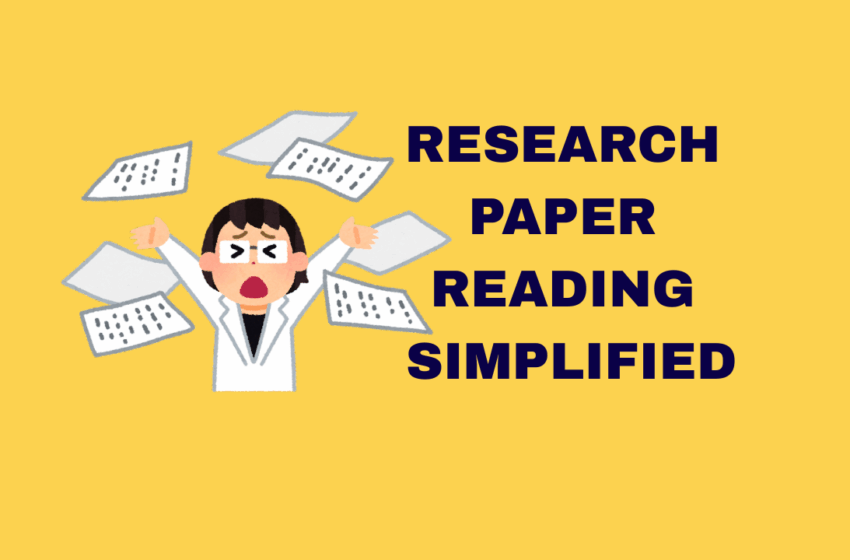
Reading scientific papers can seem like a mammoth task, especially when you are planning to write a research paper of your own and are looking to perform a literature review for your study. Time is of the essence, and reading every research paper that you refer to in its entirety is impossible. This blog will guide you through several techniques you can use and help you identify the best way to read a research paper.
Why Learning How to Read a Research Paper is Important
Types of Research Papers You May Need to Read
Steps to Read a Research Paper
Common Mistakes When Reading Research Papers
Tips to Read a Research Paper Efficiently: A Final Overview
Why Learning How to Read a Research Paper is Important
As researchers, knowing how to read scientific papers is as important as breathing oxygen!1 Yet, academic reading skills are not explicitly taught in grad schools or during advanced studies. So, it is important for researchers to develop this skill, and doing it at an early stage in the career can be highly beneficial in the long run.
Research papers are typically structured in a certain way to ease the academic reading process. Most research papers follow a format that presents content in a logical flow: Title, Abstract, Keywords, Introduction, Methods, Results, Conclusions, and References. Structuring research papers in this manner helps students, clinicians, researchers, and even journal editors peruse them conveniently. However, considering that an average research paper can vary between 4,000 to 6,000 words, efficient reading becomes crucial.
Let’s be clear about one thing: No author has the time to read a research paper completely! Moreover, it is neither feasible nor efficient to set this impossible task for yourself amid a packed schedule. Yet, reading scientific papers is the basis for conducting research, and a thorough literature review is key for the successful execution of research. Efficient reading helps save precious time that can be used for other, more important tasks in a researcher’s life. Therefore, mastering how to read research papers without spending too much time can be an invaluable skill, especially for students and early-career researchers.
Types of Research Papers You May Need to Read
Before learning how to read research papers, it is important to be aware of the different types of research papers you are likely to encounter.
Original Research Articles
An original research article is the most common type of scientific paper that majority of researchers author and publish. These papers explore fresh experimental avenues and report original findings to build on existing knowledge. They typically follow the IMRaD structure (Introduction, Methods, Results, and Discussion) to present novel data and observations.
Original research articles vary in length depending on the field of study, but on an average, they can be 8 to 10 pages long with the word count ranging from 4,000 to 8,000.
Systematic Reviews & Review Articles
Review papers provide a broad overview of existing knowledge on a research topic. The objective of review articles is to summarize what has been reported so far to help identify gaps in existing knowledge and recommend potential future research directions. Systematic reviews, on the other hand, are more rigorous and focused on answering a specific research question. They follow strict protocols like the PRISMA guidelines for reporting.
These research article types are slightly longer than original research papers and can contain up to 20,000 words depending on the research topic.
Short Communications & Case Reports
Short communications are often used to quickly share research findings, typically preliminary, that do not require an extensive full-length format to report. Case reports document clinical or patient cases and report observations to aid clinical studies. These research article types are generally limited to about 4,000 words and are considerably brief compared to original research papers and review papers.
The depth of content varies in all these research article types, and how you approach reading them could also differ greatly. Nevertheless, the following steps should help you tackle any academic research paper and make reading more efficient.
Steps to Read a Research Paper
Step 1: Understand the Why
Start by answering a simple question: “Why am I reading this paper?” Defining the goal of picking up a research paper helps decide your reading approach.
- Do you want to understand the current state of knowledge in the field?
- Is it authored by someone who inspires you? Do you wish to collaborate with them in the future?
- Are you looking for information to support a particular point in your research paper?
- Are you performing a literature review and need to extract key details from the paper?
The list of questions can go on, but take time to analyze the “why” before jumping into the “how.” Understanding your reading objective will give you a clear idea of which approach suits you best. In fact, you can even choose to tackle different parts of the research paper using one of the following approaches depending on your intent.
Step 2: Implementing the Three-Pass Approach
The three-pass approach2 or the triple-pass approach is considered an efficient method for reading academic papers. Rather than reading a paper linearly from start to finish, divide the reading into stages to help simplify the process.
Imagine using the Google Maps app and how you get different views of a particular city3. It starts with a bird’s eye view of the city map, then lets you zoom in on a specific location, and further offers a street view of the selected location. The same concept can be applied to understanding the triple-pass approach.
Bird’s Eye View
In this step, you give a quick look-over the paper by scanning the title, abstract, section headings, sub-headings, and conclusions. When you read the abstract, divide the sentences into categories to extract the background, methods, main findings, and conclusions of the study.
Do not read the content under each section, but try to understand the gist of the study by skimming over the essentials to determine whether the paper serves your reading purpose. For instance, read the first and last paragraphs of the Introduction section, then move on to the sub-headings under the Methods and Results section, and finally peruse the Conclusions.
This bird’s eye view should take no more than 15 to 20 minutes. At the end of this first pass, you should have clarity on the context of the study and its primary contributions, thereby helping you decide whether to proceed to the next pass.
The Swoop Method
Once you decide to go ahead with reading the paper, you need to extract more details from it. This is where the “swoop” method is helpful. Based on the information you’ve gathered from the first pass, identify which portion of text you need details from.
For instance, you might want to know more about the research questions posed in the Introduction. Or you might be keen on learning what methods were used to conduct the study. You may even want to understand more about the main research findings and primary conclusions. So, go ahead and “swoop” into these specific sections or sub-sections and read them in detail. Depending on your reading speed, this method should take you anywhere between 30 to 45 minutes.
The Street-View Method
The third pass is where you dive deeper into the paper. If you wish, you can print out the paper and use highlighters to mark important portions of text in the physical copy. Alternatively, if you are reading a digital copy on the computer, make notes or add comments on the Word document for easy referencing.
In this method, you are essentially trying to recreate the authors’ work to get a deep knowledge of the methods and research findings so you can critically evaluate the study for yourself. This pass requires you to spend about 1 to 2 hours with the research paper, maybe more if you are new to reading research papers. At the end of the third pass, you should be able to identify the strengths and weaknesses of the research, recognize possible issues with experimental methods or analyses, and know how it will help develop your topic of study.
Step 3: Decode Figures and Tables
Figures and tables often tell a story of their own, and it is important to unpack each of them carefully. There can be two ways of tackling this. One, as you read through the methods/results and come across references to figures or tables, refer to them immediately to get a deeper understanding of the text. Two, you may choose to browse the figures and tables separately by reading the captions or legends to understand the data presented.
There is no correct approach; try which one works best for you when reading a research paper. In each figure, examine the axes, graphical representations, color scheme used, and statistical data (if any). In the tables, identify the variables and the categorization of data to better understand the process of data collection and analysis.
Step 4: Critically Evaluate
Reading a research paper is not only about agreeing with everything the author says. It is also critiquing the work objectively. Why was this particular methodology used? Could there be a better way to analyze and validate the hypothesis? Do the conclusions align with the findings reported? Would you have interpreted the study findings differently? Are you agreeing with the author simply because it supports your pre-conceived notion about the topic? Or are you disregarding their findings because it contradicts your own research findings?
Learn how to think critically, ask valid questions, and answer them with an open mind. Evaluate the reported findings and minimize bias in your analysis of the paper.
Common Mistakes When Reading Research Papers
Despite trying not to delve into the entire research paper, it may be challenging to skip portions of text knowing that the author has written all of it with the intent of helping readers understand their research topic better. Here are a few common mistakes to avoid when reading a research paper.
Linear reading
While it may appear tempting since research papers are organized in a systematic and logical manner, reading linearly from abstract to conclusions is a recipe for wasted time. Although research papers are written following a systematic flow of information, they need not be consumed that way. Considering the length of research articles and the limited time researchers have, effective reading techniques should be consciously practiced.
Trying to understand everything in the first attempt
Do not expect to understand everything you read in the first pass (bird’s eye view) of the triple-pass reading approach. If you do not understand a particular phrase or if a terminology is unclear in the context, mark it so that you can come back to it at a later time. Instead of getting distracted to understand a concept, continue focusing on finishing the first pass without deviating from the flow of reading.
Re-reading lengthy sentences unnecessarily
At times, sentences may appear quite lengthy, and the intent may not be clear immediately. Unless you are in the third pass wherein you want to gain a deeper understanding of the research paper, do not waste time re-reading unclear sentences. It is alright to skip these portions of text and only try to gauge the general meaning of the paragraph without spending too much time on the minute details.
Assuming that all research papers are well written
Authors are other researchers just like you, and writing may not be a skill they have mastered. If you are still struggling to understand what the research paper is trying to convey despite multiple attempts at reading, chances are that the paper is not very well written in the first place. So, do not get frustrated or blame yourself.
See if the research paper has something valuable to offer you. If not, move on to other research papers that will help you understand the study topic better.
Not utilizing tools efficiently
Refusing to use tools to aid research workflow is equivalent to being ignorant! Reference managers like Zotero, Mendeley, and Endnote help organize your research papers. Literature mapping tools like R Discovery, ResearchRabbit, and Litmaps help in efficient literature reviews, even offering options of optimizing your reading experience through summaries and translated content.
Make sure to integrate these tools into your research work, and use them even when you are not working on a deadline. For instance, saved papers on R Discovery can be accessed anytime, and the audio paper feature lets you listen to full text or summarized research paper content, allowing you to multitask seamlessly. Take time to figure out which tools work best for you when it comes to organizing and reading research papers.
Tips to Read a Research Paper Efficiently: A Final Overview
- Understand the difference between skimming and deep reading. Once you have identified “why” you are reading a research paper, choose the most efficient reading method that will serve your purpose.
- Follow a “non-linear” approach and avoid linear reading. Practice implementing effective research paper reading strategies to save time and improve productivity.
- Set realistic expectations for yourself before diving into a research paper. You may not understand everything the author is trying to convey, but it is alright to extract crucial information that will help your research.
- Learn to use tools efficiently for effective research paper reading. Utilizing tools can significantly simplify the process of reading research papers without causing you frustration and helping you save time.
References
1. 7 benefits of reading research papers regularly https://researcher.life/blog/article/7-benefits-of-reading-research-papers-regularly/
2. How to read a paper https://web.stanford.edu/class/ee384m/Handouts/HowtoReadPaper.pdf
3. How to read research papers effectively https://www.youtube.com/watch?v=WVv2jWXW0K4
Want to find the most recent and up-to-date literature? Check out Editage’s Literature Search Services and collaborate with a subject matter expert today!