What Are Preprints? Benefits, Limitations, and How to Use Preprint Servers (arXiv, bioRxiv, medRxiv & More)
Contents
- What Is a Preprint?
- Why Do Researchers Post Preprints?
- Key Benefits of Posting a Preprint
- Limitations and Risks of Preprints
- Major Preprint Servers: A Comparison
- Deep Dive: arXiv, the Original Preprint Server
- bioRxiv vs. medRxiv: Key Differences
- bioRxiv vs. medRxiv vs. arXiv vs. Others: Full Comparison
- Do Journals Accept Papers That Have Been Posted as Preprints?
- Are Preprints Citable?
- Frequently Asked Questions About Preprints
- The Bottom Line
What Is a Preprint?
A preprint is a complete draft of a scientific manuscript that an author uploads to a publicly accessible server before it undergoes formal peer review.
Once uploaded, preprints go through a basic screening to confirm the content is scientific in nature. They are then made freely available online, usually within one to two days. Authors can upload revised versions later, but all earlier versions remain publicly accessible.
Preprints are not a replacement for peer-reviewed journal articles. They are a complementary mechanism to share findings faster and more openly.
Why Do Researchers Post Preprints?
Academic publishing is slow. Peer review, editorial back-and-forth, and production queues can delay publication by months or even years. In fast-moving fields like biomedical science, machine learning, and physics, this delay can be damaging to careers, funding applications, and scientific progress itself.
Preprints solve this by letting researchers:
- Share findings with the global scientific community immediately
- Establish a date-stamped record of priority for their work
- Receive community feedback before formal submission
- Satisfy grant agencies and hiring committees who need to see recent work
Key Benefits of Posting a Preprint
| Benefit | Description |
| No delays | Bypasses the slow journal review process; work is available within days |
| Open access | Freely readable by anyone worldwide (also called green open access) |
| Priority establishment | Date-stamped upload proves when you first reported a finding |
| Early feedback | Peers can identify errors or improvements before journal submission |
| Early citations | Preprints are citable, so you can accumulate citations before publication |
| Career evidence | Provides tangible proof of output for grants, jobs, and promotions |
| Collaboration opportunities | Increases visibility among potential collaborators and conference organizers |
| Scientific integrity | Null findings and replication studies (often rejected by journals) can gain visibility |
Limitations and Risks of Preprints
Preprints are not without controversy. The main concerns raised by the scientific community include:
- No peer review: The most significant concern. Without expert scrutiny, flawed or low-quality studies can circulate freely.
- Misinformation risk: In sensitive areas like vaccine safety, climate science, or drug efficacy, unvetted findings reaching the public can cause real harm.
- Premature claims: Researchers may post early results to claim priority before data is fully validated, which can mislead the field.
That said, the traditional journal system is not immune to these problems either. Retractions from peer-reviewed journals have risen steadily in recent decades, and flawed peer-reviewed papers can be more dangerous because they carry an official stamp of credibility. Authors posting preprints also bear higher personal reputational risk, which often makes them more careful about what they upload.
Major Preprint Servers: A Comparison
There are dozens of preprint repositories across disciplines. Here is a breakdown of the most widely used ones:
| Server | URL | Disciplines | Founded | Operator |
| arXiv | arxiv.org | Physics, math, CS, statistics, economics, biology | 1991 | Cornell University / arXiv.org |
| bioRxiv | biorxiv.org | Biology (all subfields) | 2013 | Cold Spring Harbor Laboratory |
| medRxiv | medrxiv.org | Clinical medicine, public health, epidemiology | 2019 | Cold Spring Harbor Laboratory + BMJ + Yale |
| chemRxiv | chemrxiv.org | Chemistry and chemical engineering | 2017 | American Chemical Society |
| SSRN | ssrn.com | Social sciences, law, economics, humanities | 1994 | Elsevier |
| ESSOAr | essoar.org | Earth and space sciences | 2018 | AGU / Wiley |
| PsyArXiv | psyarxiv.com | Psychology | 2016 | Society for the Improvement of Psychological Science |
| engrXiv | engrxiv.org | Engineering | 2016 | Open Engineering Inc. |
| SSRN | ssrn.com | Economics, law, social sciences | 1994 | Elsevier |
| Preprints.org | preprints.org | Multidisciplinary | 2016 | MDPI |
Deep Dive: arXiv, the Original Preprint Server
What Is arXiv?
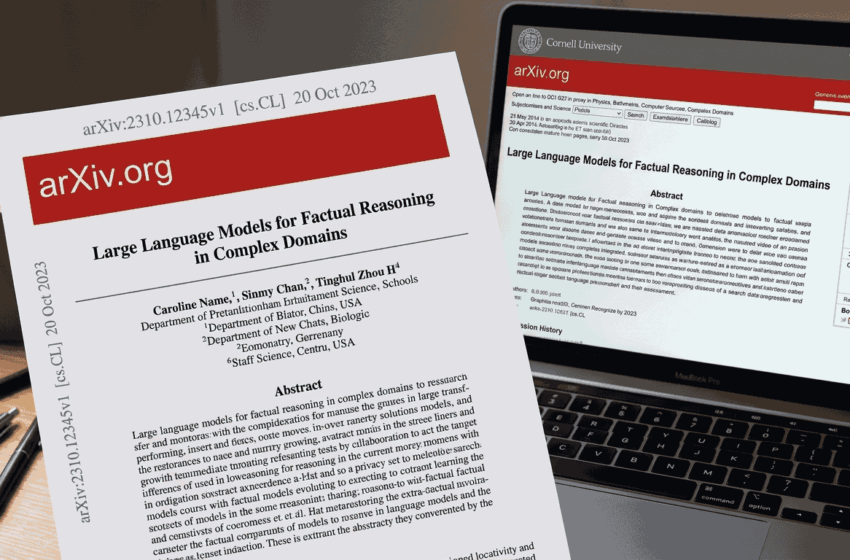
arXiv (pronounced “archive” — the X represents the Greek letter chi) is the oldest and most established preprint server in the world. It was founded in 1991 by physicist Paul Ginsparg at Los Alamos National Laboratory. It is now maintained by Cornell University.
Originally created to distribute physics preprints, arXiv has grown into a multidisciplinary repository covering:
- Physics (all subfields)
- Mathematics
- Computer science (including AI, ML, and robotics)
- Statistics
- Quantitative biology
- Quantitative finance
- Economics
It hosts over 2 million papers and receives thousands of new submissions every week. In fields like machine learning and high-energy physics, arXiv is effectively the primary venue where new work is announced whereas journal publication is often secondary.
How to Get Published on arXiv: Step-by-Step
“Published” on arXiv is a slight misnomer; it is not peer-reviewed publication. But getting your manuscript posted on arXiv follows a clear process:
Step 1: Create an account
- Go to arxiv.org and register for a free account
- You will need an institutional email address or endorsement from an existing arXiv author (see Step 3)
Step 2: Prepare your manuscript
- arXiv strongly prefers submissions in LaTeX format, though PDF-only submissions are accepted
- Figures should be embedded or submitted as separate files in standard formats (PNG, EPS, PDF)
- Ensure your paper has: title, authors, abstract, and full text
Step 3: Get endorsed (if required)
- First-time submitters in most subject areas need an endorsement from a researcher who is already an active arXiv submitter in that field
- Ask a colleague, supervisor, or collaborator who uses arXiv to endorse you
- Some subject areas (e.g., general mathematics) do not require endorsement
Step 4: Submit your paper
- Log in and click “Submit”
- Select the appropriate subject category (e.g., cs.LG for machine learning, quant-bio.BM for biomolecules)
- You can also add cross-listings to secondary categories
- Upload your files and fill in metadata: title, authors, abstract, comments (e.g., number of pages, conference submission status), and license
Step 5: Wait for moderation
- arXiv is not peer-reviewed, but it does have moderation. Screeners check that submissions are scientific and appropriate for the category
- Most papers appear online within 1–2 business days after submission
- Submissions made before 14:00 ET Sunday–Thursday are typically announced the following day
Step 6: Receive your arXiv ID
- Once posted, your paper receives a permanent identifier (e.g., arXiv:2401.12345)
- This ID is citable and is recognized by Google Scholar, Semantic Scholar, and most bibliographic databases
Tips for arXiv Submission:
- Check your target journal’s policy on preprints before posting. Most journals now allow it, but a few do not
- Choose your subject category carefully; it affects who sees your work
- Update your arXiv submission if you revise the paper (all versions remain accessible)
- Link your arXiv paper to your ORCID profile for full academic credit
bioRxiv vs. medRxiv: Key Differences
Both bioRxiv and medRxiv are operated by Cold Spring Harbor Laboratory and share similar infrastructure, but they serve distinct communities with important differences.
| Feature | bioRxiv | medRxiv |
| Focus | Basic and applied biology (cell biology, genetics, neuroscience, ecology, etc.) | Clinical medicine, public health, epidemiology, health policy |
| Founded | 2013 | 2019 |
| Peer review link | Partners with journals for direct submission | Partners with BMJ and other clinical journals |
| Screening | Basic scientific content check | Enhanced screening; clinical claims reviewed more carefully |
| COVID-19 impact | Hosted many early pandemic biology papers | Hosted most major early COVID-19 clinical studies |
| Typical users | Basic scientists, academic biologists | Clinicians, epidemiologists, public health researchers |
| Journal transfer | Direct submission to ~200+ partner journals | Direct submission to BMJ, Lancet, NEJM, and others |
Which one should you use?
- Studying CRISPR mechanisms, neuronal circuits, or plant genetics? → bioRxiv
- Reporting a clinical trial, case series, or population-level health study? → medRxiv
- Unsure? Both sites will redirect you if your submission belongs in the other
bioRxiv vs. medRxiv vs. arXiv vs. Others: Full Comparison
| Feature | arXiv | bioRxiv | medRxiv | chemRxiv | SSRN |
| Founded | 1991 | 2013 | 2019 | 2017 | 1994 |
| Primary field | Physics, CS, math | Biology | Clinical medicine | Chemistry | Social sciences |
| Peer review | None (moderated) | None (moderated) | None (enhanced screening) | None (moderated) | None |
| Free to post | Yes | Yes | Yes | Yes | Yes |
| LaTeX support | Yes (preferred) | No (PDF) | No (PDF) | No (PDF) | No |
| DOI assigned | No (arXiv ID) | Yes | Yes | Yes | Yes |
| Journal transfer | Limited | Yes (~200+ journals) | Yes (major clinical journals) | Yes | Limited |
| Indexed by Google Scholar | Yes | Yes | Yes | Yes | Yes |
| Version history | Yes | Yes | Yes | Yes | Limited |
Do Journals Accept Papers That Have Been Posted as Preprints?
Yes, the vast majority do. This has become standard practice, especially since the COVID-19 pandemic normalized rapid preprint sharing. However, always verify your target journal’s specific policy.
- Most journals (Nature, Science, Cell, PLOS, NEJM, BMJ, Lancet, and thousands of others) explicitly allow or even encourage preprints
- Some journals require you to disclose the preprint in your cover letter
- A small minority still prohibit prior posting. Check the journal’s author guidelines or Open Policy Finder to confirm
Are Preprints Citable?
Yes. Preprints have become standard citations in many fields. When citing a preprint:
- Include the server name (e.g., bioRxiv, arXiv)
- Include the unique identifier or DOI
- Note that it is a preprint and has not been peer reviewed
- Update your citation if the paper is later published in a journal
Example citation format:
Smith J, Doe A. (2024). Title of the paper. bioRxiv 2024.01.05.123456. https://doi.org/10.1101/2024.01.05.123456
Frequently Asked Questions About Preprints
Can a preprint be my only publication?
For most academic hiring and grant purposes, preprints alone are not equivalent to peer-reviewed publications. They are valuable supporting evidence, but peer review remains the standard.
Will posting a preprint hurt my chances of journal acceptance?
Generally no. Most journals do not penalize authors for posting preprints. Some editors may even have seen your preprint and reached out to invite a submission.
Can I update my preprint after posting?
Yes. All major servers allow you to post new versions. Older versions remain accessible, but the latest version is shown by default.
Do preprints expire?
No. Preprints on arXiv, bioRxiv, and medRxiv are permanently archived, even if the paper is later retracted.
Can I ask for arXiv endorsements on social media?
It’s not advisable and many Reddit forums explicitly ban asking for arXiv endorsements. Sharing your research and its results before posting your preprint increases your chances of getting scooped, especially if you broadcast it on social media instead of emailing specific people, like faculty at your institute.
The Bottom Line
Preprints have shifted from a niche practice in physics to a mainstream tool across virtually every scientific discipline. They accelerate the spread of knowledge, democratize access to research, and give authors tangible career benefits — faster feedback, earlier citations, and proof of productivity.
The key is using them strategically:
- Choose the right server for your discipline (arXiv for CS and physics, bioRxiv for basic biology, medRxiv for clinical research)
- Follow the server’s submission guidelines carefully
- Check your target journal’s preprint policy before posting
- Disclose the preprint in your journal submission cover letter
Preprints will not replace peer-reviewed journals anytime soon but for researchers who want their work seen, cited, and built upon without waiting a year for publication, they are an essential part of the modern research toolkit.
This article was originally published on July 5, 2016, and updated on June 9, 2026.