Infographic: What are research ethics? Definition, guidelines, and examples


Jump to Contents
- What are research ethics?
- Why are research ethics important?
- Where can I find research ethics guidelines?
- What are common ethical issues in research?
- What are the consequences of unethical research?
- Informed consent requirements for human subjects
- ARRIVE Guidelines for Animal Research Ethics
- How to write a research ethics statement?
- How long does IRB approval take, and what’s the difference between expedited and full review?
- What constitutes a conflict of interest in research, and when must it be disclosed?
- How should researchers handle sensitive personal data and ensure confidentiality of study participants?
- What are the ethical differences between authorship, acknowledgment, and contributorship in research publications?
- What should researchers do if they discover ethical violations in their own research or a colleague’s work?
- How do international variations in research ethics requirements affect researchers conducting multi-country studies?
- Downloadable infographic
What are research ethics?
Research ethics are moral principles that researchers need to follow while conducting and reporting their research so as to not deceive or harm the participants, research community, and wider society.
Why are research ethics important?
Research ethics are important because they
- Protect human and animal subjects
- Prevent data falsification and fabrication
- Increase public trust in research
- Keep researchers accountable to funders
- Boost researchers’ credibility and reputation
Where can I find research ethics guidelines?
The EQUATOR Network (Enhancing the QUAlity and Transparency Of health Research) contains a comprehensive set of ethics and reporting guidelines for various kinds of studies. The World Health Organization also publishes a number of valuable ethics guidelines.
What are common ethical issues in research?
Common ethical issues in research, especially those that hinder publication of your research paper, include
- Lack of informed consent/Institutional Board Approval
- Data integrity issues (data fabrication or falsification)
- Image manipulation
- Inadequate measures to protect participant confidentiality and data privacy
- Misleading reporting/ “cherry picking” data that fits in with your hypothesis and discarding any findings that don’t
- Non-disclosure of conflicts of interest: e.g., a researcher receives a grant from a dairy products company but does not disclose this in their paper on how dairy consumption protects against osteoarthritis.
What are the consequences of unethical research?
If you or your research paper is found to violate ethical guidelines, the consequences could be
- Retraction of your research paper
- Failed grades/courses for students
- Suspension or expulsion from the university for students
- Suspension without pay or firing for university employees
- Damaged reputation
- Loss of funding
- Legal repercussions like lawsuits or even imprisonment
- Erosion of your institute’s/lab’s public reputation and credibility
Informed consent requirements for human subjects
Informed consent is a cornerstone of research ethics. It ensures participants understand the study, risks, and their rights before agreeing to participate.
Required Elements of Informed Consent:
| Element | Description | Example |
| Study Purpose | Clear explanation of research goals | “This study examines how social media affects sleep patterns” |
| Procedures | What participants will do | “Complete surveys weekly for 12 weeks” |
| Risks | Potential harms or discomforts | “Minimal risk; may experience survey fatigue” |
| Benefits | Direct/indirect benefits | “Contribute to sleep research; receive $25 gift card” |
| Privacy/Confidentiality | Data protection measures | “Data stored in encrypted databases; names replaced with ID numbers” |
| Voluntary Participation | Right to refuse/withdraw | “You may skip questions or withdraw anytime without penalty” |
| Contact Information | Researcher and IRB contacts | Names, phone numbers, email addresses |
Key Consent Principles:
- Accessible language – Use 8th-grade reading level; avoid jargon
- Written documentation – Participants retain signed copy
- Prior to enrollment – Obtain consent before data collection begins
- Competency – Ensure participants can understand (consider language/literacy barriers)
- Voluntariness – No coercion; freedom to decline participation
- Capacity assessment – Verify ability to consent (cognitive, legal competence)
Special Considerations:
- Vulnerable populations (minors, prisoners, cognitively impaired) require additional protections
- Non-English speakers should receive translated consent forms with certified interpreters
- Digital research may require click-through consent with comprehension checks
- Longitudinal studies may involve re-consent at major study milestones
Journal Standards:
Most journals reject papers lacking proof of informed consent. Always provide your IRB approval letter and consent forms during manuscript submission.
ARRIVE Guidelines for Animal Research Ethics
The ARRIVE (Animal Research: Reporting of In Vivo Experiments) guidelines promote ethical and transparent animal research. They’re increasingly required by journals, funders, and institutions.
See also: How to get your study approved by an animal ethics committee.
What ARRIVE Covers (20 Essential Items):
Study Design (Items 1-6)
- Study objectives and hypotheses
- Ethical approval and animal care standards
- Study design details (randomization, blinding)
- Sample size calculations
- Inclusion/exclusion criteria
Methods (Items 7-13)
- Animal species, strain, age, weight
- Housing, husbandry, and environmental conditions
- Anesthesia and analgesia protocols
- Surgical procedures (if applicable)
- Study timeline and outcomes
Results & Analysis (Items 14-18)
- Animal numbers and attrition explanations
- Outcome data and statistical methods
- Adverse events reporting
- Implementation fidelity assessment
Reporting (Items 19-20)
- Conflict of interest disclosure
- Funding source transparency
Key Ethical Requirements:
| Requirement | Purpose | Implementation |
| 3Rs Framework | Reduce, Replace, Refine | Use alternatives; minimize animals; improve welfare |
| Institutional IACUC approval | Oversight | Submit protocol before research begins |
| Pain mitigation | Animal welfare | Provide anesthesia, analgesia, humane endpoints |
| Housing standards | Well-being | Meet species-specific environmental needs |
Best Practices:
- Consult ARRIVE checklist during protocol design
- Use alternative methods (in vitro, computational) when possible
- Ensure adequate researcher training in animal handling
- Document all animal care and welfare measures
- Report negative/null results transparently
Publication Impact
Most high-impact journals now require ARRIVE compliance for studies involving animals, or else reject the paper without peer review.
How to write a research ethics statement?
In your research paper, you generally present ethical declarations as follows:
For a study involving human subjects:
This study was conducted in accordance with the Declaration of Helsinki. All procedures were approved by the [Insert Institution] Ethics Committee (Protocol #12345). All participants gave written informed consent.
For a study using databases without actively collecting new data:
The study was considered exempt from institutional review board approval by [Committee Name, Institute] because [reason, e.g., it used data from an anonymized public dataset]
For a study using animal subjects:
“All experiments were conducted in accordance with the ARRIVE guidelines and the [Name of Institution] animal care guidelines and approved by the [Committee Name] (approval no.).
How long does IRB approval take, and what’s the difference between expedited and full review?
IRB approval timelines vary depending on the review type and study complexity:
Full Board Review:
- Timeline: 4-8 weeks on average
- Used for: Studies involving vulnerable populations, significant risk, invasive procedures
- Process: Reviewed by full IRB committee, typically meets monthly
- Chance of revision requests: Higher (45-60%)
Expedited Review:
- Timeline: 1-2 weeks on average
- Used for: Minimal risk studies, modifications to approved protocols, observational research
- Process: Reviewed by designated IRB chair or subset of members
- Chance of revision requests: Lower (15-25%)
Exempt Review:
- Timeline: Less than 1 week
- Used for: Secondary data analysis, surveys without identifiers, educational assessments
- Process: No committee review required
- Outcome: No approval letter, but IRB confirmation needed
Pro Tip: Submit applications early in your research timeline. Most delays occur due to incomplete applications or missing informed consent forms. Common reasons for revision requests include:
- Vague risk assessment descriptions
- Unclear participant recruitment procedures
- Missing conflict of interest disclosures
- Inadequate data security measures
What constitutes a conflict of interest in research, and when must it be disclosed?
A conflict of interest (COI) exists when a researcher has a personal or financial stake that could compromise their objectivity. This includes:
Financial Conflicts:
- Receiving grants or funding from companies related to your research
- Owning stock in a company whose product you’re studying
- Consulting fees or honorariums from interested parties
- Patents or royalties related to your research area
Non-Financial Conflicts:
- Personal relationships with co-researchers or funders
- Professional competition or rivalries
- Political or ideological biases
- Institutional pressures or expectations
Mandatory Disclosure Points:
- During grant applications – Before funding approval
- At IRB submission – In your ethics application
- In the manuscript – As a “Conflicts of Interest” section or statement
- At publication – Most journals require COI statements
- During peer review – If invited to review related research
- When presenting – At conferences and seminars
Disclosure Example:
“Dr. [Name] received research funding from [Company] totaling $50,000 for this study. Dr. [Name] also serves as a paid consultant for [Company]. These relationships are unrelated to the current study on [Topic].”
Note: Disclosing a COI does NOT disqualify your research but failing to disclose one may trigger retraction.
How should researchers handle sensitive personal data and ensure confidentiality of study participants?
Protecting participant confidentiality is both an ethical obligation and a legal requirement. Here’s how researchers should approach data security:
Data Anonymization Strategies:
| Method | Protection Level | Best For |
| De-identification | High | Medical/health data |
| Coded data systems | High | Longitudinal studies |
| Aggregated data | Medium | Survey research |
| Secure coding | High | All sensitive data |
Technical Safeguards:
- Encryption: Use AES-256 for data at rest and TLS 1.2+ for data in transit
- Access controls: Limit data access to essential research team members only
- Secure storage: Use institutional servers or HIPAA-compliant cloud services (not personal devices)
- Audit trails: Log all data access and modifications
- Multi-factor authentication: Required for accessing participant databases
Administrative Safeguards:
- Train all team members on confidentiality protocols (CITI certification recommended)
- Create a Data Security Plan as part of IRB submission
- Use Data Use Agreements (DUAs) if sharing data
- Establish a protocol for data breach reporting
- Plan data retention and destruction procedures
Red Flags to Avoid:
- ❌ Storing participant names with their data
- ❌ Using personal email for sensitive data
- ❌ Discussing participant information publicly
- ❌ Leaving printed data unattended
- ❌ Using public Wi-Fi for data access
Compliance Standards:
- HIPAA (Health Insurance Portability and Accountability Act) – For US health data
- GDPR (General Data Protection Regulation) – For EU residents’ data
- State/national laws – Many states and countries have additional privacy requirements
- Funder requirements – NIH, NSF, etc. have specific data sharing policies
What are the ethical differences between authorship, acknowledgment, and contributorship in research publications?
Improper authorship attribution is a leading cause of ethical violations and publication disputes. Here’s the framework:
ICMJE Authorship Criteria (International Committee of Medical Journal Editors):
All authors must meet ALL four criteria:
- ✓ Substantial contribution to conception or design (or data acquisition/analysis)
- ✓ Drafted or critically revised the intellectual content
- ✓ Final approval of the version to be published
- ✓ Agreement to be accountable for all aspects of the work
Authorship vs. Acknowledgment:
| Aspect | Authors | Acknowledged Contributors |
| Criteria | Must meet all 4 ICMJE criteria | Provided technical assistance, writing, or financial support |
| Responsibility | Accountable for entire work | No accountability required |
| Visibility | Listed on title page | Mentioned in acknowledgments section |
| Liability | Can be held responsible for misconduct | Not responsible for misconduct |
| Order | Determined by contribution magnitude | Listed with their roles and funding |
Examples of Authors vs Contributors:
✓ Should be an author:
- Conceived the study design
- Conducted statistical analysis
- Wrote major sections of manuscript
- Critically reviewed and approved final version
✓ Should be acknowledged:
- Provided laboratory equipment or space
- Performed routine technical work (but didn’t analyze data)
- Provided administrative support
- Provided funding or funding source information
✗ Not appropriate to include:
- Honorary authors (names added for prestige/politics)
- Gift authors (undeserved inclusion to inflate publication count)
- Ghost authors (major contributors not listed)
Authorship Order Conventions by Field:
- Medical/Life Sciences: First author = most work; Last author = senior researcher/lab director
- Physics/Math: Often alphabetical or equal contribution
- Social Sciences: Variable; often indicates seniority in field
Best Practices:
- Discuss authorship early – Before research begins
- Use CRediT taxonomy – Document specific contributions (Conceptualization, Data Curation, Formal Analysis, etc.)
- Written authorship agreement – Have all contributors sign off
- Update as needed – Revise if roles change significantly
- Declare equal contributions – Use “equal contribution” footnote when appropriate
What should researchers do if they discover ethical violations in their own research or a colleague’s work?
Discovering ethical violations creates a complex situation. Here’s how to respond responsibly:
Types of Research Misconduct:
- Fabrication: Making up data that was never collected
- Falsification: Misrepresenting or changing actual data
- Plagiarism: Using others’ words/ideas without attribution
- Self-plagiarism: Reusing your own published work without disclosure
- Authorship fraud: Listing authors without their knowledge/contribution
- Data manipulation: Cherry-picking data or removing outliers inappropriately
- Undisclosed conflicts of interest: Failing to reveal financial relationships
Step-by-Step Response Protocol:
Step 1: Document Everything
- Keep detailed records of what you discovered
- Save copies of relevant documents/data
- Note dates and times of discovery
- Avoid discussing with potentially involved parties initially
Step 2: Consult Resources
- Contact your Institutional Research Integrity Officer (first choice)
- Consult your Research Ethics Committee/IRB
- Review your institution’s research misconduct policy
- Consider consulting a trusted mentor (outside the situation)
Step 3: File a Formal Report (typically to):
- Your institution’s Research Integrity Office
- Department Chair or Ombudsman
- Funding agency (if federally funded – NIH, NSF, etc.)
- Journal Editor (if already published)
Step 4: Provide Preliminary Evidence
- Explain why you believe misconduct occurred
- Present evidence clearly and factually
- Avoid accusations; stick to observable facts
- Expect investigation to take 120+ days
Step 5: Protect Yourself
- Document all communications
- Keep copies of your report
- Understand whistleblower protections (see below)
- Avoid retaliation from colleagues
Whistleblower Protection:
- Federal Protection: Protected Disclosure Act shields researchers in the US from retaliation
- Institutional Protection: Most institutions have policies against retaliation
- Anonymous reporting: Many institutions allow confidential complaints
- Legal recourse: Consult an employment attorney if facing retaliation
Investigation Process (NIH/NSF Model):
- Allegation received → Research Integrity Office (RIO)
- Assessment → Determine if allegation meets definition (14 days)
- Inquiry → Initial investigation (60 days, can extend)
- Investigation → Formal review if inquiry supports misconduct (120 days)
- Final decision → Institutional finding with appeal option
Possible Outcomes:
- No misconduct found
- Misconduct found – Minor infractions (retraining required)
- Misconduct found – Major violations (publication retraction, loss of funding, dismissal)
If You Are Accused:
- Respond promptly and completely to investigation
- Provide all requested documents
- Request representation if allowed
- Know your institution’s appeals process
- Understand that investigation is separate from legal proceedings
How do international variations in research ethics requirements affect researchers conducting multi-country studies?
Conducting research across multiple countries requires navigating different ethical standards, regulations, and review processes. This is increasingly important as research becomes more globalized.
Major Regional Variations:
North America (USA/Canada):
- Primary body: Institutional Review Board (IRB)
- Standard: Common Rule (45 CFR 46) in USA
- Key requirement: Informed consent mandatory for most research
- Timeline: 4-8 weeks typical review
- Enforcement: Federal oversight, funding restrictions for violations
European Union:
- Primary body: Research Ethics Committee (REC)
- Standard: GDPR + national regulations (varies by country)
- Key requirement: GDPR compliance mandatory for any EU resident data
- Timeline: 3-6 weeks typical review
- Enforcement: GDPR fines up to €20 million or 4% of global revenue
United Kingdom:
- Primary body: Health Research Authority (HRA)
- Standard: UK Policy Framework for Health and Social Care Research
- Key requirement: Health and Social Care Act regulations
- Timeline: Integrated review (4-8 weeks)
- Enforcement: HRA oversight
Asia-Pacific Region (varies significantly):
- Australia: National Health and Medical Research Council (NHMRC) guidelines
- Japan: Institutional Ethics Committees follow MEXT/MHLW guidelines
- India: Indian Council of Medical Research (ICMR) guidelines; no centralized IRB system
- China: Institutional Ethics Committees required; increasing GDPR-like regulations
- Timeline: 2-12 weeks depending on country
- Enforcement: Highly variable
Key Differences Researchers Must Navigate:
| Factor | USA/Canada | EU | Asia-Pacific |
| Data transfers | Minimal restriction | Requires adequacy finding/standard contracts | Variable; increasing restrictions |
| Vulnerable population protections | Extensive | Very comprehensive (GDPR Article 9) | Varies widely |
| Conflict of interest | Disclosure required | Mandatory; GDPR consideration | Often not required |
| Participant withdrawal rights | Standard right to withdraw | Includes right to data erasure | Limited/not guaranteed |
| Insurance/liability | Researcher/institution responsibility | Often institution + funder responsibility | Unclear; varies by country |
Practical Steps for International Research:
1. Pre-Planning Phase:
- Identify each country’s specific requirements (6+ months before start)
- Map ethical and legal requirements for each site
- Identify local research partners/IRB equivalents
- Budget additional time (typically +6 months per country)
- Consult with legal experts in each jurisdiction
2. Regulatory Submission:
- Submit to coordinating site first (usually principal investigator’s institution)
- Obtain approval before submitting elsewhere
- Submit to each country’s ethics body with localized consent forms
- Ensure consistency in protocol across sites
- Budget for local translations (professional translation required)
3. Informed Consent Considerations:
- USA: “Adequate information to make informed decision”
- EU: “Explicit, freely given consent” + additional protection for vulnerable groups
- China: Oral consent often acceptable; written consent may not be standard
- India: No standardized consent form; varies by institution
- Customization: Adapt consent forms to cultural norms while maintaining ethical standards
4. Data Management Across Borders:
- Data transfer: EU to non-EU requires data transfer agreement
- Data storage: GDPR requires data stored in EU for EU citizens
- Access: Limit access to necessary personnel only
- Retention: Follow strictest requirements among all countries
Common Pitfalls to Avoid:
- ❌ Assuming USA approval will suffice for international research
- ❌ Neglecting local language ethics committee requirements
- ❌ Using same consent form across all countries without review
- ❌ Underestimating review timelines
- ❌ Missing local funder requirements
- ❌ Failing to obtain approval from all sites before enrolling participants
Resources for Navigating Research Ethics Internationally:
- WHO: Global standards for health research ethics
- CIOMS (Council for International Organizations of Medical Sciences): International guidelines
- ESOMAR: Standards for market research ethics
- Local embassies: Often have research liaison contacts
- University consortiums: Shared resources and guidance
Timeline Example for a Multi-Country Study:
| Month | Activity |
| 1-2 | Identify local partners and requirements |
| 3-4 | Prepare applications with local input |
| 5-6 | Submit to coordinating site IRB |
| 6-8 | Coordinate approval across all sites (parallel submission possible) |
| 9 | Begin recruitment with full approvals |
| 9+ | Continue managing ongoing compliance/amendments |
Downloadable infographic
This infographic includes the most common ethical considerations that must be considered when a study involves human subjects or experimental animals. It is aimed at helping researchers develop best practices so that they can publish ethically and avoid rejection or retraction due to misconduct.
Feel free to download this infographic and refer to it when you consider starting a new study.
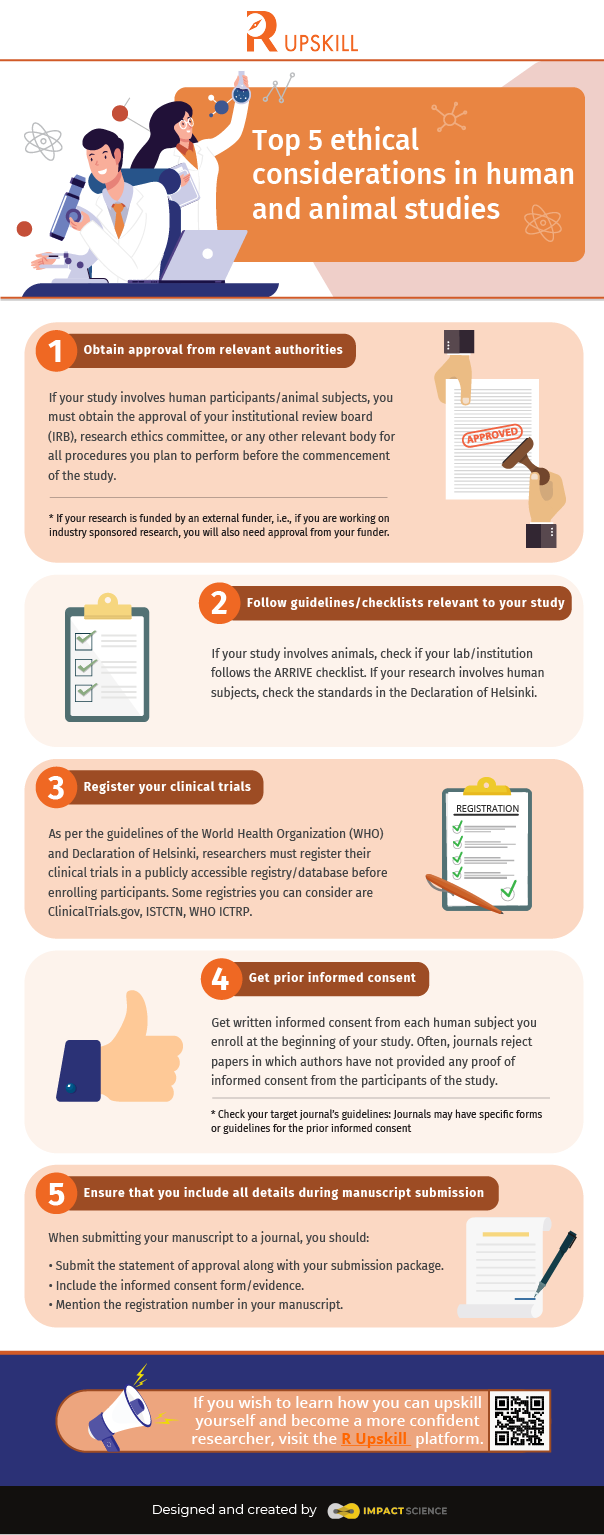
Top 5 ethical considerations in human and animal studies
| No. | Ethical Consideration | Description |
|---|---|---|
| 1 | Obtain approval from relevant authorities | Get approval from IRB, ethics committee, or relevant body before starting the study. External funding may also require funder approval. |
| 2 | Follow guidelines/checklists | Use ARRIVE checklist for animal studies and Declaration of Helsinki standards for human studies. |
| 3 | Register your clinical trials | Register trials in public databases (e.g., ClinicalTrials.gov, ISCTN, WHO ICTRP) before enrolling participants, as per WHO and Helsinki guidelines. |
| 4 | Get prior informed consent | Obtain written consent from all participants at the beginning. Journals may reject studies without proof of consent. |
| 5 | Include all details during submission | Submit approval statements, consent evidence, and trial registration number with your manuscript. |
References
- Declaration of Helsinki – Ethical Principles For Medical Research Involving Human Subjects
- ARRIVE guidelines – Animal Research: Reporting of In Vivo Experiments
- WHO, Statement on Public Disclosure of Clinical Trial Results
This article was originally published on November 24, 2020, and revised on May 12, 2026.
Top 5 ethical considerations when you conduct research_0.pdf