Binomial nomenclature: How to present scientific names of plants, animals, and organisms in academic writing
How to Write Scientific Names of Organisms in Academic Writing
When writing about living organisms in a research paper, scientific names (also called taxonomic or binomial names) are the universal standard. They ensure that every reader, regardless of language or region, knows exactly which species is being discussed. These names are governed by international codes of nomenclature, including the International Code of Zoological Nomenclature (ICZN) for animals, the International Code of Nomenclature for algae, fungi, and plants (ICN), and the International Code of Nomenclature of Prokaryotes (ICNP) for bacteria. Getting them right is not optional: errors in species nomenclature can undermine the credibility of your manuscript and delay journal acceptance.
What Is Binomial Nomenclature? A Quick Overview
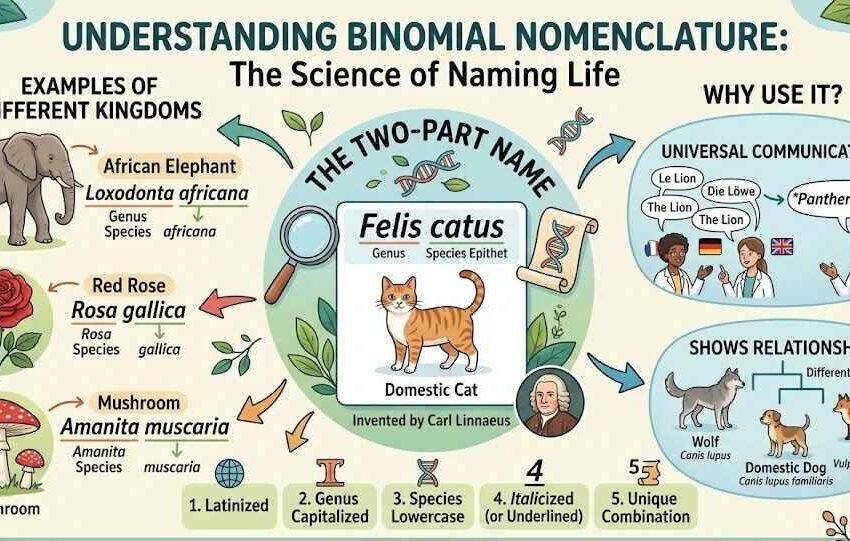
In the 1750s, Carl Linnaeus developed the two-part naming system, binomial nomenclature, that scientists still use today. Every species name consists of exactly two parts:
- The genus name (generic name): a noun, always capitalized
- The specific epithet (species name): an adjective or descriptor, always lowercase
Together, they form a unique identifier for each species. Homo sapiens, for instance, translates roughly as “wise man” (Homo being Latin for man and sapiens meaning wise). Oryza sativa identifies cultivated rice: Oryza from the Latin for rice, sativa meaning cultivated.
Names are derived from Latin or Latinized words from any language, and they can describe the organism’s appearance, habitat, the person who discovered it, or even be an inside joke among taxonomists (see the frog genus Mini). What matters for academic writing is not the etymology, but the formatting, and that is where many authors make avoidable mistakes.
The 4 Core Style Rules for Scientific Names in Academic Writing
These rules apply across all organisms and all major journals. Mastering them keeps your manuscript clean and saves time during peer review.
1. Capitalization
The genus name always begins with a capital letter. The specific epithet never does, not even at the start of a sentence.
- Correct: Homo sapiens, Oryza sativa, Triticum aestivum
- Incorrect: homo sapiens, Oryza Sativa, triticum Aestivum
One practical trap: Microsoft Word treats the dot after an abbreviated genus name (e.g., T.) as a full stop and automatically capitalizes the next letter. Always override this manually. Some journals also require the genus name to be spelled out in full even when starting a sentence, rather than using the abbreviated form. Check your target journal’s author guidelines.
2. Italics
Scientific names are always italicized in typeset text. The italics serve a clear functional purpose: they visually distinguish the Latin name from the surrounding prose.
- In running text: Panthera tigris is the Bengal tiger.
- Exception: if the surrounding text is already in italics (for example, in a figure legend or a book title), the species name switches to roman (upright) type to maintain the contrast.
- In handwritten manuscripts or when italics are unavailable, underline the name instead.
3. Abbreviating the Genus Name
Writing the full binomial every time it appears is unnecessary and makes for clunky reading. The standard practice:
- Write the full binomial on the first mention in the text: Triticum aestivum
- Abbreviate the genus to its initial letter on all subsequent mentions: T. aestivum
- If a paper discusses multiple species whose genus names begin with the same letter (e.g., Solanum tuberosum (potato) and Sorghum bicolor (sorghum)), use two-letter abbreviations to prevent ambiguity: So. tuberosum and Sr. bicolor, or write out the full name where clarity is at risk.
- Scientific Style and Format (CSE manual) explicitly discourages three-letter abbreviations, so avoid them
- Many journals require the full binomial to appear in both the abstract and the main text, even if the name was already introduced — check the journal’s instructions
4. Referring to Unspecified Species
Sometimes a genus is known but the exact species is not, or you need to refer collectively to multiple species within a genus. The conventions are:
- Genus sp. — one unidentified species (Zea sp.)
- Genus spp. — multiple unidentified species (Triticum spp.)
Note that “sp.” and “spp.” are not italicized, because they are abbreviations of common English words (species/species plural), not Latin names. Both always end with a period.
Example in context:
“The collection included two specimens of Oryza sativa, three of Zea mays, and one of Sorghum sp.”
Quick-Reference Style Rules at a Glance
| Element | Rule | Example |
| Genus name | Capitalized, italicized | Homo |
| Specific epithet | Lowercase, italicized | sapiens |
| Full binomial | Genus + epithet, both italicized | Homo sapiens |
| Abbreviated genus | Initial letter + period | H. sapiens |
| Unknown species (singular) | Genus + sp. (roman) | Oryza sp. |
| Unknown species (plural) | Genus + spp. (roman) | Triticum spp. |
| Name in already-italicized text | Switch to roman type | Homo sapiens |
| Handwritten manuscripts | Underline instead of italicize | <u>Homo sapiens</u> |
Beyond the Basics: Additional Notations Used in Research Papers
Once you have the four core rules down, you may encounter more specialized situations depending on your field.
Subspecies and Varieties
When taxonomic distinctions go below the species level, the conventions differ between animals and plants:
- Animal subspecies: the subspecies name follows the species epithet in lowercase italics, like Panthera tigris sondaica (Sumatran tiger)
- Plant subspecies: insert the abbreviation subsp. (roman, not italicized) between the species and subspecies names, like Cornus sericea subsp. sericea
- Varieties: use var., for example, Gleditsia triacanthos var. inermis (thornless honeylocust)
- Forms: use f. for occasional individual variation, for example, Cornus florida f. rubra (pink-flowered dogwood)
Hybrids
Hybrids are indicated with a multiplication sign (×), not the letter “x”:
- Named hybrid: the × goes between the genus and species epithet — Solanum × procurrens
- Unnamed hybrid where parentage is specified: S. nigrum × S. physalifolium
Cultivars
Cultivar names are written in single quotation marks, capitalized, and not italicized. They follow the specific epithet if bred from a single species:
- Zea mays ‘Wisconsin 153’
If the cultivar was developed by hybridizing multiple species, the cultivar name replaces the specific epithet:
- Rosa ‘Iceberg’
Taxonomic Authority
In some disciplines like particularly botany, zoology, and microbiology, the name of the person who first formally described the species is appended to the scientific name. This is called the taxonomic authority:
- Animals: full surname + year — Balaena mysticetus Linnaeus, 1758
- Plants: abbreviated surname — Panicum virgatum L. (L. = Linnaeus)
- Amended names: if the name was revised after the original description, the authority appears in brackets — Pulchrapolia gracilis (Dyke and Cooper)
Whether to include taxonomic authority depends on your journal’s conventions. When in doubt, omit it unless your study is explicitly taxonomic.
Which Governing Code Applies to Your Organism?
| Organism Group | Governing Code | Abbreviation |
| Animals | International Code of Zoological Nomenclature | ICZN |
| Plants, fungi, algae | International Code of Nomenclature for algae, fungi, and plants | ICN / ICNafp |
| Bacteria and archaea | International Code of Nomenclature of Prokaryotes | ICNP |
| Viruses | International Committee on Taxonomy of Viruses | ICTV |
Each code has its own specific rules, and some conventions differ between them — for instance, tautonyms (where the genus and species names are identical, such as Gorilla gorilla for the western gorilla) are permitted under the ICZN but explicitly prohibited under the ICN.
Common Mistakes to Avoid in Binomial Nomenclature
- Capitalizing the specific epithet: Homo Sapiens is always wrong
- Italicizing “sp.” or “spp.”: these stay in roman type
- Abbreviating the genus before its first full mention: always introduce the full binomial first
- Using three-letter genus abbreviations: discouraged by the CSE manual and most style guides
- Omitting the full binomial from the abstract: many journals require the name to be spelled out in full in both the abstract and the body, independently
- Assuming your species name is current: taxonomy is a living science; names change as new genetic data emerges. Always verify against a current authoritative source before submission
Where to Find and Verify Scientific Names
Species names can change when new taxonomic evidence becomes available, so always verify before you submit. Reliable sources include:
- Integrated Taxonomic Information System (ITIS): itis.gov; broad coverage of animals, plants, fungi, and microbes
- Catalogue of Life: catalogueoflife.org; curated global species list
- IUCN Red List: iucnredlist.org; authoritative for animals, with conservation status data
- World Register of Marine Species (WoRMS): marinespecies.org; gold standard for marine organisms
- BirdLife International Datazone: birdlife.org; preferred for avian species
- Most recent peer-reviewed taxonomic publications: always the final word when database entries lag behind accepted revisions
A practical example of why this matters: the sweet thorn tree was reclassified from Acacia karroo to Vachellia karroo following a 2008 publication, yet some databases still list the outdated name. Cross-checking two sources is always safer than relying on one.
See also: Style tips for presenting scientific names of bacteria
Frequently Asked Questions
Can two species share the same scientific name?
Within a single kingdom, homonyms are not permitted. However, hemihomonyms (identical names assigned to organisms in different kingdoms) do occur, because separate codes govern different organism groups. For example, Ficus variegata is the name of both a sea snail and a fig tree. This is rare but worth knowing if your work spans kingdoms.
Do I need to write the scientific name every time I mention a species?
No. Write the full binomial on the first mention, then abbreviate the genus on all subsequent mentions. However, many journals require the full name in the abstract and also in the body text. They may also require the full name in each figure/figure legend because a figure is expected to stand alone and be understandable without reference to the main text.
What if I don’t know the exact species?
Use Genus sp. for a single unidentified species or Genus spp. for multiple. Keep “sp.” and “spp.” in roman type.
What if two genera in my paper share the same first letter?
Avoid single-letter abbreviations in this situation. Use two-letter abbreviations (An. for Anopheles and Ae. for Aedes, for example) or write the genus name out in full wherever confusion is possible. Clarity for the reader always takes priority over brevity.
What if my journal has its own rules for scientific names?
Author guidelines sometimes override general conventions. For instance, some journals require the full genus name to open any sentence, regardless of prior abbreviation. Always check the target journal’s instructions for authors before finalising your manuscript.
References
[1] CSE, Style Manual Committee. 2014. Scientific Style and Format: the CSE manual for authors, editors, and publishers, 8th edn, p. 401. Wheat Ridge, Colorado, USA: Council of Science Editors. 722 pp.
[2] Oregon State University. Scientific Plant Names (Binomial Nomenclature). https://landscapeplants.oregonstate.edu/scientific-plant-names-binomial-nomenclature
[3] AMA. 2007. AMA Manual of Style: a guide for authors and editors, 10th edn., pp. 748–753. New York: Oxford University Press [and American Medical Association]. 1010 pp.
This article was originally published in June 2014 and updated on May 26, 2026.