IEEE Paper Format: Guidelines and Template
The Institute of Electrical and Electronics Engineers (IEEE) is the world’s largest technical professional organization for technologists to share knowledge, collaborate, and network through IEEE’s various platforms [1]. Any researcher in the engineering and telecommunication field would be familiar with IEEE journals and publications. This blog explains the formatting guidelines you need to follow for each section of IEEE papers, including the title page, abstract, headings, citations, and references.
What is the IEEE Paper Format?
Differences between IEEE Journal and Conference Templates
Why is IEEE Format Important for Academic Papers
Frequently Asked Questions on IEEE Paper
What is the IEEE Publication?
IEEE is known for publishing nearly one-third of the world’s technical literature [2]. Through their platform IEEE Xplore, researchers can share scientific content on various subjects in fields like electrical engineering, computing, and electronics. It is known for publishing journals, books, magazines, and standards.
What is the IEEE Paper Format?
IEEE Templates
To make it easy for authors, IEEE offers a template selector [3] that lets you navigate to the template required for your target publication.
- Start by selecting the publication type (e.g., transactions/journals/letters, conferences, magazines)
- Choose the name of the publication from a dropdown
- Select the article type (e.g., original research)
- Choose the template you want (e.g., Word, LaTex)
- Download the template
There’s also a different template for publishing in IEEE Access, which is their multidisciplinary, online-only, gold fully open access journal [4]. Here too, you can download either the Word or LaTex template.
IEEE Format: Key Guidelines
IEEE lists formatting guidelines for journal articles and conference papers separately. However, some elements remain common:
- A4-size paper
- Two-column format
- Standard font (Times New Roman 10 pt)
- Title must be centered at the top and written in Times New Roman 24 pt
- Numbered citations within square brackets
- Figure numbers are labeled as “Fig. 1.” followed by the caption
The paper format for IEEE Access is slightly different:
- Title is left-aligned, written in font type Helvetica (22 pt)
- Abstract and index terms span across the full page; content following it is presented in a two-column format
- Figure numbers are indicated in full (e.g., Figure 1) followed by a period and two spaces
Differences between IEEE Journal and Conference Templates
The table below shows the differences between some of the formatting elements in IEEE journal papers and conference papers.
| IEEE Journal Paper Format | IEEE Conference Paper Format |
| Author names and affiliations are written in a single line | Author names and affiliations are written in multiple lines, distributed over three columns |
| Page numbers are included at the top right-hand side corner on all pages | No page numbers needed |
| Figure caption is written as ‘Fig. 1. Figure caption example’ with a single space between the period after the figure number and the caption text. Use Times New Roman 10 pt | Figure caption is written as ‘Fig. 1. Figure caption example’ with a double space between the period after the figure number and the caption text. Use Time New Roman 8 pt |
| Author photographs and biographies can be mentioned at the end of the manuscript after the reference list | No need to include author photographs and biographies |
Why is IEEE Format Important for Academic Papers
In engineering and technology, IEEE format is known for representing well-structured and organized content. It simplifies editorial checks and peer reviews because of the consistent layout, such as the two-column format, specific font type and size, bracketed citations etc. Using the template recommended by the journals also benefits authors since the editorial review process is fast-tracked without requiring reformatting. Adhering to IEEE guidelines and templates shows professionalism, letting journal editors know that you’ve been meticulous in preparing the manuscript.
IEEE Paper Format Guidelines
General Format Rules
- The main manuscript should be presented in a two-column format
- Use 10 pt Times New Roman for all text
- All papers should include a paper title, abstract, and index terms
- Divide the manuscript into appropriate sections and sub-sections with suitable headings
- The first section heading should always be Introduction
- Number figures, tables, and equations consecutively in the text
IEEE Title Page and Abstract
There’s no separate title page in IEEE papers. The manuscript begins with the title, followed by the abstract, index terms, and main body. Follow the below guidelines for writing the title and abstract:
- Center the title at the top of the page; use Times New Roman 24 pt
- The author byline is centered right below the title after a line break
- Mention the author name(s) and author affiliation(s) in Times New Roman 10 pt in this format: First A. Author, Fellow, IEEE, Second B. Author, and Third C. Author Jr., Member, IEEE
- For conference papers and IEEE Access papers, even the country, email address, and ORCID should be provided
- The abstract and index terms are written in Times New Roman 9 pt
- Abstract word limit is journal-specific; typically, keep it within 200 words
- Do not include any undefined abbreviations, footnotes, references, tables, graphs, charts, figures, and mathematical equations in the abstract.
- Index terms are nothing but keywords; list them in alphabetical order
- Choose index terms from the IEEE Thesaurus [5] to use standardized terms
IEEE Headings
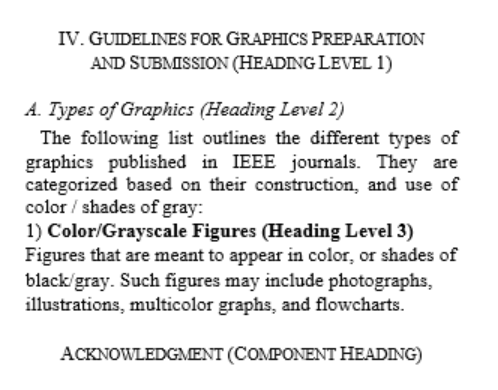
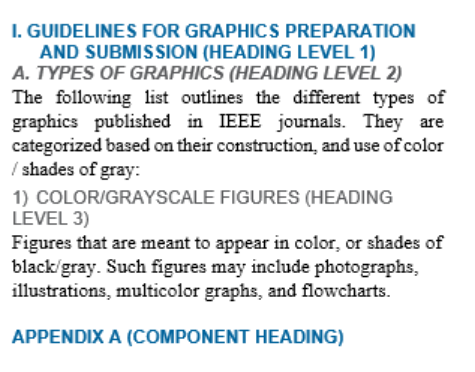
Headings in IEEE papers can be of different levels, and each level has its own formatting requirement.
- Level 1 Headings are indicated using a Roman numeral followed by a period. They are centered in the column and written in small caps, title case (e.g., V. Conclusion)
- Level 2 Headings begin with a capital letter followed by a period. They are left-aligned, italicized, and written in title case (e.g., E. Resolution)
- Level 3 Headings start with an Arabic number followed by a closing parenthesis. They are indented like any other paragraph, italicized, boldfaced, and written in title case (e.g., 1) Figure Axis Labels).
- Level 4 Headings begin with a lowercase letter followed by a closing parenthesis. They are indented slightly further than a regular paragraph, italicized, and written in title case (e.g., c) Sizing of Graphics).
- Component Headings refer to the elements of the paper that are not part of the main text, such as the Acknowledgment, Appendix, and References. These headings are centered in the column and written similar to level 1 headings but without numbering (e.g., References)
Headings in IEEE Access are formatted slightly differently. Most rules remain the same, but all headings are left-aligned and written in all caps. See below images to understand the different IEEE heading styles.
IEEE paper heading format:
IEEE Access heading format:
Formatting Figures, Tables, and Equations in IEEE Papers
Figures, tables, and equations are important elements in an IEEE paper. Their formatting rules are quite straightforward:
- Figures and tables should be placed either at the top or the bottom of the column on a page.
- If the figure or table is large, it can span over two columns.
- Number these elements consecutively throughout the paper, including the appendix. Do not start over the numbering system in a different section. For example, if Section I has three figures, the next figure in Section II will be numbered Fig. 4 and not Fig. II.1 or something similar.
- Each category should be independently numbered, meaning if there’s a table after five figures, number it as Table I and not Table VI.
- Equations are centered in the column and labeled with Arabic numerals in parentheses (right aligned). Equations are referred directly using these numbers, e.g., use “(2)” and not “Eq. (2)” or “equation (2),” except at the beginning of a sentence: “Equation (2) is…”
IEEE Citations and References
How to Format IEEE Citations
The IEEE style guide asks for numbered in-text citations. You’ve to use Arabic numbers, non-superscripted, and enclosed in square brackets. Like this:
Jason et al. [8] devised a novel machine learning approach for predicting temperature.
A previous study [6] examined the effectiveness of using Chebyshev polynomials to quantify uncertainty.
Best Practices for IEEE Citation Style
- Don’t use an en dash in a reference range. Write out all the citations, like this: “[1], [2], [3], [4]”. However, in IEEE Access papers, en dash can be used to indicate a range of references (e.g., [3]–[6]).
- If there are more than 3 author names and you’ve to use the author names in the main text, use “et al.” after the first author’s name: “Jason et al. [7] devised …”
- If there are two author names, use “and” between them in the main text: “… as shown by Vanwall and Kuthe [10]”
How to Format IEEE References
Here are some basic rules for formatting references in IEEE papers:
- The reference list appears at the end of the text and is numbered.
- Order references according to how they are mentioned in the main text, not alphabetically.
- Use Times New Roman 8 pt
- The reference number appears flush left and is enclosed in square brackets.
- All references end with a period, except those ending with URLs. Use a period after the DOI.
- Wherever available, use digital object identifier (DOI) for references. Write it as “doi: 10.1109/TTHZ.2016.2544142”
- Never combine references.
- Always use initials for the first name of authors or editors. Don’t use commas around “Jr.” or “Sr.” or other similar suffixes in author names.
- List names of all authors up to the sixth author if you’re citing other IEEE publications. When there are seven or more authors, list the first author’s name followed by “et al.” If you’re citing non-IEEE publications, try to follow the same style but it’s okay to use “et al.” if names aren’t provided for fewer than six authors too.
- IEEE considers software a “legitimate and citable product of research,” just like a journal article or book. You therefore need to provide citations and references for any software mentioned in your research paper.
Examples of References in IEEE Format
Journal Articles
M. Long and K. Taxman, “Induction of electric field in fat eagles nesting in coconut trees: A machine learning approach to cooking sheepskin pasta,” IEEE Trans. Biomed. Eng., vol. 28, pp. 287–299, Oct. 2015, doi: 10.1109/TBME.2001.2658415.
Book Chapters
T. V. Pump and G. M. Chap, “Why we love to eat fish,” in The Joy of Telling Stories About Hip Hop Music, vol. 4, P. G. Peton and B. S. Hump, Eds., Princeton, NJ, USA: Princeton Univ. Press, 1965, pp. 124–133.
Book
K. Matzuki, Y. Watanabe, and H. Takashima, Japan’s Railway System, Tokyo: Nihon Keizai Hyoronsha (in Japanese), 2017.
Conference Proceedings
C. Naly and S. Gogol, “Wavelength-switched passively coupled single-mode optical network,” in Proc. IEEE Antennas Propag. Soc. Int. Symp., Jul. 2017, pp. 4322–4334.
G. Singh, “Digital single sideband detection for interferometric sensors,” in Proc. Humanoids ’06: 6th IEEE-RAS Int. Conf. Optical Fiber Sensors, 2013, pp. 444–448, doi: 10.1109/ICHR.2006.321337.
Datasets
Department of Happy Nutcases, Aug. 2013, “Funny Dogs Dataset: All Jumping Cats, 2006 to 2009,” Department of Happy Nutcases, Substance Abuse and Mental Health Services Administration, Office of Skydiving Sealions. [Online]. Available: http://www.icsr.ujuch.edu/icpsrweb/SAMHDA/studies/30122/version/
Patents
T. Mater and J. Cat, “Method for circumcision of waltzing oxen and somersaulting guinea pigs,” U.S. Patent 7 818 177 B1, 2011, Mar. 1, 2012.
Common Abbreviations Used in IEEE References
A quick look at the most popular abbreviations used in IEEE style:
- Annals = Ann.
- Annual = Annu.
- Proceedings = Proc.
- Record = Rec.
- Symposium = Symp.
- Conference = Conf.
- Convention = Conv.
- National = Nat.
- International = Int.
Note that “Meeting” and “Workshop” are not abbreviated.
Frequently Asked Questions on IEEE Paper
1. What font and font size should I use in IEEE articles?
IEEE papers require a standard font, Times New Roman. The font size depends on the section in the paper. Most of the text is written in 10 pt. But sections like the abstract and index terms are written in 9 pt and the references are listed in 8 pt. In IEEE conference template, figure captions are also written in 8 pt. The paper title is written in 24 pt.
IEEE Access papers use the font Helvetica for title, headings, and captions. The font size of the title is 22 pt, whereas those of headings and figure captions are 9 pt and 7 pt, respectively.
2. Should I include page numbers in IEEE papers?
IEEE conference papers need not include page numbers. IEEE journal articles, however, should include page numbers on the top right-hand side corner on all pages. On the other hand, the odd and even page numbers in IEEE Access papers should be mentioned on the right and left sides, respectively, at the bottom of the pages.
3. Where can I get IEEE article template?
IEEE article templates can be obtained from the IEEE template selector page by selecting the publication type, publication name, article type, and template type. Template for IEEE Access papers can be obtained here.
4. Is conference template different from article template in IEEE?
Yes, IEEE templates for journal articles and conference submissions differ slightly. Most of the major elements remain same between the two, but there are minor variations in formatting of certain components. It is best to select the correct submission type (journal articles or conference proceedings) before downloading the template to avoid confusion.
References
1. IEEE Organization https://www.ieee.org/about-ieee
2. IEEE Publications and Research https://www.ieee.org/publications-research
3. IEEE article template selector https://template-selector.ieee.org/secure/templateSelector/publicationType
4. IEEE Access template https://ieeeaccess.ieee.org/authors/preparing-your-article/#article-acceptance-requirements
5. IEEE Thesaurus https://www.ieee.org/publications/services/thesaurus.html