APA Style Formatting Guidelines for In-text Citations and References
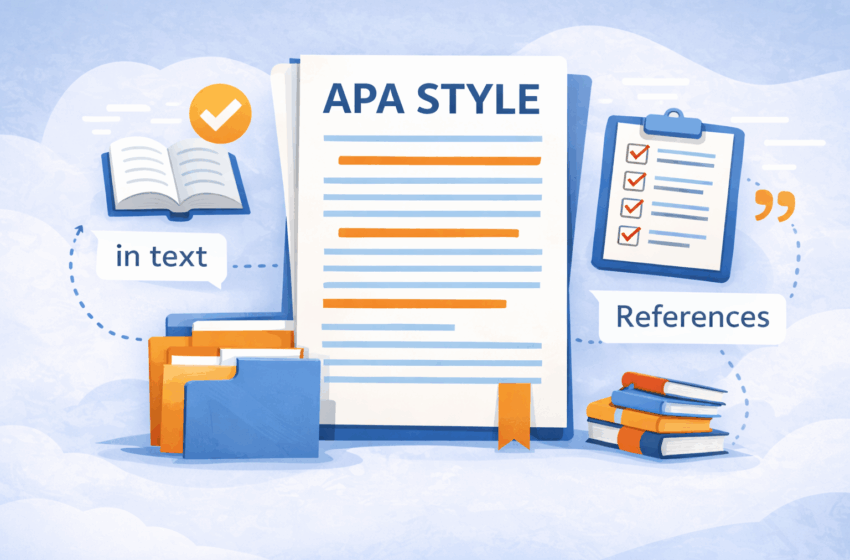
When you’ve got so many formatting style guides to choose from (and journals also create their own), it can get tricky. Or, what if your target journal says you can follow any style at initial submission? This blog explains how to use the American Psychological Association (APA) style manual for in-text citations and references along with a quick overview of other formatting essentials of APA style.
Formatting Citations in APA Style: Basic Principles
APA Style Guidelines for In-text Citations
General APA Formatting Style for Journal Papers: Key Aspects
What is APA Format?
A researcher in the social sciences and behavioral sciences should be familiar with the 7th edition of the APA style manual [1]. This style guide is highly popular not only in psychology but also in the fields of sociology, anthropology, and political science. The style guide outlines how academic documents such as research papers, theses, dissertations, and case reports should be formatted. It includes guidelines on page layout, font, margin, line spacing, heading styles, paragraph style, and citation & reference format.
Formatting Citations in APA Style: Basic Principles
The APA style citation follows the “author-date” format, wherein a brief in-text citation contains the author(s)’ surnames and year of publication. This is accompanied by a full entry in the reference list at the end of the paper. When writing or formatting a research paper as per the APA style guide, below are a few key points to note:
- Spellings should match between in-text citations and the reference list.
- Personal communications should be cited in the main text only (but if you’re citing traditional knowledge or oral traditions of indigenous peoples, do go through the APA guidelines [2] for the same).
- All quotations require a citation.
- Avoid using online sources that are not recoverable, such as personal emails, non-archived social media livestreams, or unarchived social media posts.
- Limit long strings of citations, for the sake of readers using assistive technology like screen readers.
- Any facts or figures that are NOT common knowledge require a citation. For instance, you do not need to cite a source when you state that humans are mammals but you must cite a source when you state that depression is a risk factor for suicide ideation.
- Where possible, APA recommends that authors use primary sources rather than secondary sources. This means that you refer to WHO reports on the incidence of malaria in X country, rather than cite a study that has not collected the actual incidence data.
Important: Every citation in the text MUST have a corresponding entry in the reference list. Likewise, every entry in the reference list should be cited at least once in the main text (or figure, table, footnote, or appendix).
Some people may tell you that you should cite only those works that have been published in the last 5-10 years. The APA publicly calls this a myth [3], and recommends citing reliable, primary sources with the most current information wherever possible. There’s no date cutoff in APA style. Of course, some fields like neuropsychology or psycho-oncology advance very rapidly; so you do need to make sure you are keeping abreast of latest developments there.
APA Style Guidelines for In-text Citations
In-text citations in APA can be narrative or parenthetical.
Parenthetical Citations in APA
In parenthetical citations, the author’s name and the year of publication are placed within parentheses in the text. In this style, the citation can be written at the middle or at the end of a sentence.
Example: A longitudinal, multi-center study (Rangypants, 2010) did not find any relationship between sleep duration and dementia risk.
Narrative Citations in APA
In narrative citations, write the author’s name as a part of the sentence, and follow it by the publication year in parentheses.
Example: Rangypants (2010) identified economic barriers to access to mental health services.
How to Cite Sources in APA Style Format
Citing sources in APA differs based on the number of authors and availability of information. For instance, there could be sources where the author is an organization. Some sources may not have all the details, like publication date or page numbers may be missing. The following tables highlight how to write in-text citations in different scenarios when following the APA style guide.
Table 1: How to cite works in APA
| No. of author(s) | Parenthetical citation example format | Narrative citation example format |
| 1 author
|
(Nadal, 2004) | Nadal (2004) |
| 2 authors
|
(Taylor & Devon, 2021) | Taylor and Devon (2021) |
| 3 or more authors
|
(Romera et al., 2014) | Romera et al. (2014) |
| Organization as an author* | (ISRO, 2024)
|
ISRO (2024) |
*When citing for the first time in text, the expanded form must be mentioned along with the abbreviation: (e.g., (Indian Space Research Organization [ISRO], 2024)). Subsequent citations should mention only the abbreviation (e.g., (ISRO, 2024)).
Table 2: How to cite works with missing details in APA
| Missing information | Solution | APA style citation |
| Author | Write the title of the work in title case
|
(What is the structure of a research paper, 2020) |
| Date
|
Write “n.d.” (indicates no date) | (Williams, n.d.) |
| Page number
|
Write an alternative locator | (Hamilton, 2021, para. 3)
OR (Verstappen, 2023, Chapter 5) |
| Title
|
Describe the source when listing under references | (Leeroy, 2018)
[no change in citation format] |
APA Reference Style Format
It is also important to format your reference list as per the style guide’s requirements. In APA, the list of references should start on a separate page with the heading “References” written in bold and centered on the page. The works should then be alphabetically sorted with a hanging indent of 0.5 inch and double line spaced.
Notable Changes in Reference Page Format (APA 7th Edition)
- List up to 20 authors; for more than 20 authors, add ellipses (…) between the 19th and the last author.
- Both DOIs and other URLs must be added as hyperlinks; do not prefix the URLs with “DOI:”
- Publisher location need not be mentioned for books.
- Titles are written in title case (capitalize only the first word and proper nouns in the title).
How to Format References in APA Style
The format of references varies based on the type of source. Journal articles, books, and thesis/dissertations are the most referenced works. However, sources like podcast videos, webpages, and news articles could also be referenced. The table below explains the format for different types of sources along with examples.
Table 3: How to format references in APA
| Source type | Reference list format | Example |
| Journal article | Author1, A. A, & Author2, B. B. (Year of publication). Article title. Journal name, Volume(issue), page range. DOI | Pasini, A., Torre, L., Romeo, L., Cervone, A., & D’Agostino, L., (2010). Reduced-order model for H2O2 catalytic reactor performance analysis, Journal of Propulsion Power, 26(3), 446–453. https://doi.org/10.2514/1.44355. |
| Book | Author, A. A. (Year of Publication). Title of the book. Publisher. DOI | Hendricks, L., Shane, W., & Rao, A. (2024). Athletes in action: The evolution of Olympics. Penguin Random House. https://doi.org/10.1037/00034-9056 |
| Book chapter | Author1, A. A., & Author2, B. B. (Year). Title of the chapter title. In Initial. Surname (Eds.), Book title (chapter page number). Publisher. DOI of the chapter | Walid, Z. A., Thomas, H. L., & Nadine, D. C. (2016). Balancing extracurricular activities with core subjects. In M. Calvin & B. M. Andrews (Eds.), Promoting holistic learning in schools (pp. 17–25). Penguin Random House. https://doi.org/10.1037/005670-638 |
| Dissertation/Thesis | Author, A. A. (Year of Publication). Title of dissertation/thesis [Master’s thesis/Doctoral dissertation, Name of institution]. URL or database name | Maya, H. L. (2025). Genuine reviews to paid promotions: The evolution of influencer marketing [Doctoral dissertation, Stanford University]. ProQuest Dissertations and Theses. |
| Webpage | Author, A. A. (Year, Month Day). Title of webpage. Website name. URL | Oliver, K. (2022, June 14). Creamy vegan mushroom stroganoff. Yummy Tummy. https://yummytummy.com/creamy-vegan-mushroom-stroganoff |
| Podcast episode | Host name, A. A. (Host). (Year, Month Day). Title (episode number if known) [Podcast episode name]. In Title of podcast. Publisher. URL | Whitaker, S. (Host). (2025, October 21) Become a Nat Geo Photographer and Explorer (No. 17) [Audio podcast]. In Some Like it Wild. Spotify. https://www.spotify.com/season-1-episodes/episode-17 |
| Newspaper article | Author, A. A. (Year, Month Day). Title of the article. Title of the Newspaper. URL
|
Smith, B. (2021, March 5). Barcelona’s Gerard Pique set to be out for weeks with right knee injury. The Indian Express. https://indianexpress.com/article/sports/football/gerard-pique-barcelona-right-knee-injury-update-7215106/ |
General APA Formatting Style for Journal Papers: Key Aspects
The APA style guide provides a template that authors can directly use for formatting research papers. Here are the basic things you should be taking care of when formatting your research paper as per APA style:
- Keep 1-inch margins on all 4 sides.
- Use 12-point Times New Roman font with double line spacing.
- First line of paragraphs should be indented by 0.5 inch.
- Page numbers must be written in the top right-hand side corner.
- Provide a running head (abbreviated paper title) of 50 or fewer characters, including spaces, on the top left-hand side corner of all pages.
Here is a handy cheat sheet along with free template and citation generator covering the fundamentals of APA style. You can also refer to this helpful infographic to understand the format for citing journal articles in APA.
References
1. American Psychological Association (APA)’s style manual https://apastyle.apa.org/style-grammar-guidelines/citations/basic-principles
2. APA guidelines for personal communication https://apastyle.apa.org/style-grammar-guidelines/citations/personal-communications
3. The “outdated sources” myth https://apastyle.apa.org/blog/outdated-sources-myth
Originally published on September 2, 2024. Revised on February 17, 2026