MLA Formatting Guide & Citation Generator: Free Template Covering Title Page, Quotations, Headings, Citations, & References
In this article, you’ll learn
- What is MLA Format?
- Downloadable Free MLA template
- How to make an MLA Header and Title Page?
- How to format short quotations in MLA style
- How to format block quotations in MLA style
- How to format in-text citations in MLA style?
- Most Common Mistakes in MLA Citations
- Free MLA citation generator
- What is the Works Cited Page in MLA style?
- General MLA Formatting Style: Key Aspects
- What are the main differences between MLA 8th and 9th editions?
Are you planning a research career in literature, language studies, art history, etc.? Get familiar with the requirements of the Modern Language Association (MLA) style guide [1], because it’s one of the most popular style guides in these fields. You’ll especially need a good working knowledge of MLA citation style.
What is MLA Format?
The MLA style guide includes a set of rules for formatting research papers a certain way, specifically in the Humanities field, to maintain uniformity in presentation. The 9th edition of the MLA style guide, introduced in 2021, outlines detailed instructions for authors on formatting headers, citations, references, tables, and figures, among other elements of a research paper.
Downloadable Free MLA template and sample paper
If you’re brand new to MLA formatting, use this handy MLA_Template to get your basics right. Here’s what’s pre-formatted inside it:
Page setup
- US Letter, 1-inch margins on all sides
- Times New Roman 12pt throughout
- Double-spacing everywhere (including the Works Cited page)
First page
- Header block (top-left): placeholders for your name, instructor’s name, course, and date in MLA date format
- Centered title placeholder below the header block
- Running head in the top-right corner on every page: [Last Name] #
Body
- Three body paragraphs with 0.5-inch first-line indent
- A block quotation example showing the correct left-indent (0.5″), no quotation marks, and citation placement after the period
- Short quote examples with parenthetical citations in the correct position
Works Cited page
- Starts on its own page with a centered “Works Cited” heading
- Four pre-formatted entry templates (book, journal article, website, video) all with the correct 0.5-inch hanging indent
Just replace each [placeholder] with your own content and you’re good to go.
How to make an MLA Header and Title Page?
There is no need for a separate title page in MLA. The main paper typically starts with an MLA header which also contains the title of the paper.
The header starts with four important details:
- your full name
- the name of your supervisor or instructor
- the course name
- the date of submission
All these details must be left aligned and written on separate lines on the header page. Do not forget to include a running head at the top right-hand side corner, which contains your surname and the page number.
The title should be centered below the line indicating the due date for the assignment submission. Some supervisors might instruct you to create a separate title page; in such cases, follow the guidelines outlined by them.
How do I format MLA headings and subheadings?
In the MLA format, headings should be written in title case and left-aligned with the page margin. The font and size can be the same as that of the main text, but don’t add a period after the heading.
The guidelines are not that strict for headings and subheadings in MLA, so you may use boldface for the main headings and italicize the subheadings to differentiate between the two. The key requirement is that you remain consistent when writing headings at all levels. For example, all level 1 headings must be in the same font, size, and style and the same must be maintained for the subsequent heading levels (level 2, level 3, etc.) as well.
How to format short quotations in MLA style
A short quotation in MLA is any prose passage of four lines or fewer (or two lines or fewer of poetry). These are integrated directly into your text, enclosed in quotation marks.
Rules:
- Keep the quote within your paragraph — no new line or indent
- Enclose in double quotation marks
- Place the parenthetical citation before the closing period (opposite of block quotes)
- Integrate grammatically into your sentence
Examples:
Narrative citation (author named in sentence):
Orwell argues that political language is designed to “make lies sound truthful and murder respectable” (136).
Parenthetical citation (author not named):
Political prose, one critic observes, exists to “make lies sound truthful and murder respectable” (Orwell 136).
Altered quotation — use brackets for changes, ellipses for omissions:
Orwell warns that language can “make […] murder respectable” (136).
Poetry of two lines or fewer: separate lines with a forward slash and a space on each side.
Frost opens with a deceptively simple image: “Two roads diverged in a yellow wood, / And sorry I could not travel both” (1–2).
Key rule: The period always falls after the closing parenthesis, not before it.
How to format block quotations in MLA style
In MLA style, any prose quotation of more than four lines (or more than three lines of poetry) must be formatted as a block quotation.
Rules:
- Start the quotation on a new line
- Indent the entire quote 0.5 inches from the left margin (no additional right indent)
- Maintain double spacing throughout
- Omit quotation marks
- Place the parenthetical citation after the closing period (unlike short quotes, where the citation comes before the period)
Prose example:
Discussing the nature of grief, Didion reflects on the physical dimension of loss:

Poetry example (three or more lines): preserve the original line breaks and indent the same way.
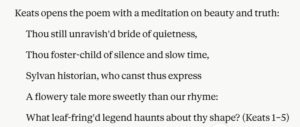
Key distinction from short quotes: The block format itself signals to the reader that the material is quoted, so quotation marks are dropped entirely.
How to format in-text citations in MLA style?
In MLA style, the in-text citation should include the author’s surname (or last name) and page number in parentheses. The purpose is simply to direct the readers to the Works Cited list and the locator, i.e., the page number, in the cited source.
The citation style varies depending on the number of authors for a work.
- For a single author, the author’s surname and page number should be mentioned
- For two authors, specify the last names of both authors separated by “and” and then include the page number
- For three or more authors, mention the first author’s last name followed by “et al.”
When it comes to page numbers in MLA format, you need to provide the specific page number or a page range based on the information you are citing. Also, if you want to cite two non-consecutive page numbers from the same source, both page numbers should be specified and separated by a comma. Basically, the purpose is to let readers know exactly what details you have covered from the source.
| Number of authors | MLA in-text citation format | MLA in-text citation example |
| One | (author’s last name, page no.) | (Manickam 34) |
| Two | (author1’s last name and author2’s last name, page no.) | (Bert and Ellis 45–48) |
| Three or more | (author1’s last name et al., page no.) | (Slater et al. 22, 65) |
What if you want to cite works as part of the sentence and not in parentheses? Yes, MLA allows this. But don’t include the page number in the middle of the sentence; it should be mentioned in parentheses at the end of it. See below example for clarity.
You can write it as
From a psychologist’s perspective, the so called “red flags” in relationships appear attractive rather than repulsive (Gandalf, 32).
OR
When talking about “red flags” in relationships, Gandalf notes that they attract people instead of repelling (32).
Most Common Mistakes in MLA Citations
This infographic shows you the most common mistakes authors make in MLA citation formatting.
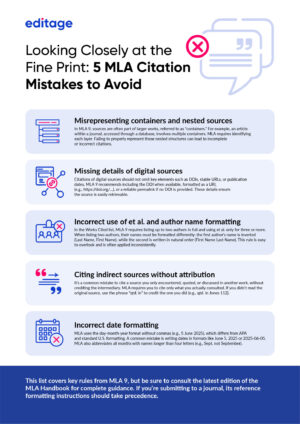
Want to download this infographic for reference later? It’s available here.
Free MLA citation generator
If you find MLA citation formatting intimidating, Paperpal’s free citation generator covers all aspects of MLA citation style. It can be used in Word, Google Docs, Chrome, or Web (or even Overleaf if you’re using LaTex).
What is the Works Cited Page in MLA style?
The Works Cited page is for readers to know all the works and sources you referred during your research. Every in-text citation included in the main manuscript should have a corresponding source listed here. Now, let’s see how the Works Cited page should be written in the MLA format [2].
Basic Rules for the MLA Works Cited Page
- The Works Cited list must begin on a new page at the end of your manuscript. The page should be formatted similar to the rest of the manuscript, i.e., use one-inch margins, running head, and double-line spacing.
- The title Works Cited must be placed at the center of the page at the top. There’s no need to highlight this title in any unique manner, so don’t italicize or underline or write it in boldface.
- Arrange the works in the list alphabetically based on the first item in each entry, which is usually the last name of the author. If your source does not have an author, then arrange it alphabetically with the rest of the works as per the first letter of its title.
- If your work listed spans multiple lines, the second and subsequent lines of the citations must be indented by 0.5 inch to create a hanging indent.
- End all entries with a period.
Sample Works Cited Page
Format and Examples of Works Cited Page Entries
The following table summarizes the MLA format for different types of entries in a Works Cited page along with examples.
Journal article |
|
| Format | Author1’s last name, First name, and Autrho2’s first name, Last name. “Title of Article.” Title of the Journal, vol., issue, year of publication, pp. (if available). DOI or URL. |
| Example | Vasilev, Andre, and Paul Bettany. “The Evolution of Professional Sports in Middle East.” Sports International Journal, vol. 4, no. 5, 2021, pp. 23–28. https://doi.org/10.1189/345674-sij-04523 |
Book |
|
| Format | Author’s last name, First name. Title of Book. Publisher, Publication Date. |
| Example | Smith, Jonas. The Running Damsel. Penguin Book House, 2023 |
Web page |
|
| Format | Author’s last name, First name. “Title of Webpage.” Title of Website, URL. Access date. |
| Example | Slater, Frederick. “Sharks Impacted by Ocean Garbage Dump.” The Deep Blue Sea, https://deepbluesea.com. Accessed on 4 Mar. 2025. |
Video |
|
| Format | Author/Creator. “Title of Video.” Platform. Date, URL. |
| Example | Editage Insights “Peer Reviewer Reveals Top 7 Reasons for Desk Rejection.” YouTube 10 Apr. 2025, https://www.youtube.com/watch?v=kfAH3ZGksc0 |
Newspaper article |
|
| Format | Author’s last name, First name. “Title of the Article.” Name of the Newspaper, Publication Date, p. (if available), URL. |
| Example | Foreman, Nicholas. “Are the Tropics Safe from Climate Crisis?” The Daily Bugle, 13 Dec. 2019, www.dailybugle.com/2019/12/13/tropics-and-climate-change |
Conference paper |
|
| Format | Author’s Last Name, First Name. “Conference Paper Title.” Conference Title that Includes Date and Location, edited by Conference Editor(s). Publisher. Date of Publication. |
| Example | Bevan, Kevin, and Norma Randy. “Rethinking Video Creation in the AI Era.” Digitized Future: What to Expect, 3 Sept. 2024, edited by Paul Norman and Katherine Kidman. 5 Nov. 2024. |
Dissertation |
|
| Format | Author’s Last Name, First Name. Title of Dissertation (Doctoral dissertation). Database name, date of publication, URL (if available). |
| Example | Forsyth, Daniel. Channelizing Positivity in Negative Situations (Doctoral dissertation). ProQuest Dissertations and Theses Global, 30 Jun. 2020. |
General MLA Formatting Style: Key Aspects
When you format essays or academic papers in the MLA format, here are some basic guidelines to follow:
- Use one-inch margins on all four sides of the page.
- The first line in all paragraphs must be indented by half an inch from the left margin.
- Maintain double line spacing throughout the text.
- Any standard font (e.g., Times New Roman and Arial) can be used with a font size of 12 point or 11 point.
- The manuscript title should be centered and written in title case in the MLA Header page.
- Include a running head at the top right corner of all pages, mentioning the author’s surname and page number in Arabic numerals.
- The Works Cited page should contain a list of all references that are cited in the main text.
What are the main differences between MLA 8th and 9th editions?
The table below lists the key differences between the 8th and 9th editions of the MLA style guide:
| Feature | MLA 8th Edition | MLA 9th Edition | Example/Impact |
| Core Citation Principles | Introduced the “universal set of guidelines” for all source types | Retained the same core principles with additional clarification | Citations remain flexible across print, web, and digital media |
| Inclusion of URLs | Recommended including URLs but omitted “http://” or “https://” | Strongly encourages full URLs including protocols when relevant | https://doi.org/… may now appear in Works Cited |
| Author Designation | Used “Author” in examples and templates | Replaced with “Author(s)” for inclusivity and clarity | Better guidance for multiple authors |
| Containers | Introduced the concept of “containers” in citations | Expanded explanation of containers and nested containers | Useful for citing databases, streaming platforms, and apps |
| Pronouns and Inclusive Language | Limited discussion on bias-free language | Greater emphasis on inclusive and respectful language | Recommends gender-neutral wording where possible |
| Works Cited Formatting | Standard formatting rules established | Minor clarifications on formatting consistency | Improved guidance for online and multimedia sources |
| Digital and Online Sources | Covered websites and online media broadly | Added more guidance for social media, apps, and online videos | Better support for citing platforms like YouTube and Twitter/X |
Frequently Asked Questions on MLA Citation Style
1. Do I use page numbers in MLA citation style?
Yes, page numbers are a must in in-text citations as per MLA style. In fields like literature, you’re often referencing lengthy books and without a page number, your reader will simply not know what part of Anna Karenina you’re referring to! That’s why MLA follows the author-page number style of citations, like this:
(Austen 178)
Or like this
Austen (178) makes it clear that Elizabeth Bennet has her own sense of humor.
2. How can I cite multiple works by the same author in MLA style?
When you’re referring to different books, poems, etc., by one author, use the title in your in-text citation, along with the page number. If the work you’re citing is short (like a poem), you’ve to enclose the title in quotation marks. If it’s a full book, the title has to be italicized.
An example to help you out:
Wordsworth’s idealization of marital life is obvious in Chestnuts (75) and to a lesser degree in Ringmere Street (98).
If the title is longer, you can use a shortened version of the title. So, for a short title, you would say
Northanger Abbey (45)
But “The Hound of the Baskervilles” can be shortened further by removing articles (e.g., ‘the’):
Hound of Baskervilles (78)
3. How can I cite a work that doesn’t have page numbers in MLA style?
Obviously, poems and songs are unlikely to have page numbers, and many plays don’t either. And if you’re citing an online-only source, you won’t find page numbers too. In such cases, you’ve to use line numbers, scene numbers, or paragraph numbers. Abbreviate “paragraph” and “scene” as “par.” and “sc.” respectively.
This sense of pathos is renewed toward the end of the poem (Shelfey, lines 26–32).
Zhang argues that such imagery can be misleading (par. 16).
But a word of caution: you might access a work online (like through Project Gutenberg or a similar website) when that work has previously been published in print. In these cases, your citation should contain page numbers as per the print version. You shouldn’t use paragraph numbers or page numbers as per your browser’s print preview function.
4. How can I cite a work with no author in MLA style?
If there’s no identified author, your in-text citation would consist of the title (either abbreviated or in full, depending on its length) and the page number. Your citation would look like
It can be argued that arachnophobia is not a recent phenomenon, as evidenced by 19th century English nursery rhymes (“Little Miss Muffet” line 6).
In “Little Miss Muffet” (line 6), there is a clear mention of fear of spiders.
5. Can I use “et al.” in MLA citation style?
MLA style requires that you list the last names of the authors if the work has one or two authors. If there are 3 or more authors, use the last name of the first author and then “et al.” if in parentheses or “and colleagues” if in the main text.
Greyson and colleagues (72) have exhaustively examined the influence of Pantheism on Wordsworth’s later works.
The influence of Pali literature on Buddhist architecture has been well documented (Anantaraman et al. 65).
6. How do I cite a movie or web series in MLA style?
If you’re citing an audiovisual source like a movie, a video hosted on YouTube or a Netflix series, you use timestamps in the in-text citation.
Example: (Titanic 01:20:45-01:34:10)
7. Is it okay to use online sources when following MLA citation style?
MLA style allows you to refer to a variety of online sources, from online-only journal articles to listservs and tweets (now called just “posts” on X). Follow the guidelines we’ve described above. In an in-text citation, you can use an abbreviated version of the website name, such as “bbc.com” and skip the “www.” or “https://.”
8. Where can I get a free MLA sample paper?
We have a free MLA sample paper for you to download in MS Word here: MLA9_Sample_Paper_Pomeranian_Bakery_Isles
Note that the examples in the sample paper are completely made up.
References
- Modern Language Association (MLA) style guide https://style.mla.org/
- MLA works cited page: Basic format https://owl.purdue.edu/owl/research_and_citation/mla_style/mla_formatting_and_style_guide/mla_works_cited_page_basic_format.html
- MLA Headings and Headers: Formatting Style with Examples: https://www.editage.com/insights/mla-headings-and-headers-formatting-style-with-examples
- Infographic: How to perfectly format MLA citations and references: https://www.editage.com/insights/looking-closely-at-the-fine-print-mla-citation-mistakes-to-avoid
- How to Write a Bibliography in Different Formatting Styles with Examples: https://www.editage.com/insights/how-to-write-a-bibliography-in-apa-mla-and-chicago-style-with-examples
This article was originally published on July 27, 2025, and has been updated on May 21, 2026.