Infographic: How to perfectly format MLA citations and references

Reading time
2 mins
Modern Language Association (MLA) style guide is a staple in the field of humanities, and as researchers start their writing and publishing journeys, they are expected to have a good grasp on this formatting style. But some of its nuanced requirements and rules can trip up even the most experienced researchers. This is not surprising given the nature of this style guide whose strength lies in the details that most of us stop checking after grad school.
In the list below, we focus on five specific citation oversights that can come up in reference formatting, especially while following the MLA 9 framework.
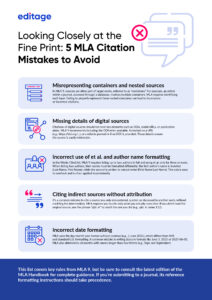
5 Key considerations for MLA citations and references
| Description | |
|---|---|
| Check for containers and nested sources | In MLA 9, sources are often part of larger works, referred to as “containers.” For example, an article within a journal, accessed through a database, involves multiple containers. MLA requires identifying each layer. Failing to properly represent these nested structures can lead to incomplete or incorrect citations. |
| Supply all details of digital sources | Citations of digital sources should not omit key elements such as DOIs, stable URLs, or publication dates. MLA 9 recommends including the DOI when available, formatted as a URL (e.g., https://doi.org/…), or a reliable permalink if no DOI is provided. These details ensure the source is easily retrievable. |
| Verify use of et al. and author name formatting | In the Works Cited list, MLA 9 requires listing up to two authors in full and using et al. only for three or more. When listing two authors, their names must be formatted differently: the first author’s name is inverted (Last Name, First Name), while the second is written in natural order (First Name Last Name). This rule is easy to overlook and is often applied inconsistently. |
| Avoid citing indirect sources without attribution | It’s a common mistake to cite a source you only encountered, quoted, or discussed in another work, without crediting the intermediary. MLA requires you to cite only what you actually consulted. If you didn’t read the original source, use the phrase “qtd. in” to credit the one you did (e.g., qtd. in Jones 112). |
| Crosscheck date formatting | MLA uses the day-month-year format without commas (e.g., 5 June 2025), which differs from APA and standard U.S. formatting. A common mistake is writing dates in formats like June 5, 2025 or 2025-06-05. MLA also abbreviates all months with names longer than four letters (e.g., Sept. not September). |
INSIGHTS_MLA Formatting Mistakes to Avoid.pdf