Infographic: What are research implications? Definition, types, examples


The implications section of your research paper is often where the real impact of your work becomes clear. While your results section tells readers what you found, implications explain why it matters. Many researchers struggle with this section, either overreaching into speculation or staying too close to their data without drawing meaningful connections. In this guide, we’ll explore how to effectively discuss the implications of your study, whether they’re clinical, theoretical, methodological, or practical.
Jump to Contents
- What are Study Implications?
- Key Characteristics of Strong Implications
- Types of Implications You Should Consider
- Distinguishing Implications from Related Concepts
- How to Structure Your Implications Discussion
- Common Pitfalls to Avoid When Discussing Your Implications
- A Framework for Writing Strong Implications
- Examples of How to Discuss Implications from Biomedical Research
- Tailoring Implications for Different Research Types
- Final Checklist for a Strong Implications Section
- How Much Space Should My Implications Section Take?
What are study implications?
Implications are the potential consequences, applications, and broader meanings of your research findings. They represent the “so what?” of your study. They are the answer to why your work matters beyond the immediate research question. Unlike conclusions, which summarize what you found, implications explore what your findings mean for theory, practice, policy, or future research directions.
Implications are typically written in the Discussion section of your research paper.
Key Characteristics of Strong Implications
- Grounded in evidence: Directly supported by your study results
- Realistic and achievable: Not overstating what your findings can accomplish
- Clearly articulated: Explained in language accessible to your intended audience
- Actionable: Pointing toward specific applications or next steps
- Appropriately scoped: Distinguishing between direct and indirect implications
Types of Implications You Should Consider
Theoretical Implications
Theoretical implications address how your findings advance scientific understanding and contribute to existing theories or frameworks.
In biomedical research, theoretical implications might include:
- Refining disease mechanisms or pathophysiology
- Validating or challenging current molecular models
- Supporting new theoretical frameworks in immunology, cell biology, or genetics
- Contributing to understanding of drug mechanisms of action
Example
A study investigating the role of microRNA-221 in breast cancer progression might have theoretical implications such as: “These findings suggest that miR-221 acts as a critical regulator of the HER2 signaling pathway, challenging the current model that positions it primarily as a proliferation driver and indicating a novel role in metastatic progression.”
Clinical and Practical Implications
These implications focus on real-world application in healthcare settings, diagnostic practices, and patient care.
Common areas include:
- New diagnostic or screening approaches
- Modifications to treatment protocols
- Patient selection criteria
- Prognostic value of biomarkers
- Risk stratification strategies
Example
A randomized controlled trial showing superior outcomes with a novel combination chemotherapy in advanced pancreatic cancer has clear clinical implications: “These results support the adoption of FOLFIRINOX plus nanoparticle albumin-bound paclitaxel as first-line therapy for patients with ECOG performance status 0-1, potentially extending median overall survival by 3-4 months compared to current standard approaches.”
Methodological Implications
These address improvements in research methods, measurement approaches, or study design that other researchers should consider.
- Validation of new biomarkers or measurement tools
- Advantages of certain study designs for specific research questions
- Refinement of animal models or in vitro systems
- Improved statistical approaches for analyzing complex data
Policy and Implementation Implications
Implications that extend to healthcare systems, public health, regulatory frameworks, or institutional practices.
Examples include:
- Changes to clinical guidelines or standards of care
- Resource allocation recommendations
- Regulatory approval considerations
- Public health interventions
- Health equity considerations
Distinguishing Implications from Related Concepts
| Element | Focus | Scope | Time Frame |
| Implications | What your findings mean and their potential impact | Can be broad and exploratory | Both immediate and long-term |
| Recommendations | Specific actionable steps based on implications | More concrete and targeted | Usually actionable in near-term |
| Conclusions | Summary of what you found | Limited to study results | Present findings only |
| Limitations | Factors that constrain interpretation | Constraints on scope and generalizability | Affect current study validity |
| Future Research | Questions raised by your findings | New research directions | Future investigations |
Your implications section should address these distinct concepts but shouldn’t overlap significantly with your conclusions or limitations sections. Implications look forward and outward, while conclusions look backward at what you discovered.
How to Structure Your Implications Discussion
Start with Direct Implications
Begin with implications that follow most directly from your specific findings. These should be obvious to readers and require minimal inferential leaps.
Approach:
- State the finding clearly
- Explain what it means in a specific context
- Provide preliminary direction on application
Example:
“Our finding that circulating tumor DNA (ctDNA) burden predicts progression-free survival independently of imaging (hazard ratio 2.3, 95% CI 1.8-3.1) suggests that ctDNA quantification could serve as a non-invasive biomarker for treatment response monitoring in metastatic colorectal cancer.”
Expand to Broader Implications
Once you’ve covered direct implications, carefully extend your interpretation to broader contexts. This is where researchers often struggle with the balance between insight and overreach.
Questions to ask:
- How does this change current understanding in the field?
- What new possibilities does this open?
- How might this influence clinical practice or health policy?
- What about special populations or different clinical contexts?
Address Implications for Different Audiences
Different readers will care about different implications. Consider explicitly addressing implications for:
Clinicians and healthcare providers
- How should clinical practice change based on these findings?
- What about patient selection or timing of interventions?
Researchers and scientists
- What theoretical advances does this represent?
- What new methodologies or approaches does this suggest?
- What fundamental questions does this help answer?
Policy makers and health systems
- What are the resource implications?
- How might this affect healthcare delivery or access?
- Are there equity considerations?
Patients and the public
- What does this mean for disease understanding?
- Are there implications for prevention or management?
Common Pitfalls to Avoid When Discussing Your Implications
1. Overreach and Unfounded Speculation
- Problem: Making leaps that exceed what your data supports
- Example of overreach: “Our in vitro finding that drug X inhibits protein Y suggests it will revolutionize cancer treatment and save thousands of lives annually.”
- Better approach: “Our findings that drug X selectively inhibits protein Y in cell lines warrant further investigation in animal models to assess whether this mechanism translates to efficacy in vivo, which could eventually lead to clinical evaluation.”
2. Underestimating Your Findings
- Problem: Failing to articulate the meaningful implications of solid research
- Example of underreach: After demonstrating a novel mechanism of resistance to immunotherapy, simply stating “further research is needed” without explaining why this matters.
- Better approach: Explicitly connect the mechanism to clinical implications—for example, “Understanding this resistance pathway opens the possibility for combination approaches targeting both PD-1 and [novel target], which could overcome current treatment limitations in 30-40% of non-responding patients.”
3. Losing the Reader in Technical Details
- Problem: Discussing implications in overly technical language inappropriate for your audience
- Solution: Provide context and clarity. “The increased expression of histone deacetylase 6 (HDAC6) correlates with treatment resistance” is less clear than “Cancer cells that survive chemotherapy activate a specific enzyme (HDAC6) that helps them evade drug effects, suggesting that blocking HDAC6 might restore treatment sensitivity.”
4. Ignoring Limitations When Discussing Implications
- Problem: Presenting implications without acknowledging how study limitations constrain them
- Better approach: Integrate limitation acknowledgment into implications: “While our findings in this single-center study suggest biomarker X predicts response, validation in multi-center cohorts with diverse patient populations will be essential before implementation in clinical practice.”
5. Conflating Implications with Future Research
- Problem: Using the implications section primarily to list what future studies should do
- Better approach: First explain what your findings mean, then suggest how future research might test or expand on those implications.
A Framework for Writing Strong Implications
Step 1: List All Potential Implications
Before writing, create a comprehensive list:
- Direct implications from your specific findings
- Theoretical advances or paradigm shifts
- Clinical or practical applications
- Methodological contributions
- Questions or gaps your findings raise
Step 2: Evaluate Each Implication
| Implication | Strength of Support | Audience Relevance | Actionability | Include? |
| Biomarker could predict treatment response | Very strong – directly demonstrated | High – clinicians and patients | High – testable in prospective study | Yes |
| May explain disease mechanism | Moderate – supported but not directly tested | High – researchers | Moderate – could guide mechanistic studies | Yes |
| Could revolutionize patient screening | Weak – premature with current evidence | High if true, but overstated | Low – requires validation | No |
| Suggests need for longitudinal studies | Strong – clear gap identified | Moderate – primarily for researchers | High – specific recommendation | Yes |
Step 3: Organize by Hierarchy
Lead with strongest implications:
- Implications most directly supported by your data
- Implications with highest relevance to your field
- Implications requiring more evidence or future work
Example structure:
- Clinical implications (if applicable)
- Theoretical implications
- Methodological implications
- Policy or implementation implications
- Implications for future research
Step 4: Write with Appropriate Confidence Language
Use language that reflects the certainty of your implications:
- Higher certainty (directly supported): “These findings demonstrate…”, “This establishes…”, “This validates…”
- Moderate certainty (reasonably inferred): “These results suggest…”, “This indicates…”, “This implies…”, “This supports the possibility that…”
- Lower certainty (speculative but worth considering): “These findings raise the possibility that…”, “This could lead to…”, “Future work might explore whether…”
- Highly speculative (avoid unless exceptional): “If validated, this could potentially…”, “These findings provide a foundation for investigating whether…”
Examples of How to Discuss Implications from Biomedical Research
Example 1: Infectious Disease
Study finding:
A randomized trial shows that early diagnostic testing for respiratory pathogen co-infections improves antibiotic stewardship and reduces hospital-acquired infections.
Strong implications discussion:
“These findings have immediate clinical implications for sepsis management. By enabling rapid identification of viral-bacterial co-infections, this diagnostic approach supports targeted antimicrobial therapy, reducing unnecessary antibiotic exposure by an estimated 30-40%. This is particularly relevant given rising antimicrobial resistance, and suggests that implementing this diagnostic protocol in emergency departments could reduce hospital-acquired secondary infections while maintaining therapeutic efficacy. Theoretically, these results support the emerging paradigm that treating respiratory infections requires characterizing the entire microbial ecosystem rather than targeting single pathogens. For healthcare systems, widespread adoption would require new diagnostic infrastructure and training, warranting cost-effectiveness analyses in diverse clinical settings.”
Example 2: Oncology
Study finding:
A retrospective analysis identifies a combination of three genetic mutations that predict response to checkpoint inhibitors in a cohort of 200 patients with advanced melanoma.
Appropriately scoped implications discussion:
“While our findings suggest this genetic signature may predict immunotherapy response, several implications warrant discussion. First, validation in an independent prospective cohort is essential before clinical implementation. Second, the mechanism by which these mutations enhance immunogenicity remains unclear and represents an important research direction. Third, if validated, this signature could enable patient stratification to identify those most likely to benefit from checkpoint inhibitors, potentially improving response rates and reducing toxicity exposure in non-responders. However, our single-institution design and limited racial/ethnic diversity highlight the need for multi-center validation across diverse populations, as genetic and immune landscapes vary substantially. These results provide a foundation for developing a predictive assay, but clinical utility depends on prospective validation and demonstration of health economic benefit.”
Tailoring Implications for Different Research Types
Laboratory/Preclinical Research
Focus on:
- Theoretical understanding of mechanisms
- Implications for translational research paths
- Model system validation
- Future clinical research directions
Example:
“This finding that [compound] selectively targets [mechanism] in primary patient-derived cells suggests a promising avenue for therapeutic development and warrants pharmacokinetic and efficacy studies in appropriate in vivo models.”
Clinical Trials
Focus on:
- Practice-changing potential
- Patient population specificity
- Implementation considerations
- Health economic implications
Epidemiological Studies
Focus on:
- Public health significance
- Prevention strategy implications
- Health policy relevance
- Population-level impact
Final Checklist for a Strong Implications Section
Before finalizing your implications section, verify that you:
- ✓ Have separated implications from conclusions, limitations, and future research sections
- ✓ Have grounded all implications in your actual findings
- ✓ Have avoided unwarranted speculation
- ✓ Have considered multiple types of implications (theoretical, clinical, methodological, policy)
- ✓ Have used appropriate confidence language reflecting your evidence strength
- ✓ Have addressed how limitations affect implications
- ✓ Have considered diverse audiences where relevant
- ✓ Have been specific about what changes or what becomes possible
- ✓ Have explained the significance of implied changes
- ✓ Have organized implications logically from strongest to more tentative
Frequently Asked Questions
Are implications and recommendations the same thing and should they be in the same section?
While related, implications and recommendations are distinct concepts that are sometimes best separated:
- Implications answer: “What do these findings mean?” They explore the potential significance, consequences, and broader meanings of your results.
- Recommendations answer: “What should be done about this?” They provide specific, actionable steps based on your implications.
Example distinction from cancer research:
Implication: “Our finding that patients with high tumor mutational burden (TMB) show superior survival with checkpoint inhibitors suggests that TMB could serve as a predictive biomarker for immunotherapy response.”
Recommendation: “We recommend that TMB testing be incorporated into routine molecular profiling for advanced non-small cell lung cancer to guide treatment selection, with prospective validation in multi-center studies.”
You need to consult your target journal’s guidelines and recently published papers to determine whether you should combine implications and recommendations into the same paragraph/section or keep them separate. Some journals prefer a dedicated “Clinical Implications” or “Recommendations” subsection to make this distinction crystal clear.
How Much Space Should My Implications Section Take?
There’s no universal rule, but consider these guidelines:
General proportion: Implications typically occupy 15-25% of your entire discussion section (not separate from discussion but usually integrated within it or as the discussion conclusion).
By research type:
| Research Type | Typical Implications Length | Why |
| Laboratory/Preclinical | 1-2 paragraphs | More limited clinical applicability; focus on mechanism and future directions |
| Observational/Epidemiological | 2-3 paragraphs | Can address population-level and policy implications |
| Clinical Trial | 3-5 paragraphs | Must address clinical practice, patient population specificity, implementation |
| Systematic Review/Meta-analysis | 2-4 paragraphs | Synthesizes across studies; implications are central to value |
Quality over quantity: A single strong paragraph that clearly articulates why your findings matter is better than three paragraphs of vague speculation.
Benchmark: In high-impact journals like Lancet, JAMA, and Nature Medicine, implications are often woven throughout the discussion rather than isolated at the end. Read recent papers in your target journal to see how they handle implications.
If your entire implications section is only 2-3 sentences, you’re likely underexploring the significance of your work. If it’s longer than your results summary, you may be speculating too much.
My Results Are Negative or Unexpected, so How Do I Discuss Implications?
Negative and unexpected results often have profound implications. This is where careful discussion is crucial.
For negative results (hypothesis not supported):
Your implications should address:
- Theoretical implications: What does this tell us about existing theories or assumptions? What mechanisms did we rule out?
- Methodological implications: Did we ask the right question the right way? Should future studies modify the approach?
- Clinical implications: Does this help us rule out ineffective treatments, saving patients from unnecessary exposure?
Example from antibiotic resistance research:
“Contrary to our hypothesis, rifampicin failed to enhance vancomycin activity against methicillin-resistant Staphylococcus aureus in our in vitro model. This negative result has important implications: it challenges the widely-held assumption that this combination would be synergistic and suggests that alternative mechanisms of resistance may predominate. Clinically, this finding argues against empirical use of this combination and supports focusing on mechanisms that our preliminary data suggest may be more promising.”
For unexpected results (found something you didn’t anticipate):
Implications may be especially interesting:
- You discovered an unintended finding of potential significance
- You identified a novel mechanism or pathway
- You found benefits or harms not previously recognized
Example from cardiac research:
“Unexpectedly, the SGLT2 inhibitor not only improved glycemic control but also reduced heart failure hospitalization in non-diabetic patients—a finding not anticipated when the trial was designed. This unexpected result has major therapeutic implications, suggesting that SGLT2 inhibitors may have cardioprotective mechanisms independent of glucose lowering. If validated in dedicated trials, this could expand the therapeutic indication for this drug class to heart failure patients regardless of diabetes status.”
Key principle: Negative and unexpected results deserve thoughtful implications discussion. Don’t dismiss them as “failed studies.”
How Do I Know When I’m Being Too Speculative with Implications?
Use this framework to gauge appropriate speculation:
Tier 1: Direct implications (strong evidence)
- Directly supported by your data
- Require minimal inferential steps
- Use confident language: “demonstrates,” “establishes,” “validates”
- Always include in implications
- Example: “Our RCT demonstrates that drug X improves outcomes compared to placebo in patient population Y”
Tier 2: Reasoned implications (moderate evidence)
- Supported by your findings and existing literature
- Require moderate inferential steps
- Use cautious language: “suggests,” “implies,” “indicates”
- Include, but acknowledge uncertainty
- Example: “These findings suggest that targeting pathway Z could overcome treatment resistance, warranting mechanistic studies in models of therapy-resistant disease”
Tier 3: Exploratory implications (emerging ideas)
- Suggested by your findings but require substantial future work
- Speculative but scientifically reasonable
- Use tentative language: “could,” “might,” “raises the possibility”
- Include selectively; be clear about limitation stage
- Example: “While speculative, these results raise the possibility that this mechanism could eventually inform combination therapy approaches in future clinical development”
Tier 4: Unfounded speculation (avoid)
- Leaps beyond what current evidence supports
- Use language like: “will revolutionize,” “could cure”
- Example (to avoid): “Our mouse model studies suggest this could be a cure for human cancer” (without any clinical data)
Red flags indicating overreach:
- You use words like “will,” “should definitely,” or “revolutionize”
- You make claims about clinical populations when you studied only laboratory systems
- You discuss implications for groups (e.g., pediatric patients) not studied in your research
- Reviewers consistently push back on your implications claims
- You can’t explain in one sentence why each implication follows from your results
Self-check: For each implication, ask “If a skeptical colleague asked ‘Why?’, could I point to a specific result or established principle that supports this?” If not, it may be too speculative.
Can I Discuss Implications for Populations or Settings Different from My Study?
Yes, but with important caveats. Use this approach:
Direct implications (same population):
- Present confidently based on your actual data
- “Our findings in adult patients with stage III melanoma…”
Extended implications (different but related populations):
- Acknowledge the extension
- Explain why it’s reasonable
- Propose how it should be tested
Example with appropriate caveats:
“While our study enrolled only patients aged 18-65 at academic centers, these findings may have implications for older adults, where comorbidities and polypharmacy could affect tolerability. However, our results cannot be directly applied to this population without prospective evaluation, given potential differences in pharmacokinetics and comorbidity burden. Similarly, implementation in resource-limited settings would require assessment of feasibility, cost, and accessibility, which are beyond the scope of this study but warrant investigation.”
Better approach than claiming broad applicability:
- Acknowledge specific populations you studied
- Explain where findings likely generalize and where they don’t
- Recommend specific studies to test applicability in other groups
- Discuss equity implications when relevant
Avoid: “Our findings in this single-center, predominantly White population likely apply to all patients globally” (overgeneralization without evidence)
Better: “Our findings in this specific patient population suggest a promising approach. Validation in diverse racial/ethnic groups, older patients, and resource-limited settings would be essential to establish generalizability and inform implementation across healthcare systems.”
References
- Szabo Z, et al. Hyaluronic acid-induced signaling pathways during chondrogenic differentiation of human mesenchymal stem cells. Int J Mol Sci. 2020;21(9):3275. doi:10.3390/ijms21093275. PMID: 32366978.
- Ganesh K, et al. Immunotherapy in colorectal cancer: rationale, challenges and potential. Nat Rev Gastroenterol Hepatol. 2021;18(8):561-576. doi:10.1038/s41575-021-00469-7. PMID: 34262204.
- Weber JS, et al. Nivolumab versus chemotherapy in patients with advanced melanoma who progressed after anti-CTLA-4 treatment (CheckMate 037): a randomised, controlled, open-label, phase 3 trial. Lancet Oncol. 2015;16(4):375-384. doi:10.1016/S1470-2045(15)70076-8. PMID: 25795410.
- Cohen JF, et al. STARD 2015 guidelines for reporting diagnostic accuracy studies. BMJ. 2015;351:h5527. doi:10.1136/bmj.h5527. PMID: 26511519.
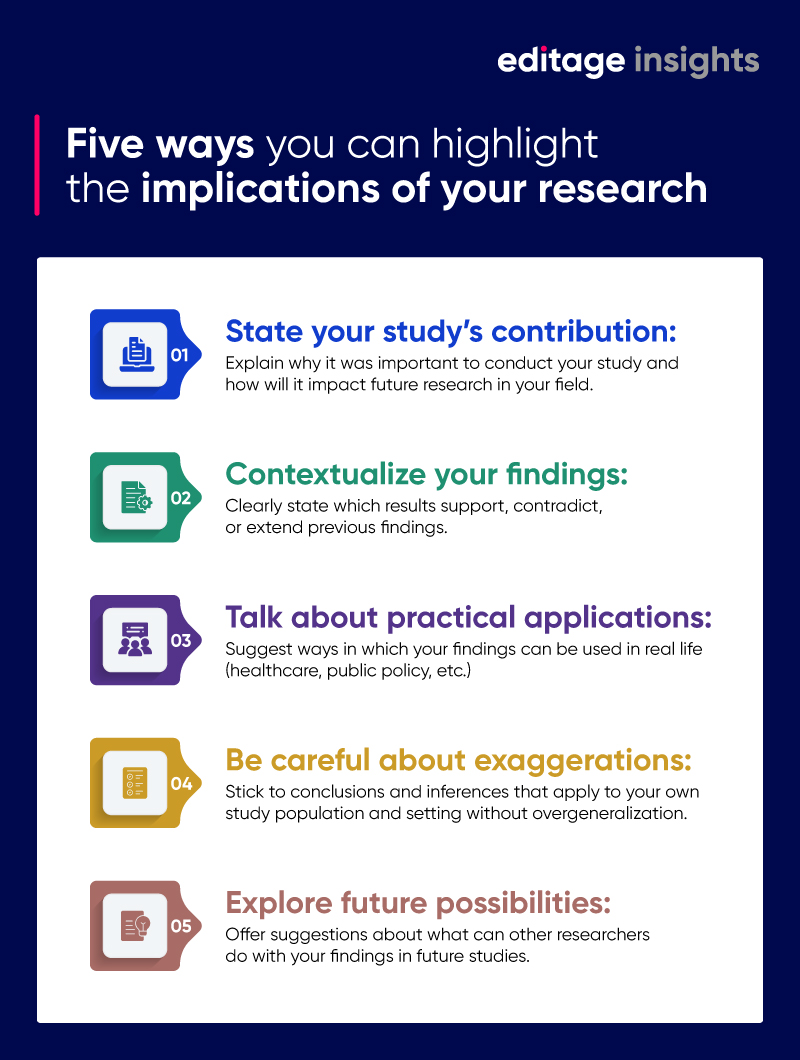
How to report the implications of your study
| Action Step | Description |
| State your study’s contribution | Explain why the study was important and its potential impact on future research in the field. |
| Contextualize your findings | Clearly identify which results support, contradict, or extend existing literature. |
| Talk about practical applications | Suggest real-world uses for the findings, such as in healthcare or public policy. |
| Be careful about exaggerations | Stick to inferences specific to your study population and avoid overgeneralizing. |
| Explore future possibilities | Provide suggestions for what other researchers can do with the findings in future studies. |
This article was originally published on March 3, 2023, and updated on May 25, 2026.
5 Ways you can highlight the implications of your research_0.jpg