Infographic: Choosing Your Research Design: Qualitative, Quantitative, and Mixed Methods


Contents
- What Is Research Design?
- What Does Research Design Include? The Core Elements
- Key Characteristics of a Good Research Design
- Three Main Approaches to Research Design: Quantitative, Qualitative, and Mixed Methods
- Qualitative Research Design
- Quantitative Research Design
- Mixed Methods Research Design
- Qualitative vs. Quantitative vs. Mixed Methods: A Side-by-Side Comparison
- Choosing Your Research Design: Step by Step
- How to Choose the Right Research Design: A Decision Framework
- Common Mistakes to Avoid in Research Design
- Frequently Asked Questions About Research Design
- Summary & Infographic: Choosing the Right Research Design
What Is Research Design?
Every piece of research begins with a plan. Before you collect a single data point, interview a single participant, or run a single statistical test, you need a blueprint that tells you how the entire study will unfold. That blueprint is your research design.
Research design is the overall framework of methods and techniques a researcher chooses to conduct a study. It determines how data will be collected, measured, and analyzed. And it also shapes whether your findings will be valid, reliable, and meaningful. Choosing the wrong design is one of the most common reasons research fails to answer its own questions. Choosing the right one sets the entire study up for success.
This guide covers everything you need to know: what research design is, its core elements and characteristics, the main types (qualitative, quantitative, and mixed methods), how to distinguish between them, and how to decide which approach fits your study.
What Does Research Design Include? The Core Elements
A research design is not just a methodology label. It is a detailed plan that addresses several interconnected decisions:
- Research purpose and questions: What exactly is the study trying to find out? The research questions or hypotheses must be clearly defined before anything else.
- Sampling: Who or what will be studied? This includes decisions about the target population, sample size, and the method used to select participants (random sampling, stratified sampling, convenience sampling, etc.).
- Data collection: What information will be gathered, how will it be gathered, and with what tools? This covers instruments such as surveys, interview guides, observation protocols, or experimental equipment.
- Data analysis: What statistical or analytical techniques will be applied? This decision depends on the type of data collected and the nature of the research questions.
- Type of methodology: Is the study qualitative, quantitative, or mixed? This overarching methodological choice flows from the research purpose.
- Time frame: How long will the study run? Will data be collected at a single point in time or across multiple points?
- Ethical considerations: How will informed consent be obtained? How will participant confidentiality be protected? What are the relevant ethical guidelines?
- Resources: What budget, personnel, equipment, and access to data sources does the study require?
All of these elements must be planned and aligned with each other. A mismatch, for example, choosing a data analysis method that does not suit the type of data collected, can invalidate an otherwise well-executed study.
Key Characteristics of a Good Research Design
Regardless of the type of design chosen, high-quality research design shares several fundamental characteristics:
| Characteristic | What It Means |
| Neutrality | The design minimizes bias. The researcher’s beliefs or expectations do not color the findings. |
| Reliability | The study produces consistent results across repeated measurements, with minimal random error. |
| Validity | The design measures what it claims to measure, minimizing systematic error. |
| Generalizability | Findings apply beyond the immediate sample to a larger population. |
| Flexibility | The design can accommodate reasonable changes as new data emerges during the study. |
These characteristics are not in competition with each other. A rigorous design pursues all five simultaneously, though trade-offs do exist — particularly between the depth of exploration (often stronger in qualitative work) and the breadth of generalizability (often stronger in quantitative work).
Three Main Approaches to Research Design: Quantitative, Qualitative, and Mixed Methods
Research methodology broadly divides into three approaches: qualitative, quantitative, and mixed methods. The choice between them depends on the nature of your research question.
| Qualitative | Quantitative | Mixed Methods | |
| Primary purpose | Explore, understand, interpret | Measure, test, predict | Both: explain and quantify |
| Type of data | Words, images, observations | Numbers, statistics | Both |
| Reasoning | Inductive (from data to theory) | Deductive (from theory to data) | Both |
| Sample size | Typically small | Typically large | Varies |
| Generalizability | Limited | Broader | Moderate to broad |
| Typical fields | Sociology, anthropology, linguistics | Economics, medicine, ecology | Health sciences, education, social policy |
Qualitative Research Design
What Is Qualitative Research?
Qualitative research is an exploratory approach designed to understand human experience, meaning, and context. It does not seek to produce numerical measurements or statistical generalizations. Instead, it produces rich, detailed accounts of phenomena that are difficult to quantify: attitudes, perceptions, cultural practices, lived experiences, and social processes.
Data in qualitative research is typically gathered through:
- In-depth interviews with open-ended questions
- Focus group discussions
- Direct observation of people in their natural environments
- Analysis of documents, texts, or other naturally occurring materials
The analysis is interpretive rather than statistical. Researchers look for patterns, themes, and meanings in the data rather than calculating frequencies or testing hypotheses. The reasoning moves inductively, from specific observations toward broader theoretical insights.
When to Use Qualitative Research
Choose qualitative research when:
- The research question is exploratory (“Why do patients avoid seeking mental health care?”)
- Little existing theory or prior research exists on the topic
- The goal is to understand context, process, or meaning rather than to measure outcomes
- The phenomenon being studied is complex and context-dependent
- Numerical data alone cannot capture what matters
Types of Qualitative Research Design
Grounded Theory
- Also called exploratory design
- Used to develop new theoretical frameworks from data, particularly for understudied topics
- Data is collected iteratively (often through interviews), coded, and analyzed to identify patterns that form the basis of a new theory
- Example: Studying how first-generation college students construct their sense of academic identity, where no established theory yet exists
Thematic Analysis
- Used to identify, analyze, and interpret recurring themes across qualitative data sets
- Particularly useful for comparing findings across multiple sources or participants
- Example: Reviewing transcripts of therapy sessions to identify common themes in how patients describe their recovery from addiction
Discourse Analysis
- Examines language in social and cultural contexts
- Focuses on how language constructs social reality, power relationships, and ideological frameworks
- Example: Analyzing a series of government health policy documents to identify the ideological assumptions embedded in how “healthy behavior” is defined
Ethnography
- Involves immersive, long-term observation of a group or community in its natural setting
- Produces highly contextualized accounts of cultural practices and social dynamics
- Example: Spending six months embedded with a hospital emergency team to understand informal communication norms
Phenomenology
- Focuses on the lived experience of individuals around a specific phenomenon
- Seeks to describe the essence of the experience as participants themselves understand it
- Example: Interviewing survivors of a natural disaster about their subjective experience of the event and its aftermath
Strengths and Limitations of Qualitative Research
Strengths:
- Produces deep, contextually rich understanding
- Flexible and responsive to unexpected findings
- Suitable for sensitive or complex phenomena
- Generates hypotheses and theory where none previously existed
Limitations:
- Findings are not statistically generalizable
- More susceptible to researcher bias in interpretation
- Time-intensive data collection and analysis
- Difficult to replicate
Quantitative Research Design
What Is Quantitative Research?
Quantitative research is an empirical approach that uses numerical data and statistical methods to test hypotheses, establish relationships between variables, and produce findings that can be generalized to broader populations. It is objective and structured, with clearly defined variables measured in standardized ways.
Data collection in quantitative research typically involves:
- Surveys and questionnaires with closed-ended, scaled, or numerical response options
- Controlled experiments
- Structured observations recorded in numerical form
- Analysis of existing numerical datasets (administrative records, registries, databases)
The reasoning is deductive: researchers begin with a theory or hypothesis, collect data to test it, and use statistical analysis to draw conclusions. Results are presented numerically as frequencies, percentages, means, correlations, regression coefficients, or effect sizes.
When to Use Quantitative Research
Choose quantitative research when:
- The research question involves measuring variables or testing relationships (“Does intervention X reduce symptom Y?”)
- Established theory or prior research provides a testable hypothesis
- A large, representative sample is accessible
- The goal is to generalize findings to a broader population
- Statistical precision matters
Types of Quantitative Research
Descriptive Research Design
- Describes the characteristics, frequencies, or distribution of variables without manipulating them
- Answers the questions “what,” “when,” “where,” and “how” but not “why”
- Does not typically begin with a hypothesis
- Example: A survey documenting the prevalence of vitamin D deficiency among adults over 50 in urban India
Correlational Research Design
- Examines the relationship between two or more variables without manipulating them
- Determines whether a relationship exists, its direction (positive or negative), and its strength
- Does not establish causation
- Example: Investigating whether there is a relationship between hours of sleep per night and academic performance among undergraduate students
Experimental Research Design
- The gold standard for establishing cause-and-effect relationships
- Involves random assignment of participants to experimental and control groups
- The researcher deliberately manipulates an independent variable and measures its effect on a dependent variable
- Randomized Controlled Trials (RCTs) are the most rigorous form
- Example: Testing whether a new antibiotic reduces recovery time from a specific infection compared to the standard treatment
Quasi-Experimental Research Design
- Similar to experimental design, but without random assignment
- Used when random assignment is not ethical or practical
- Compares groups that are similar but not randomly assigned
- Example: Comparing exam scores before and after a new teaching method is introduced in a school, where random assignment to classrooms is not feasible
Diagnostic Research Design
- Identifies factors that contribute to specific conditions or problems
- Commonly used in clinical and epidemiological research
- Example: Identifying risk factors that predict the development of Type 2 diabetes in a cohort study
Explanatory (Causal) Research Design
- Moves beyond describing or correlating to explaining why something happens
- Tests causal theories against empirical evidence
- Example: Testing whether socioeconomic status causally influences dietary choices, controlling for other variables
Longitudinal Research Design
- Collects data from the same subjects at multiple points over time
- Tracks change, development, or trends
- Can be prospective (following subjects forward in time) or retrospective (looking back at historical data)
- Example: Following a cohort of children from birth to age 18 to study the long-term effects of early childhood nutrition
Cross-Sectional Research Design
- Collects data from subjects at a single point in time
- Provides a snapshot of a population
- Efficient and relatively inexpensive, but cannot establish causation or track change
- Example: A one-time national survey measuring the current rates of physical activity across age groups
Strengths and Limitations of Quantitative Research
Strengths:
- Produces statistically generalizable findings
- Allows testing of specific hypotheses
- Replicable and objective
- Can handle large datasets efficiently
Limitations:
- Does not capture context, meaning, or nuance
- Assumes that what can be measured numerically is what matters
- Structured instruments may not capture the full complexity of human experience
- Large sample requirements can be costly
Mixed Methods Research Design
What Is Mixed Methods Research?
Mixed methods research integrates both qualitative and quantitative approaches within a single study or series of studies. Rather than treating the two paradigms as mutually exclusive, mixed methods research uses each to compensate for the other’s limitations and to produce a more complete picture of the research problem.
Mixed methods is not simply doing a qualitative study and a quantitative study side by side. It involves deliberate integration of the two strands: combining the data, comparing the results, or using one to build on the other.
When to Use Mixed Methods Research
Choose mixed methods when:
- The research question requires both breadth and depth
- Quantitative findings need qualitative explanation (“The intervention worked, but why?”)
- Qualitative findings need quantitative validation (“This theme emerged in interviews, but how widespread is it?”)
- The phenomenon is too complex to be captured by one approach alone
- You want to triangulate findings across data types for greater confidence
Common Mixed Methods Designs
Convergent (Triangulation) Design
- Quantitative and qualitative data are collected simultaneously and independently
- Findings are compared to look for convergence (agreement) or divergence (contradiction)
- Contradictions prompt deeper investigation
- Example: Surveying patients about satisfaction (quantitative) and interviewing them about their experience (qualitative), then comparing results
Explanatory Sequential Design
- Quantitative data is collected and analyzed first
- Qualitative data is then collected to explain or elaborate on surprising or unclear quantitative findings
- Example: A survey reveals that a training program improved productivity, but not uniformly. Follow-up interviews explore why some departments benefited more than others.
Exploratory Sequential Design
- Qualitative data is collected first to explore the phenomenon
- Findings inform the design of a quantitative instrument (e.g., a survey)
- The survey is then administered to a larger sample
- Example: Focus groups with patients explore their barriers to medication adherence; findings are used to develop a validated survey administered to a national sample
Strengths and Limitations of Mixed Methods Research
Strengths:
- Provides a more complete and nuanced understanding
- Allows triangulation, increasing confidence in findings
- Flexible in addressing complex research questions
- Can overcome the limitations of either approach alone
Limitations:
- Resource-intensive: requires expertise in both qualitative and quantitative methods
- More time-consuming than single-method studies
- Integration of the two strands can be methodologically challenging
- Potential for conflicting findings that are difficult to reconcile
Qualitative vs. Quantitative vs. Mixed Methods: A Side-by-Side Comparison
| Feature | Qualitative | Quantitative | Mixed Methods |
| Research question type | Exploratory (“How?” “Why?”) | Confirmatory (“How much?” “Does X cause Y?”) | Both |
| Data type | Non-numerical (text, images, observations) | Numerical | Both |
| Sample size | Small (depth over breadth) | Large (breadth over depth) | Varies |
| Data collection tools | Interviews, focus groups, observation | Surveys, experiments, structured observation | Combination |
| Analysis approach | Thematic, interpretive | Statistical | Both, integrated |
| Reasoning | Inductive | Deductive | Both |
| Output | Theories, themes, narratives | Statistics, predictions, generalizations | Comprehensive understanding |
| Generalizability | Limited | High | Moderate to high |
| Flexibility | High | Low | Moderate |
| Bias risks | Researcher interpretation bias | Measurement and sampling bias | Both |
| Typical example | Ethnographic study of a community | RCT testing a drug’s efficacy | Survey + interviews exploring health behavior |
Choosing Your Research Design: Step by Step
Regardless of which broad approach you choose, the process of developing a research design follows a similar sequence:
- Define your aims and research questions. What problem are you investigating? What do you need to know to address it? State your objectives clearly.
- Choose the appropriate methodology. Based on the nature of your questions, decide whether a qualitative, quantitative, or mixed methods approach is most suitable.
- Select a specific research design type. Within the broad methodology, identify the design that fits your context: experimental, correlational, grounded theory, ethnographic, etc.
- Identify your population and sampling method. Who will participate? How will you recruit them? How large must the sample be to produce meaningful findings?
- Choose data collection methods and instruments. Will you use surveys, interviews, observations, secondary data? Develop or adapt the tools needed.
- Plan your data analysis. Decide in advance how the data will be analyzed. For quantitative data, identify the statistical tests. For qualitative data, specify the analytical framework.
- Address ethical requirements. Identify what ethical approvals, consent procedures, and confidentiality protections are needed.
- Pilot and refine. Where possible, pilot your instruments with a small group before the main data collection to identify and correct problems.
How to Choose the Right Research Design: A Decision Framework
Use the following questions to narrow down your choice:
Step 1: What is the nature of your research question?
- If it asks “what is happening?” or “what do people think/feel?” → lean qualitative
- If it asks “how much?” “how often?” or “does X cause Y?” → lean quantitative
- If it asks both → consider mixed methods
Step 2: What does the existing literature tell you?
- If the topic is poorly understood with little existing theory → qualitative (exploratory)
- If there is a well-developed theory and testable hypotheses → quantitative (confirmatory)
- If some groundwork exists but key questions remain unanswered → mixed methods
Step 3: What do you need to do with the findings?
- If findings need to be generalized to a broad population → quantitative
- If findings need to capture nuance and context → qualitative
- If both are required → mixed methods
Step 4: What are your practical constraints?
- Time, budget, sample access, and methodological expertise all constrain design choices
- Be realistic: an underpowered quantitative study or a poorly analyzed qualitative one serves no one
Step 5: Consider the trade-offs and select accordingly.
| If you need… | Choose… |
| Deep understanding of a new or poorly studied topic | Qualitative (grounded theory or ethnography) |
| Causal evidence about the effect of an intervention | Quantitative (experimental or quasi-experimental) |
| A statistical snapshot of a population | Quantitative (descriptive, cross-sectional) |
| Trends over time | Quantitative (longitudinal) |
| To understand relationships without establishing cause | Quantitative (correlational) |
| To explain unexpected quantitative findings | Mixed methods (explanatory sequential) |
| To build a survey instrument from exploratory research | Mixed methods (exploratory sequential) |
| Both depth and statistical confidence | Mixed methods (convergent/triangulation) |
Common Mistakes to Avoid in Research Design
- Choosing the method before defining the question. The research question must drive the design, not the other way around.
- Confusing correlation with causation. A correlational design cannot establish that one variable causes another, even if a strong relationship exists.
- Ignoring sample size requirements. Quantitative studies are particularly vulnerable to being underpowered; always calculate the required sample size in advance.
- Treating mixed methods as a fallback. Mixed methods is not a hedge against methodological uncertainty. It should be chosen because the research question genuinely requires both types of data.
- Neglecting validity threats. Every design has specific threats to internal and external validity. Identifying them in advance allows you to address them systematically.
- Underestimating the time and skill required for qualitative analysis. Rigorous qualitative analysis is demanding and cannot be rushed without compromising the quality of findings.
Frequently Asked Questions About Research Design
What is the difference between research design and research methodology?
Research methodology refers to the broad philosophical and theoretical framework: the “why” behind the approach. Research design is the practical implementation plan: the “how.” Methodology informs design, but design is more specific and operational.
Can a study use more than one research design type?
Yes. Particularly in mixed methods research, a study might combine a cross-sectional survey with in-depth interviews, or use a longitudinal design alongside qualitative case studies. What matters is that the choice of designs is justified by the research questions.
Is qualitative research less rigorous than quantitative research?
No. Qualitative research has its own standards of rigor (credibility, transferability, dependability, and confirmability) that are distinct from but equivalent to the validity and reliability criteria used in quantitative research. The appropriateness of a design for its research questions determines rigor, not the presence or absence of statistical analysis.
How do I know if my research design is valid?
A design is valid when it measures what it claims to measure (internal validity) and when its findings can be applied beyond the immediate study context (external validity). Threats to validity should be identified during the design phase and addressed through methodological choices such as randomization, blinding, triangulation, or reflexivity.
What is the role of a theoretical framework in research design?
A theoretical framework provides the conceptual foundation for the study. It guides which variables are studied, how they are conceptualized, and how findings will be interpreted. In quantitative research, theoretical frameworks often generate specific testable hypotheses. In qualitative research, they shape the interpretive lens applied to the data.
Summary & Infographic: Choosing the Right Research Design
Research design is not a bureaucratic formality. It is the architecture of your study, and a poorly designed study cannot produce trustworthy findings, no matter how carefully the data is collected.
The choice between qualitative, quantitative, and mixed methods is not about personal preference or convention. It is a methodological decision that must be driven by your research questions, your existing knowledge base, the population you are studying, and the use to which your findings will be put.
- Use qualitative methods when you need to understand experiences, meanings, and processes.
- Use quantitative methods when you need to measure, test hypotheses, or generalize findings statistically.
- Use mixed methods when a single approach cannot capture the full complexity of your research problem.
Whatever design you choose, build it carefully, justify it explicitly, and execute it rigorously. Good research design is what transforms a research question into reliable knowledge.
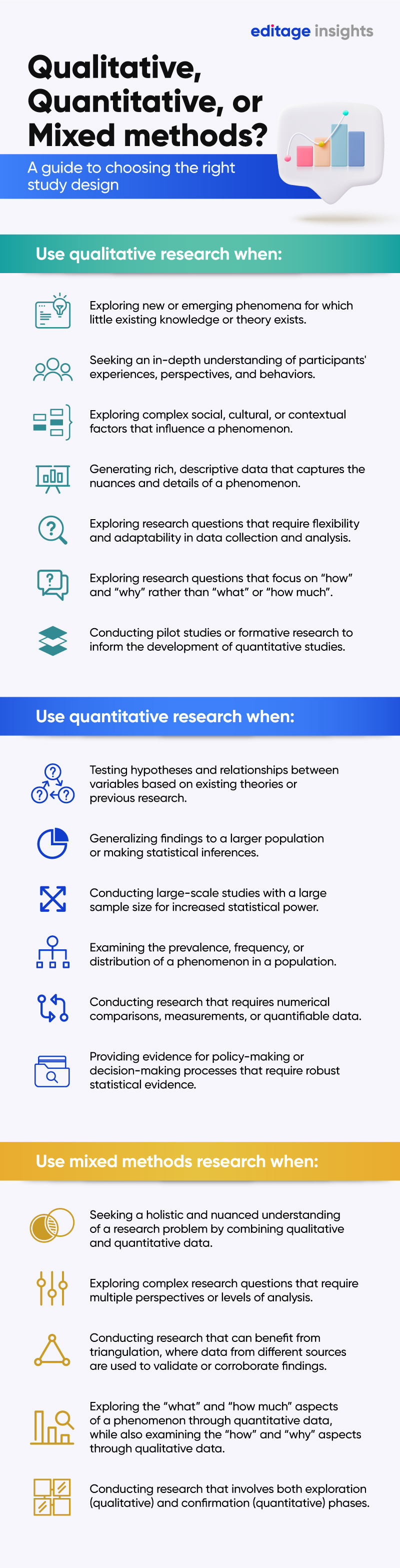
Infographic text: How to choose between qualitative, quantitative, and mixed methods?
| Research Method | Use This Method When: |
| Qualitative Research |
* Exploring new or emerging phenomena with little existing knowledge.
* Seeking in-depth understanding of participants’ experiences and behaviors.
* Exploring complex social, cultural, or contextual factors.
* Generating rich, descriptive data that captures nuances and details.
* Requiring flexibility and adaptability in data collection/analysis.
* Focusing on “how” and “why” rather than “what” or “how much.”
* Conducting pilot studies to inform future quantitative research. |
| Quantitative Research |
* Testing hypotheses and relationships between variables based on theory.
* Generalizing findings to a larger population or making statistical inferences.
* Conducting large-scale studies with large sample sizes for statistical power.
* Examining the prevalence, frequency, or distribution of a phenomenon.
* Requiring numerical comparisons, measurements, or quantifiable data.
* Providing robust statistical evidence for policy-making or decisions. |
| Mixed Methods Research |
* Seeking a holistic and nuanced understanding by combining both data types.
* Exploring complex questions requiring multiple perspectives or levels of analysis.
* Benefiting from triangulation to validate or corroborate findings.
* Examining “what” and “how much” (quant) alongside “how” and “why” (qual).
* Involving both exploration (qualitative) and confirmation (quantitative) phases. |
This article was originally published on June 9, 2023, and revised on May 31, 2026.
ChoosingRightStudyDesign_0 scaled.jpg