Infographic: The secret to using tenses in scientific writing
INFOGRAPHICS and DOWNLOADABLES Popular


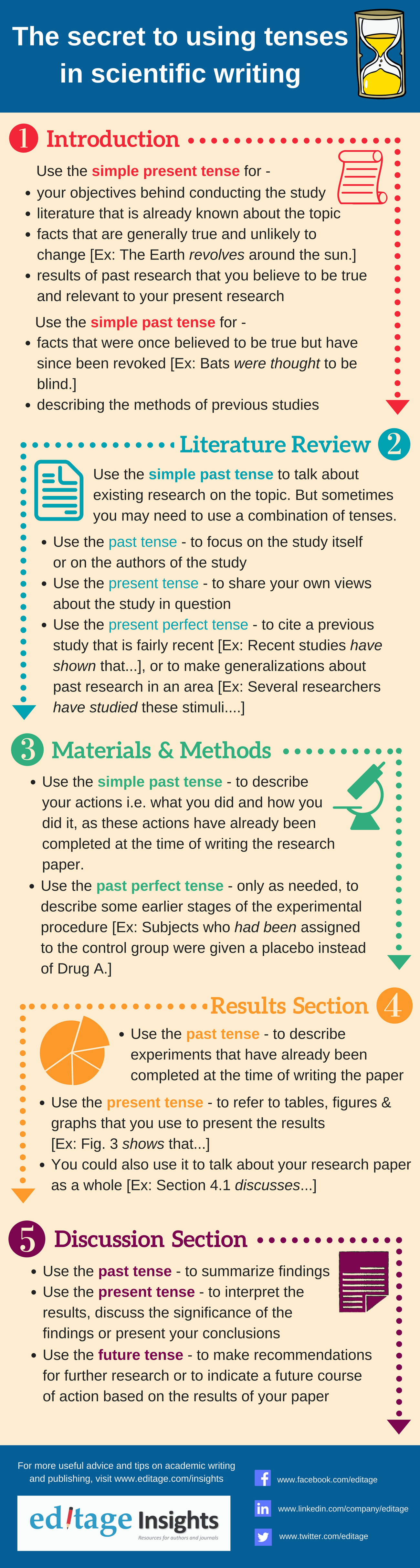
This guide walks through every major tense used in academic writing, explains the logic behind each choice, and maps those choices section by section through a typical research paper.
Jump to Contents
- Why Verb Tense Matters in Academic Writing
- The Core Tenses: What They Are and When They Apply
- Tenses by Paper Section
- Methods Section
- APA Style Guidelines on Verb Tense
- Active vs. Passive Voice and Its Relationship to Tense
- Common Tense Mistakes to Avoid
- Tense Rules in Different Fields
- Three Questions to Ask If You Don’t Know What Tense to Use
Why Verb Tense Matters in Academic Writing
A crucial writing element that must be considered when composing a paper is verb tense, because which tense you use will determine the flow and coherency of your paper.
There is also a credibility dimension. Incorrect or inconsistent tense usage signals to reviewers and editors that a manuscript has not been carefully prepared, and it can create genuine ambiguity about whether a finding is current, historical, or speculative. Verbs are direct, vigorous communicators, and using a chosen verb tense consistently throughout the same and adjacent paragraphs of a paper is essential for smooth expression.
The Core Tenses: What They Are and When They Apply
Before mapping tenses to paper sections, it helps to understand the logic of each tense independently. There are three basic verb tenses used in research papers: present (simple present), simple past, and present perfect. The past perfect and future tense play supporting roles.
Simple Present Tense
The present tense is used to talk about general facts, discuss current meanings and implications, and suggest future applications. General facts are constant and do not change throughout time: always use the present when discussing general scientific facts.
When to use it:
- Stating scientific laws, established facts, or principles that are not time-bound
- Interpreting the significance of your own findings
- Referring to tables, figures, and other parts of the paper
- Stating the aim or scope of the paper itself
Examples:
- “The liver regulates glucose metabolism.” (established fact)
- “Figure 3 shows the distribution of responses across groups.” (reference to figure)
- “This paper investigates the relationship between sleep deprivation and cognitive performance.” (paper’s own scope)
Simple Past Tense
The simple past is generally used to discuss events that have been completed in the past at some distinct time and/or place. It is most often applied to discrete events such as studies, experiments, or observed phenomena.
When to use it:
- Describing your own methodology and procedures
- Reporting the specific results of your study
- Citing what a named researcher did or found
- Referring to facts that were once accepted but have since been disproved
Examples:
- “The samples were centrifuged at 3,000 rpm for ten minutes.” (procedure)
- “Scientists in the 1980s believed that this enzyme was absent in healthy tissue.” (superseded belief)
- “Thompson (2019) analyzed over 500 patient records.” (named researcher’s actions)
Present Perfect Tense
The present perfect tense is used in research papers to refer to events or actions that have taken place at some unidentified time in the past, or that have started but are still ongoing or only recently completed. It often establishes a general background in the Introduction section, adding a backdrop on which you can explain the motivations for and purpose of your study. Note that it is the least frequently used tense in most research papers and should not be over-employed.
When to use it:
- Establishing the general state of a field before introducing your study
- Referring to a trend or body of work without citing a specific moment
- Linking past research to the current relevance of your topic
Examples:
- “Researchers have long debated the mechanisms underlying this process.”
- “Recent advances in machine learning have transformed how linguists analyze large corpora.”
- “Efforts have been made to understand the long-term effects of this treatment.”
Past Perfect Tense
The past perfect is used more selectively, primarily to establish a sequence when two past events need to be distinguished from each other. Best used to describe two related events that occurred at different times in the past, this tense is typically used in the methods section, especially when describing earlier stages of the experimental procedure. For example: “By the time the temperature and humidity reached optimal levels, the plants had already begun to revive.”
It is also useful in the introduction and literature review when referencing a position or finding that was once accepted but has since been revised. Use the past perfect when you talk about something that happened or was found to be the case in the past, but which has since been revised. Example: “The Dublonsky study had determined that X was Y, but a 2012 study found this to be incorrect.”
Future Tense
The future tense is used in research papers when describing events that are expected to occur in the future; this is not very common in academic writing. Typically, its use is limited to the discussion section toward the end, when one needs to make recommendations or indicate a future course of action based on the research results.
Examples:
- “Future studies will need to assess the long-term safety profile of this compound.”
- “These findings will open new avenues for targeted therapy in oncology.”
Tenses by Paper Section
The sections below address each part of a standard IMRAD-style paper.
Abstract
The abstract is a compressed version of the whole paper, which means it inherits a mixture of tenses that mirror what is used in each section it represents.
In general, use the simple past for the abstract of your manuscript; for a concise introductory sentence, use the present perfect. To establish a need for your study: for instance, by explaining the current circumstances of the world or the specific area in which you are working: you can also use the present tense. For general statements and facts, the paper itself, or analysis of findings, also use the present tense. If you are stating a fact or finding from an earlier specified time or place, use the simple past.
| Communicative purpose in abstract | Recommended tense |
| Introductory framing of the field | Present perfect |
| Stating the current problem or context | Simple present |
| Describing what this study did | Simple past |
| Reporting key results | Simple past |
| Stating implications or conclusions | Simple present |
Introduction
The introduction is the section where tense variation is most visible, because it simultaneously presents timeless background knowledge, historical research, and the motivating gap that justifies the current study. The introduction is usually in present tense as you are presenting facts and background information on your research topic. By having this information in present tense, you are showing that you believe that this research is correct.
Use a mixture of present and past tense in the introduction section. The present tense is applied when discussing something that is always true; the simple past tense is used for earlier research efforts, either your own or those reported by another group. If the time or location of the demonstration is unknown or not important, use the present perfect.
A practical tense map for introduction paragraphs:
- Opening general statements about the topic → simple present
- Reference to a specific past study with a named author and year → simple past
- Reference to a general trend in the literature with no specific date → present perfect
- Identifying the gap the current study fills → present perfect or simple present
- Statement of the study’s objectives → simple present
Literature Review
The literature review is where tense errors are most common. Many researchers write all citations in the past tense, when in fact the choice depends on what is being said about the cited work, not just that work was done.
Using the simple past in a literature review
The simple past is usually applied when using the researcher’s name as the subject of the sentence and discussing the methods or results of that study itself. Other verbs commonly found in this context include: investigated, compared, studied, analyzed, found, confirmed, performed, etc.
Using the present tense in a literature review
When giving your opinion on another researcher’s work or bringing up the results, discussion, and conclusions they make in their work, use the present tense. Other verbs commonly found in this context include: stresses, advocates, remarks, argues, claims, posits, etc.
This distinction is important. It means a single sentence about the same paper can require two different tenses depending on what aspect of that paper is being discussed:
- “Huang (2018) conducted a double-blind trial involving 300 participants” → past (describes what was done)
- “Huang (2018) argues that this mechanism is primarily driven by cortisol fluctuations” → present (describes the author’s claims, which are still present in the text)
| Situation | Tense | Example verb |
| Naming what a researcher did | Simple past | investigated, found, reported |
| Referring to a researcher’s argument or claim | Simple present | argues, suggests, maintains |
| Referring to an ongoing or unresolved debate | Present perfect | have debated, have explored |
| Correcting an outdated assumption | Past perfect | had believed, had assumed |
| Citing recent work without specifying when | Present perfect | have demonstrated, have shown |
Methods Section
The methods section is the most tense-consistent part of a paper. In the methods section one would use past tense due to what they have done being in the past. By the time readers encounter the paper, every procedure described has already been completed, which makes the simple past the natural and dominant choice.
Use the simple past tense to talk about what you did. Note that you will generally find the passive voice used when describing the actions of the researchers. This puts more focus on the actions being completed and less on the agents completing the action. Passive voice has become the general standard for research papers in recent decades, but it is acceptable to mix passive and active voice in order to make your paper clearer and more readable.
Two important exceptions apply within the methods section:
- References to figures, tables, and diagrams: These always use the simple present, regardless of what the surrounding text does. “Table 2 presents the demographic breakdown of participants.”
- Descriptions of instruments or methods that remain currently valid: If you are describing a statistical technique or a laboratory apparatus that still exists and is still used the same way, the simple present may be used. “The Attitude Amplification scale measures attitude strength on a five-point continuum.”
Results Section
The verb tense rules for the Results section are quite similar to those applied to the Methods section. Use the past tense to discuss actual results. Use the simple present tense to explain diagrams, figures, and tables.
Examples:
- “Participants in the treatment group showed a statistically significant improvement in recall scores (p < 0.01).” → simple past (actual finding)
- “Figure 4 illustrates the difference in mean scores between the two conditions.” → simple present (reference to figure)
Past tense would typically be used in the results section due to these results being found in the past. The logic is the same as for methods: the data were collected before the paper was written, and results are completed events.
One common error is reporting results in the present tense: “The treatment group performs better”: which blurs the boundary between what was observed (a past finding) and what is being claimed as a general truth (which belongs in the discussion). Keep the two sections tonally distinct.
Discussion Section
The discussion section requires the most tense flexibility because it moves between summarizing what was found, interpreting what those findings mean, comparing with prior literature, and recommending future directions.
Use the simple past to summarize your own findings. Use the present tense to interpret and discuss the significance of those findings.
One would use present tense if they are explaining why one cares about their results and why they are important. One would use past tense to summarize results.
Tense logic in the discussion, broken down by purpose:
| Purpose | Tense | Example |
| Summarizing what was found | Simple past | “The intervention reduced anxiety scores by 22%.” |
| Interpreting what a finding means | Simple present | “This suggests that early exposure is a critical variable.” |
| Comparing to prior literature (specific study) | Simple past | “This aligns with what Rodriguez (2020) reported.” |
| Comparing to prior literature (general field) | Present perfect | “Previous research has consistently shown this pattern.” |
| Acknowledging limitations | Simple past or present | “The sample was limited to urban adults.” / “The study is limited by its cross-sectional design.” |
| Recommending future research | Future or present passive | “Future work should examine longitudinal effects.” |
Present tense verbs should be used when discussing ongoing research, implications of a study, or to make generalizations.
Conclusion Section
Use the present perfect tense in the conclusion section to clarify that your statements still hold true at the time of reading. Use the present tense to apply findings, state implications, and suggest further research. When discussing further research that is either needed or intended to be carried out, the future or present tense or subjunctive mood can also be used, in addition to the present tense passive voice.
According to APA 7th edition, the presentation of conclusions, limitations, future directions, and so forth calls for the present tense.
A well-written conclusion typically opens with a present perfect summary (“This study has demonstrated…”), pivots into present tense implications (“These findings suggest that…”), and closes with future-oriented language (“Future trials will be needed to…”).
APA Style Guidelines on Verb Tense
The American Psychological Association’s 7th edition manual provides specific tense guidance that is widely followed across social and health sciences. The APA 7th edition recommends: past or present perfect tense for the literature review and whenever discussing other researchers’ work, as well as for the method and description of procedure; past tense for the reporting of results; and present tense for the discussion of implications of results and the presentation of conclusions, limitations, future directions, and so forth.
Present perfect tense should be used to discuss an action that began in the past and is still relevant in the present, or an action that did not have one specific start and/or end time, such as research conducted by many different people independently.
A quick-reference summary of APA tense recommendations:
| Paper Section | Recommended Tense(s) |
| Abstract | Past (primary); present perfect (intro sentence); present (facts) |
| Introduction | Present (facts); past (specific studies); present perfect (trends) |
| Literature Review | Past or present perfect (APA recommends both) |
| Methods | Simple past (primary); present (figures, stable methods) |
| Results | Simple past (primary); present (figures) |
| Discussion | Past (summaries); present (interpretations); future (recommendations) |
| Conclusion | Present; present perfect; future |
Active vs. Passive Voice and Its Relationship to Tense
Active and passive voice interact closely with tense choices, particularly in the methods and results sections. APA recommends that authors use the active voice rather than the passive. However, the passive voice is still allowed in APA style writing, and most papers are composed of sentences that use both. APA provides guidance on when to apply each: use the active voice to describe your own actions, to use “I” or “we” when referring to yourself or your group, and to recognize what participants in a study completed.
In the methods section especially, passive constructions (“Participants were randomly assigned”) serve a practical purpose: they foreground the process rather than the person, which aligns with the scientific convention of objectivity. Passive voice can also be useful when emphasizing the action but not the one doing the action. Neither choice is wrong: what matters is that the voice is used deliberately and does not create ambiguity about tense.
Common Tense Mistakes to Avoid
Even experienced writers make predictable errors. The following are the most frequently flagged:
- Switching tenses mid-paragraph without reason. A paragraph summarizing methods should remain in the past throughout. Switching to present without a shift in purpose (e.g., to reference a figure) breaks coherence.
- Writing the entire methods section in present tense. This suggests the study is ongoing, not completed, which can confuse reviewers.
- Using past tense for general scientific facts. Saying “glucose was a primary energy source for the brain” implies this is no longer true. Use present: “glucose is a primary energy source.”
- Treating all literature citations the same. As described above, whether you use past or present for a citation depends on whether you are describing what the author did or what the author argues.
- Overusing the present perfect. The present perfect is a sophisticated tense with a specific role: introducing relevant background. Overusing it across all sections dilutes its function and produces awkward prose.
- Forgetting to shift to present when referring to tables and figures. This is one of the most consistent rules across all style guides: figures exist in the present; always reference them in the present tense.
Tense Rules in Different Fields
It is worth acknowledging that conventions vary across disciplines. Always check the author guidelines for your target journal, and when those guidelines are silent on tense, look at recently published papers in that journal as a model.
| Field / Discipline | Dominant Tense(s) | Key Conventions | Notes & Exceptions |
| Natural Sciences (Biology, Chemistry, Physics) | Simple past (methods, results); Simple present (facts, figures) | Passive voice often used in methods and results; present for established laws and constants | Active voice increasingly accepted in high-impact journals like Nature and Science |
| Medicine & Clinical Research | Simple past (procedures, findings); Present (implications) | Follows IMRAD structure strictly; AMA style guides tense; passive dominates methods | Case reports often use present tense throughout to describe the patient’s condition |
| Psychology & Social Sciences | Past or present perfect (lit review); Past (methods, results); Present (discussion) | APA 7th edition is the governing style; first-person active voice encouraged | Present tense used for generalizations and implications; past for all reported data |
| Humanities (Literature, Philosophy, History) | Simple present throughout (“the eternal present”) | Authors and texts are treated as perpetually existing: “Shakespeare argues,” “Plato claims” | Historical events use simple past; the analysis of texts stays in present |
| Linguistics | Simple present (analysis, claims); Past (data collection) | Linguistic phenomena described in present; corpus collection and experiments in past | Highly variable by sub-field; formal linguistics leans present, sociolinguistics leans past |
| Economics | Simple present (models, theory); Past (empirical results) | Model assumptions and theoretical claims in present; regression results and findings in past | Working papers often use future tense for planned analysis |
| Engineering & Computer Science | Simple present (system descriptions, algorithms); Past (experiments, evaluations) | Technical specifications and system behavior in present; benchmarking and testing in past | Conference papers often use present tense more liberally than journal papers |
| Education Research | Mixed; follows APA broadly | Past for data and procedures; present for interpretation and implications | Qualitative studies often use present tense more extensively to describe themes |
| Law & Legal Studies | Simple present (statutes, doctrines); Past (cases, rulings) | Legal principles written in present as if continuously in force; case histories in past | Law review articles treat court decisions with past for facts, present for holdings |
| History | Simple past (events, actors); Present (historiographical argument) | The events themselves always in past; the historian’s own argument in present | Avoid present perfect for historical events: “Columbus sailed” not “Columbus has sailed” |
| Sociology & Anthropology | Mixed; ethnographic present common in qualitative work | Fieldwork and observations often in present tense to convey immediacy; quantitative findings in past | The “ethnographic present” is contested. Some journals now require past to avoid timelessness assumptions |
| Public Health & Epidemiology | Past (study findings); Present (policy implications, facts) | Heavily influenced by medicine and APA; surveillance data reported in present as ongoing | Reports vs. journal articles differ: surveillance reports use present more freely |
| Business & Management | Flexible; APA or AMA common | Case analyses often in past; theoretical frameworks and propositions in present | Business and trade reports lean toward present throughout; academic journal articles follow APA |
| Environmental & Earth Sciences | Simple past (field data, measurements); Present (processes, phenomena) | Geological and ecological processes described in present as ongoing; specific measurements in past | Climate projections use future tense; observed historical trends use past |
Three Questions to Ask If You Don’t Know What Tense to Use
The core logic reduces to three questions to ask before every sentence:
- Is this something that happened in the past, specifically in the context of this study or a cited study? → Simple past
- Is this something that is currently true, or is this my interpretation of what the findings mean? → Simple present
- Is this something from the past that connects to the present relevance of the topic? → Present perfect
With these anchors in place, the detailed section-by-section rules fall into a coherent and intuitive system: one that signals to editors, reviewers, and readers that the author has full command of both the research and its communication.
Feel free to download a PDF version of this infographic and print it out as handy reference.
References:
- Using past and present tenses in research writing
- What tense should I use when writing a literature review?
- Getting the tenses right: Materials and methods section
- Which tense should be used in the results and discussion section of a paper?
- Sequence of Tenses
- Using tenses in scientific writing
The secret to using tenses in scientific writing_0_0.pdf