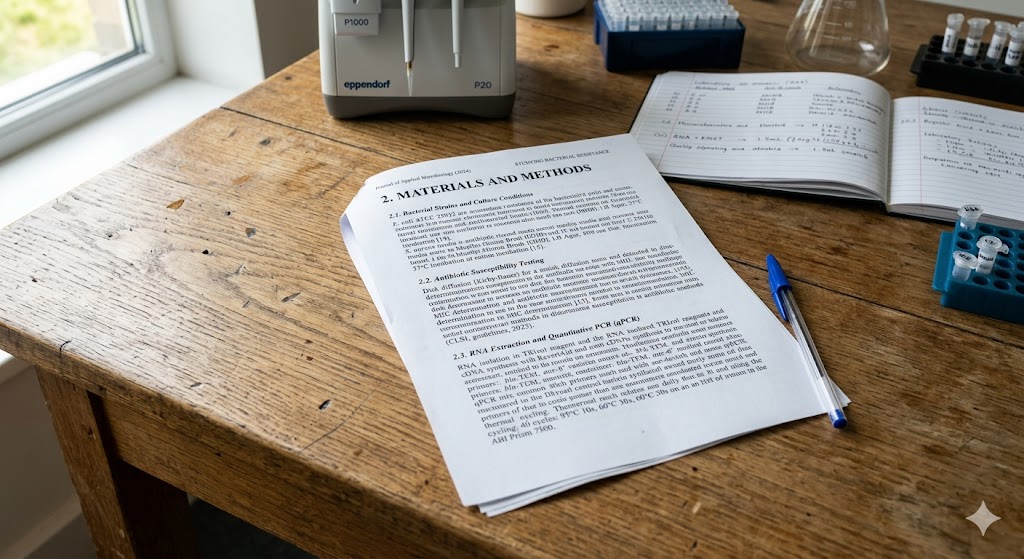
Is it acceptable to use first person pronouns in scientific writing?

Novice researchers are often discouraged from using the first-person pronouns “I” and “we” in their scientific writing. The most common reason given is that such language may appear subjective, whereas science demands objectivity. However, this is a misconception. There is no universal rule prohibiting first-person pronouns in scientific writing, and many leading journals and style guides now encourage their appropriate use to enhance clarity and directness.
What Experts Say About First-Person Pronouns
Leading voices in academic writing have challenged the outdated prohibition against first-person pronouns. Here’s what the experts recommend:
Robert Day and Barbara Gastel
(Authors of “How to Write and Publish a Scientific Paper”)
“Because of this [avoiding first person pronouns in scientific writing], the scientist commonly uses verbose (and imprecise) statements such as ‘It was found that’ in preference to the short, unambiguous ‘I found.’ Young scientists should renounce the false modesty of their predecessors. Do not be afraid to name the agent of the action in a sentence, even when it is ‘I’ or ‘we.'”
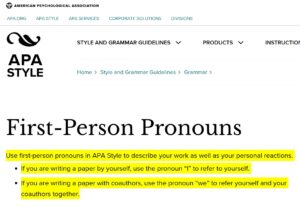
American Psychological Association
“Many writers believe the “no first-person” myth, which is that writers cannot use first-person pronouns such as “I” or “we” in an APA style paper. This myth implies that writers must instead refer to themselves in the third person (e.g., as “the author” or “the authors”). However, APA Style has no such rule against using first-person pronouns and actually encourages their use to avoid ambiguity in attribution!”
When to Use First-Person Pronouns in Scientific Papers
First-person pronouns should be used strategically in specific contexts where they add clarity and directness. Below are the appropriate situations:
Best Use Cases for First Person
| Use Case | Example | Journal Section |
| Describing your methodology | “We conducted a randomized controlled trial…” | Methods |
| Stating assumptions | “Unlike Day and Gastel, I assumed that…” | Methods/Discussion |
| Explaining decisions made | “We decided to exclude…” | Methods |
| Personal observations | “I observed that…” | Results/Discussion |
| Limitations you encountered | “We were unable to access…” | Discussion |
| Future research directions | “In our next study, we will…” | Discussion |
General Guidelines
When using first-person pronouns, follow these best practices:
- Use “we” instead of “I” when working with co-authors or teams. This emphasizes collaboration and is more standard in scientific writing.
- Restrict usage to specific sections. First person is most acceptable in the Methods, Discussion, and Conclusion sections. Use sparingly in Results and Introduction.
- Prioritize clarity over tradition. Replace awkward passive constructions (“it was found”) with active, first-person alternatives (“we found”) when it improves readability.
- Maintain professional tone. Avoid drawing attention to yourself as the author. Keep focus on the research, not the researcher.
- Check journal guidelines. Always verify the target journal’s specific requirements before finalizing your manuscript.
- Use context-appropriate language. In formal sections, maintain an academic tone even when using first person.
Which Journals Allow First-Person Writing?
Many major journals now openly accept or encourage first-person pronouns. This represents a significant shift in academic publishing norms.
Journals That Encourage First Person
| Journal | Discipline | Policy on First Person | Example |
| Nature | Multidisciplinary | Accepts first person; recommends for clarity | “We investigate whether these divisions…” |
| Science | Multidisciplinary | Permits first person in appropriate sections | “We therefore performed cross-sectional analysis” |
| The Lancet | Medicine | Encourages first person in Methods and Discussion | “We analyzed the numbers and age-standardized mortality rates” |
| PLOS ONE | Multidisciplinary | Accepts and encourages first person | “We found that neutrophils from HESN presented reduced expression of ” |
| Journal of Applied Ecology | Biology/Ecology | Encourages clear, direct language with first person | “We found that the elements of the ‘gardening triad’ were meaningful to gardeners” |
| JAMA | Medicine | Accepts first person throughout | “we review the methods used in studies published thus far” |
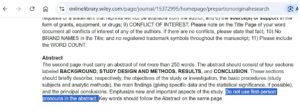
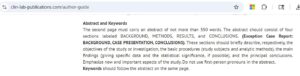
Important: Some journals discourage use of the first person in the abstract. See the examples below from Clinical Laboratory and Transfusion. Always check your journal guidelines for such rules.
How to check if your journal allows first-person pronouns
To find a journal’s stance on first-person pronouns:
- Review the journal’s “Instructions to Authors” or “Author Guidelines”
- Check the journal’s website for writing style recommendations
- Examine recent articles in the journal to see how published authors handled pronouns
- Consult discipline-specific style guides (APA, Chicago, etc.) endorsed by the journal
Common Mistakes to Avoid
When using first-person pronouns in scientific writing, be mindful of these frequent pitfalls:
Mistake 1: Overusing First Person
Problem: Peppering your paper with unnecessary “I’s” and “we’s” creates a self-focused narrative rather than a research-focused one.
Example (Incorrect): “I designed the experiment, and I collected the samples. I analyzed them, and I found interesting results.”
Corrected Version: “We designed the experiment and collected samples according to protocol X. Analysis revealed significant differences between groups.”
Mistake 2: Mixing “I” and “We” Inconsistently
Problem: Readers become confused about whether work was solo or collaborative.
Guidelines:
- Use “we” for collaborative work and team efforts
- Use “I” only for genuinely individual contributions (and sparingly)
- Never switch between them within the same discussion
Mistake 3: Using First Person to State Opinions as Facts
Problem: This blurs the line between evidence-based findings and personal interpretation.
Example (Incorrect): “I believe that climate change is the primary factor…”
Corrected Version: “The evidence suggests that climate change is a primary contributing factor…”
Mistake 5: Over-Apologizing or Over-Qualifying
Problem: First person can sometimes amplify tentative or uncertain language.
Example (Incorrect): “I’m afraid we found a moderate correlation between…”
Corrected Version: “We identified a moderate correlation between…”
Mistake 6: Ignoring Disciplinary Norms
Problem: Different fields have different expectations. What’s acceptable in cardiology may not be in theoretical physics.
Solution: Review recent papers in your specific discipline to understand current conventions.
Frequently Asked Questions
Can I use “I” in my PhD thesis or dissertation?
Yes, most institutions now permit first-person pronouns in theses and dissertations, particularly in the Methods and Discussion chapters. Many advisors actually prefer “we” over passive constructions for clarity. Check your university’s style guidelines and consult with your advisor about their preferences. Using first person can make your work more engaging and easier to follow without appearing unprofessional.
Should I use first person in the Introduction section?
Generally, minimize first-person use in the Introduction. This section should focus on existing literature and knowledge gaps, not your personal perspective. Reserve first person for the Methods section (“We designed…”) and Discussion section (“We observed…”). The Introduction is the place to establish context and background using more objective language.
Is using first person in co-authored papers different from solo-authored work?
Yes. In co-authored papers, “we” is standard and expected—it reflects collaboration. In solo-authored work, “I” can be used but “we” is also acceptable if you’re speaking on behalf of your research team or institution. Many researchers still prefer “we” even in sole-authored work for a more professional tone. The choice depends on your target journal and discipline.
What’s the difference between “we” and passive voice in terms of clarity?
“We” is more direct and concise, while passive voice often adds unnecessary length. Compare: “We analyzed the samples” (4 words) versus “The samples were analyzed by us” (7 words). When passive voice is shorter and clearer, it’s preferred. When it creates ambiguity about who performed the action, first person is superior. Choose based on clarity and word efficiency.
Will using first-person pronouns hurt my chances of publication?
No, not in reputable journals. Modern editors and peer reviewers understand that first-person pronouns enhance clarity and directness. What matters is whether you follow your target journal’s specific guidelines and use first person judiciously. Using first person excessively or inappropriately could distract readers, but measured, purposeful use actually strengthens your writing. Always verify the journal’s author guidelines to ensure compliance.
Bibliography:
1 Schultz D M. 2009. Eloquent Science, p. 412. Boston, Massachusetts: American Meteorological Society. < http://eloquentscience.com >
2 Kirkman J. 2005. Good Style: Writing for Science and Technology, 2nd edn, p. 49. London: Routledge. 160 pp.
This article was originally published on January 12, 2014, and revised on May 10, 2026.