A 4-step approach to writing the introductory section of a research paper
Contents
- What Does a Research Paper Introduction Actually Do?
- The Funnel Structure: How a Research Paper Introduction Is Organized
- Argumentative vs. Empirical Papers: How the Introduction Differs
- Step 1: Write a Strong Hook and Set the Broad Context
- Step 2: Establish the Importance of Your Topic
- Step 3: Identify the Research Gap and Review Past Work
- Step 4: State Your Objectives, Research Question, or Hypothesis
- Step 5: Provide an Overview of the Paper’s Structure (Optional but Recommended)
- Annotated Examples + Downloadable Checklist of Introduction Sections
- Writing the Introduction Section in Different Disciplines
- Common Mistakes to Avoid in the Introduction Section
- How Long Should a Research Paper Introduction Be?
- When Should You Write the Introduction?
- Expert Tip on How to Write an Introduction
- Frequently Asked Questions
What Does a Research Paper Introduction Actually Do?
Your title and abstract get the reader to open your paper. The introduction’s job is to make them stay, and keep reading all the way to your Methods, Results, and Discussion.
Think of the introduction as answering one overarching question: “Why?”
- Why did you choose this topic?
- Why is it important?
- Why is your approach the right one?
- Why does the field need this study now?
A strong introduction does all of this in a tightly constructed funnel — moving from broad to specific, from context to gap, from gap to your study.
The Funnel Structure: How a Research Paper Introduction Is Organized
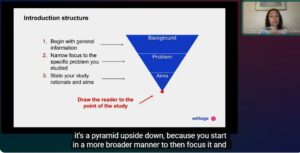
Every effective introduction narrows progressively, like a funnel:
Broad context / background
↓
Specific topic + why it matters
↓
What’s known + what’s missing (the research gap)
↓
Your study: objective, question, or hypothesis
↓
(Optional) Overview of the paper’s structure
This is sometimes called the CARS model (Create a Research Space), developed by linguist John Swales:
| CARS Move | What It Does | Maps To |
| Move 1: Establish a territory | Set the scene; show the field is important | Background & context |
| Move 2: Establish a niche | Identify the gap, problem, or contradiction | Research gap |
| Move 3: Occupy the niche | Present your study as the solution | Objectives / research question |
Argumentative vs. Empirical Papers: How the Introduction Differs
Not all research papers are the same and the structure of your introduction should reflect the type of paper you’re writing.
| Feature | Empirical paper (e.g., lab study, survey, experiment) | Argumentative paper (e.g., humanities, policy analysis) |
| End goal | Answer a research question / test a hypothesis | Defend a thesis or position |
| Literature review style | Summarize findings; identify gaps | Engage critically with competing arguments |
| Closing element | Research question + hypothesis | Thesis statement |
| Tone | Objective, neutral | Analytical, persuasive |
Example for Empirical closing:
“We investigated whether daily Instagram use is associated with increased body image concerns among adolescent girls. We hypothesized that higher use frequency would correlate with lower self-esteem ratings.”
Example for Argumentative closing:
“This paper argues that current EU carbon offset regulations disproportionately burden developing economies and require fundamental restructuring.”
Step 1: Write a Strong Hook and Set the Broad Context
The Hook
Your first sentence is your single best chance to pull the reader in. Don’t waste it on a generic statement. Use one of these proven hook types:
| Hook Type | What It Does | Example |
| Striking statistic or fact | Creates urgency or surprise | “Antibiotic-resistant infections account for an estimated 1.27 million deaths annually worldwide.” |
| A bold or counterintuitive claim | Challenges assumptions | “The most effective cancer therapies may have been hiding in bacteria for over a century.” |
| A pointed question | Invites the reader in | “Why do patients in high-income countries still die of preventable infections?” |
| A brief, vivid scenario | Makes abstract problems concrete | “When a farmer in sub-Saharan Africa loses a harvest to drought, the consequences ripple through every sector of the local economy.” |
What to avoid
Opening with a dictionary definition, a sweeping statement like “Since the beginning of time…”, or a sentence so broad it could apply to any paper in your field.
Narrowing to Context
After the hook, spend 1–2 sentences narrowing from the broad field to your specific sub-area. Compare:
- Too broad: “Cancer is one of the leading causes of death worldwide.”
- Better: “Among gastrointestinal cancers, pancreatic ductal adenocarcinoma carries the worst prognosis, with a five-year survival rate below 12%.”
Step 2: Establish the Importance of Your Topic
Once you’ve set the context, give the reader a reason to care. Two effective strategies:
Strategy A: Lead with the problem (cost, scale, urgency)
“Malaria affects over 240 million people annually, causing approximately 600,000 deaths, the majority children under five in sub-Saharan Africa.”
Strategy B: Lead with the opportunity (benefit, potential gain)
“If irrigation efficiency in rain-fed croplands improved by just 20%, an estimated 40 billion litres of water could be conserved annually across South Asia alone.”
Strategy B is often more compelling: it focuses the reader on what could be gained, not just what is lost.
Step 3: Identify the Research Gap and Review Past Work
This is where your introduction transitions from “here’s the field” to “here’s what’s missing.” This is the core of the CARS model’s Move 2, and it’s the step most researchers underdo.
How to Signal the Research Gap
Use transitional phrases that explicitly mark the gap:
| Situation | Useful phrases |
| An overlooked angle | “Although X has been extensively studied, little attention has been paid to Y…” |
| Conflicting results | “Studies report contradictory findings regarding Z, with some showing… while others find…” |
| Outdated work | “These studies were conducted before [development], and their findings may no longer apply…” |
| Methodological limits | “Prior work relied on self-reported data; objective measurement remains limited.” |
| Population gap | “Most research has focused on adult populations; the adolescent experience remains underexplored.” |
How to Cite Sources Effectively Here
The introduction is not a literature review but is a strategic selection of the most relevant prior work. Follow these citation principles:
- Cite purposefully: Every citation should serve a function like establishing a fact, signaling a gap, or contrasting your approach with a prior one.
- Don’t stack citations: Avoid sentences like “Many studies have found X [4–15].” Instead, group them meaningfully: “A strong effect has been found in adult men [4–7] and women [8–11], but evidence in adolescents remains scarce [12].”
- Cite recent work: Favor literature from the past 5–10 years unless older foundational work is essential.
- Use review articles strategically: Instead of citing 20 individual papers, cite a review that synthesizes them, especially if the introduction is already long.
Step 4: State Your Objectives, Research Question, or Hypothesis
This is the payoff of the introduction: the specific, concrete answer to the question “so, what did you do?” It should flow logically from the gap you’ve just identified.
Three Ways to Frame Your Study’s Focus
Option A: Research question (most common in empirical sciences)
“This study set out to answer the following question: Does daily social media use predict body image dissatisfaction in girls aged 13–17?”
Option B: Hypothesis (for experimental research)
“We hypothesized that exposure to idealized body imagery on Instagram for more than two hours per day would be associated with significantly lower self-esteem scores compared to non-users.”
Option C: Objective using infinitives (versatile across disciplines)
“We aimed to: (1) quantify the prevalence of antibiotic resistance in community-acquired urinary tract infections; (2) identify the most common resistant strains; and (3) evaluate the effectiveness of second-line treatment protocols.”
What to Avoid at This Stage
- Don’t preview your results (A statement like “We found that…” belongs in the abstract and results section)
- Don’t include excessive methodological detail (that belongs in Methods)
- Don’t be vague (“This study examines the relationship between X and Y”; specify the direction, population, or context)
Provide an Overview of the Paper’s Structure (Optional but Recommended)
For papers that don’t follow a standard IMRAD format (like in economics), a brief roadmap helps orient the reader. Keep it to 2–3 sentences, written in the present tense:
“This paper first reviews the regulatory landscape governing carbon offset schemes in the EU, then evaluates the distributional effects of current mechanisms on emerging economies, and finally proposes a tiered reform model calibrated to development status.”
For standard IMRAD papers (Introduction–Methods–Results–Discussion), this step is often omitted since the structure is self-evident.
Annotated Examples of Introduction Sections + Downloadable Checklist
Example 1: Empirical Paper (STEM / Life Sciences)
[Hook: striking statistic] Antibiotic-resistant infections are now responsible for more deaths globally than HIV/AIDS or malaria.
[Narrowing context] Among resistant pathogens, carbapenem-resistant Enterobacteriaceae (CRE) pose a particular threat in hospital settings, where mortality rates from bloodstream infections reach 40–50%.
[Importance] Despite the scale of this crisis, effective treatment protocols remain limited to a small number of last-resort antibiotics, and resistance to these agents is rising rapidly.
[Research gap] Previous studies have characterized CRE resistance mechanisms primarily in Western European hospital systems; comparable data from South and Southeast Asian tertiary care centers (regions with among the highest antibiotic consumption globally) remain scarce.
[Objective] The present study aimed to profile the prevalence, resistance mechanisms, and clinical outcomes associated with CRE infections across five tertiary care hospitals in India between 2021 and 2024.
Example 2: Argumentative Paper (Social Sciences / Policy)
[Hook: counterintuitive claim] Universal Basic Income (UBI) pilot programs consistently show one result their critics do not expect: labor supply does not fall.
[Context] Over the past decade, governments in Finland, Kenya, Canada, and the United States have conducted randomized controlled trials of unconditional cash transfers to low-income populations.
[Importance] As automation displaces routine employment at an accelerating rate, the question of whether UBI can serve as a viable social policy instrument has moved from the academic fringe to the mainstream policy agenda.
[Gap] Yet despite a growing empirical literature, no systematic comparison exists that accounts for cross-national variation in labor market conditions, welfare baselines, and transfer amounts, which makes policy generalization unreliable.
[Thesis] This paper argues that UBI’s labor supply effects are strongly conditioned by baseline welfare generosity and cannot be extrapolated across national contexts without structural adjustment.
Downloadable Checklist
Use this simple checklist to scan your Introduction section after you’ve written it, to make sure you’ve covered all the necessary information and haven’t wasted words on unnecessary stuff. Download here: Research_Paper_Introduction_Checklist
Writing the Introduction Section in Different Disciplines
The core funnel structure applies across all fields, but conventions vary significantly by discipline. Here’s how to adapt:
| Discipline | Citation style | Literature review depth | Closing element | Typical length |
| Biomedical / STEM | Numbered (Vancouver) | Brief; focus on key gaps | Research question + hypothesis | 3–4 paragraphs |
| Social Sciences | Author-date (often APA) | Moderate; engage with theoretical frameworks | Research question or thesis | 4–5 paragraphs |
| Humanities | Footnote-based (Chicago) or Author-page (MLA) | Extensive; historiography often central | Thesis statement | 5–7 paragraphs or more |
| Engineering | Numbered (IEEE) | Focused on applied problems and technical gaps | Objective + scope | 2–3 paragraphs |
| Law / Policy | Jurisdiction-specific | Review of doctrine and precedent | Argument / position | Variable |
STEM Papers
- Brevity is valued. An introduction of 250–400 words is typical for high-impact journals
- Lead with prevalence data, incidence, or economic burden to justify the study
- State the hypothesis clearly and early
- Avoid narrative or rhetorical flourishes. Reviewers want precision
Social Sciences Papers
- Theoretical framing is expected. Situate your study within an existing theoretical tradition (e.g., social capital theory, feminist frameworks, institutional economics)
- Engage with at least 2–3 major scholars or schools of thought
- Research question should identify the population, context, and relationship being examined
Humanities Papers
- The introduction often includes a “road map” of the entire argument
- Engaging critically with prior scholarship (historiography, critical tradition) is central, not just background
- The thesis should be specific, contestable, and intellectually ambitious
- First person and active voice are now widely accepted (“I argue that…”, “This essay contends…”)
Engineering Papers
- Focus tightly on the technical problem and the applied gap
- Quantify the problem wherever possible (energy loss, throughput reduction, failure rate)
- Scope statements (“this study is limited to…”) are common and expected early
Common Mistakes to Avoid in the Introduction Section
| Mistake | Why it’s a problem | Fix |
| Opening too broadly | “Science is important…” gives the reader no reason to keep reading | Start with your specific field or problem, not a generic truth |
| No hook | A boring first sentence signals a boring paper | Use a statistic, question, or bold claim to open |
| Turning it into a full literature review | Exhaustive citation lists slow the reader down and obscure your argument | Cite only what directly contextualizes your gap |
| Stacking citations | “Many studies have examined X [1–18]” is uninformative | Group citations by finding or nuance |
| Failing to name the gap | The reader can’t tell why your study was necessary | Use explicit gap-signaling language (see Step 3 table) |
| Previewing your results | The introduction should raise the question, not answer it | Save findings for Results and Discussion |
| Being vague about objectives | “This study examines X” tells the reader nothing specific | State what you measured, in whom, under what conditions |
| Writing the intro first | You don’t yet know exactly what your paper proves | Write — or substantially revise — the introduction after completing the rest of the paper |
| Ignoring journal word limits | Journals like Science or Nature allow only 1–2 short paragraphs | Check author guidelines before you write |
| Paragraphs or sentences that are too long | Dense walls of text reduce readability and reviewer patience | Keep paragraphs to 100–200 words; aim for sentences under 25 words |
How Long Should a Research Paper Introduction Be?
| Paper length | Recommended introduction length | Number of paragraphs |
| Short communication (1,500–2,500 words) | 150–250 words | 1–2 |
| Standard research article (3,000–5,000 words) | 350–500 words | 3–4 |
| Long research article (7,000+ words) | 500–700 words | 4–5 |
| Review article | 600–900 words | 5–6 |
| Thesis/dissertation chapter | 800–1,200 words | 6–8 |
As a general rule, the introduction accounts for 10–12% of your paper’s total word count. Always check your target journal’s author guidelines because some specify maximum word counts for individual sections.
When Should You Write the Introduction?
Counterintuitively, the introduction is often best written last or substantially revised after completing the rest of the paper. Here’s why:
- You don’t fully know what your paper is going to focus on, until you’ve written the results and discussion
- The gap you identify should precisely match the gap your study fills, which is only clear in retrospect
- Your stated objectives should map exactly to what you actually did, which is easy to check once the Methods section is written
A practical workflow:
- Write a rough placeholder introduction to get started
- Complete Methods → Results → Discussion
- Return and rewrite the introduction with full knowledge of what the paper delivers
Expert Tip on How to Write an Introduction
Dr Rafaella Gozzelino (academic editor and international trainer, NOVA Medical School, Lisbon):
It’s a pyramid upside down because you start in a broader manner and then focus it to draw the reader to the point of the study.
You can watch the entire video here: https://www.youtube.com/watch?v=ux6Z5RGM1T8
Frequently Asked Questions
1. What are the essential components of a research paper introduction?
Every introduction should include: (1) a hook and broad context, (2) narrowing to your specific topic and its importance, (3) a review of relevant prior work identifying the research gap, and (4) your research objective, question, or hypothesis. A brief overview of the paper’s structure is optional but useful in non-IMRAD formats.
2. What is the difference between a research question, hypothesis, and thesis statement, and which should I use?
Use a research question when your study is exploratory or descriptive (“What factors predict X?”). Use a hypothesis when you have a specific, testable prediction based on prior theory (“We hypothesized that X would lead to Y”). Use a thesis statement in argumentative or humanities papers where you are defending a position (“This paper argues that…”). For empirical sciences, research question + hypothesis is standard; for argumentative papers, the thesis statement is preferred.
3. How do I identify and write about the research gap?
A research gap is anything missing from the existing literature that your study addresses: unstudied population, an unanswered question, conflicting findings, an outdated methodology, or a theoretical blind spot. Identify it by reading critically and asking: “What does the literature not yet explain?” Then signal it explicitly using phrases like “little is known about…”, “prior work has not examined…”, or “existing studies are limited to…”
4. Does the introduction in a research paper need citations?
Yes. The introduction contextualizes your study within prior work, which requires citing that work. You should cite established facts, foundational theories, key statistics, and the specific studies your work builds on or departs from. However, the introduction is not a literature review. Cite purposefully and selectively, not exhaustively.
This article was originally published on September 18, 2018, and updated on May 10, 2026.