Infographic: How to maintain your lab notebook


Your lab notebook is not just a record of your experiments; it is your gateway to reproducibility, collaboration, and future discoveries. Maintaining a lab notebook is an essential task for early career researchers, serving as a trusted companion throughout their scientific journey.
We understand that the challenges of meticulous documentation can sometimes feel overwhelming. However, we cannot stress enough the significance of maintaining a lab notebook with utmost precision and consistency.
Whether you prefer the traditional route of a physical lab notebook or embrace the convenience of an electronic lab notebook, this infographic will equip you with essential tips for maintaining your lab notebook effectively.
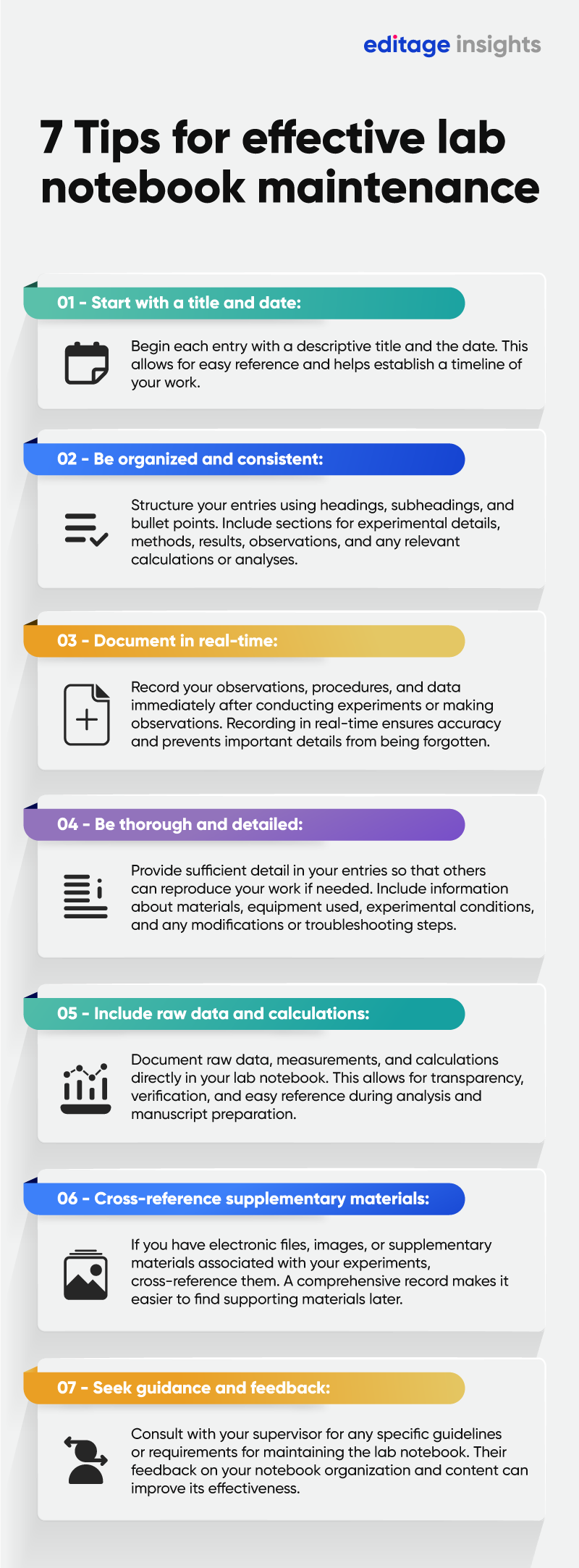
How to maintain your lab notebook
| Tip | Description |
|---|---|
| Start with a title and date | Begin each entry with a descriptive title and the date. This allows for easy reference and helps establish a timeline of your work. |
| Be organized and consistent | Structure your entries using headings, subheadings, and bullet points. Include sections for experimental details, methods, results, observations, and any relevant calculations or analyses. |
| Document in real-time | Record your observations, procedures, and data immediately after conducting experiments or making observations. Recording in real-time ensures accuracy and prevents important details from being forgotten. |
| Be thorough and detailed | Provide sufficient detail in your entries so that others can reproduce your work if needed. Include information about materials, equipment used, experimental conditions, and any modifications or troubleshooting steps. |
| Include raw data and calculations | Document raw data, measurements, and calculations directly in your lab notebook. This allows for transparency, verification, and easy reference during analysis and manuscript preparation. |
| Cross-reference supplementary materials | If you have electronic files, images, or supplementary materials associated with your experiments, cross-reference them. A comprehensive record makes it easier to find supporting materials later. |
| Seek guidance and feedback | Consult with your supervisor for any specific guidelines or requirements for maintaining the lab notebook. Their feedback on your notebook organization and content can improve its effectiveness. |
EditageInsights_LabNotebook_0.png