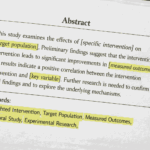
How to make your abstract more effective?
Why is the abstract of a research paper important?
An abstract is like a movie trailer. It offers a preview, highlights key points, and helps the audience decide whether to view the entire work. Abstracts are the pivot of a research paper because many journal editorial boards screen manuscripts only on the basis of the abstract.
If your abstract doesn’t grab their attention and make a good first impression, there’s a good chance your research paper will be rejected at the outset. Moreover, even after your research paper is published, your abstract will be the first, and possibly only, thing readers will access through electronic searches. They will only consider reading the rest of the manuscript if they find your abstract interesting.
How long should the abstract be?
The length of your abstract will depend on the guidelines of your target journal, but most journals ask for 200-300 words. Some conferences have limits of even 100-150 words.
What information do I include in the abstract?
For studies in the humanities and social sciences, the abstract describes the topic of research and its findings but usually doesn’t give specific information about methods and results. These abstracts may also be seen in review articles or conference proceedings. In the biomedical sciences, on the other hand, abstracts are usually structured to describe the background, methods, results, and conclusions, with or without subheadings.
How do I write an effective abstract?
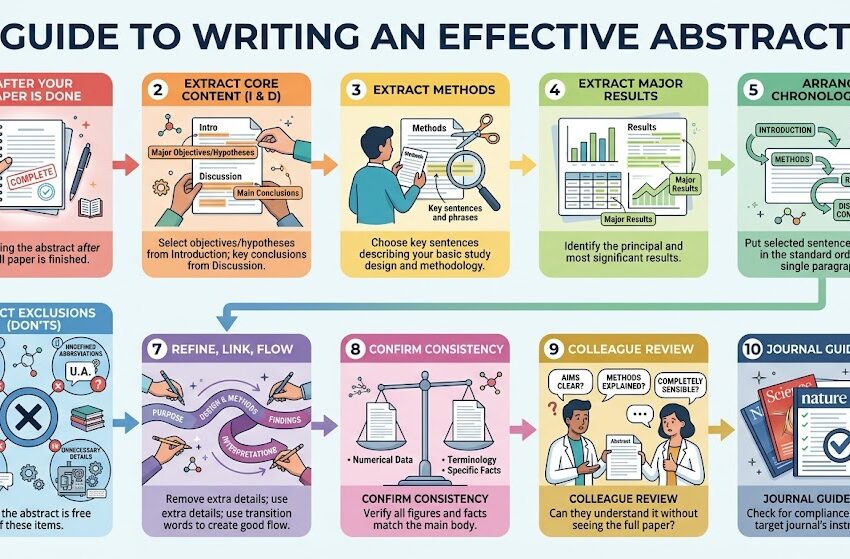
Choose the right time
Begin writing the abstract after you have finished writing your paper.
Select information carefully from your paper
- Pick out the major objectives/hypotheses and conclusions from your Introduction and Discussion/Conclusion
- Select key sentences and phrases from your Methods
- Identify the major results from your Results
Arrange information into a single paragraph
Use in the following sequence: Introduction, Methods, Results, and Discussion/Conclusions.
Condense this paragraph
Make sure that this paragraph does not contain
(i) new information that is not present in the paper
(ii) undefined abbreviations or group names,
(iii) a discussion of previous literature or reference citations,
(iv) unnecessary details about the methods used
Add flow and transition
Link your sentences to ensure that the information flows well, preferably in the following order: purpose; basic study design, methodology and techniques used; major findings; summary of your interpretations, conclusions, and implications.
Check for consistency
Confirm that there is consistency between the information presented in the abstract and in the paper, especially any numerical data.
Check that the abstract stands alone
Ask a colleague to review your abstract and check if they can easily understand the purpose, aim, methods, and conclusions of the study. Ask them if the abstract makes complete sense to them without showing them the rest of your paper.
Adjust the abstract as per journal guidelines
Make sure the abstract meets the word limit set by the target journal and add any subheadings set by the target journal. Also check if the target journal asks for specific information to be included in the abstract like sample size.
A further tip
Another thing you can do is go back to some of the most interesting papers you have read during your literature review. Don’t be surprised if you find that they also happen to have some of the best abstracts you’ve seen!
This article was originally published on October 16, 2013, and has been republished on May 09, 2026.