AI Use by Neurodivergent Professionals – Pros and Cons
“AI should empower individuals to contribute their unique strengths, perspectives, and voices while supporting a more accessible and inclusive future.”
You cannot go a day without hearing about artificial intelligence (AI). It has become part of everyday life, from search engines and writing tools to doctor’s offices, where patients are increasingly asked whether they consent to AI-powered transcription of medical notes during appointments.
At the same time, AI has introduced new concerns. Social media platforms are flooded with AI-generated text, images, and videos that can appear convincing at first glance. While some content is clearly labeled, other material can blur the line between human-created and AI-generated information, making it more difficult to distinguish fact from fiction. As a result, the potential for misinformation and manipulation has become a growing concern.
It is not your imagination. The AI landscape has expanded rapidly. As of January 2026, millions of AI models and repositories exist (Savaliya, 2026). There are more than 1,000 AI business tools, over 400 AI image-generation tools, and more than 200 AI text-generation tools available (Savaliya, 2026). In healthcare alone, AI represents a market valued at approximately $56 billion, while clinical AI and AI scribe systems report high levels of accuracy (Savaliya, 2026).
This rapid growth is reshaping how people work, learn, communicate, and access information. For neurodivergent professionals, these changes bring both opportunities and challenges. AI can support communication, organization, learning, and accessibility, but it can also introduce bias, misinformation, and new workplace barriers. For individuals who may already navigate expectations around communication style and social interaction, AI raises important questions about authenticity, personal voice, and how self-expression is shaped in an increasingly AI-assisted world.
Personally, I do not want to sound like a chatbot that communicates the same way as everyone else. I use AI tools regularly and believe they can be incredibly valuable. However, the most important part of communication remains human thinking. AI should help refine and organize ideas, not replace a person’s voice.
As AI becomes more deeply integrated into education, employment, healthcare, and daily life, understanding its impact on neurodivergent individuals has never been more important.
Exploring How Artificial Intelligence Is Reshaping Work, Learning, and Inclusion for Neurodivergent Professionals
The benefits of AI for neurodivergent professionals extend beyond productivity. Recent survey data suggest that AI may influence career advancement, workplace inclusion, disclosure decisions, and perceptions of fairness in hiring and evaluation (Figure 1).
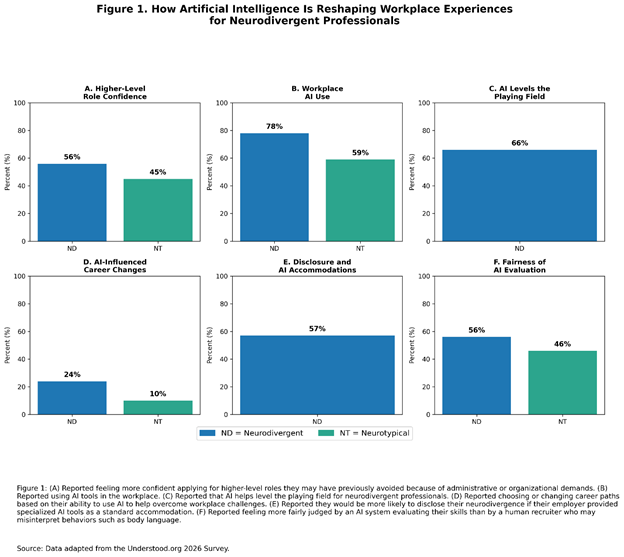
AI can be a valuable tool for increasing confidence among neurodivergent individuals. According to Understood.org’s 2026 survey, 56% of neurodivergent adults reported feeling more confident applying for higher-level roles they may have previously avoided because of administrative or organizational demands, compared with 45% of neurotypical employees (Understood.org, 2026).
Beyond career advancement, AI is also changing how professional communication is developed and refined, raising important questions about voice, authenticity, and self-expression in scientific and workplace writing.
The survey found that 78% of neurodivergent workers use AI tools, compared with 59% of neurotypical employees (Understood.org, 2026). However, only 66% of neurodivergent adults reported that AI helps level the playing field for neurodivergent professionals (Understood.org, 2026). This finding highlights an important reality: while AI can provide meaningful support, technology alone cannot create an equitable work environment. Rather, AI works best when combined with accommodations, inclusive workplace practices, and broader organizational support.
As a neurodivergent scientist, AI has strengthened my confidence as a writer. I enjoy educating others about science and neurodivergence, and AI helps me edit my work, improve clarity, and communicate ideas more effectively. At the same time, AI is only one part of the solution. Without appropriate accommodations and neuroinclusive workplaces, many neurodivergent professionals may still struggle or feel pressured to mask their challenges in order to meet workplace expectations.
Interestingly, 24% of neurodivergent adults reported choosing or changing career paths based on their ability to use AI to overcome workplace challenges, compared with 10% of neurotypical employees (Understood.org, 2026). These findings suggest that AI may expand career opportunities for some neurodivergent professionals. However, long-term success still depends on workplaces that provide the structural and human support needed for employees to thrive.
Disclosure of neurodivergence is a personal decision shaped by individual comfort, workplace culture, and past experiences. People are often more willing to disclose when they trust that doing so will lead to support, resources, and accommodations rather than stigma or disadvantage.
This highlights the importance of the human side of inclusion. While AI tools may help neurodivergent professionals perform and communicate more effectively, employees still need psychological safety and confidence that their workplace values and supports them. Notably, 57% of neurodivergent employees reported that they would be more likely to disclose their neurodivergence if their employer provided specialized AI tools as a standard accommodation (Understood.org, 2026). This finding suggests that accessible technology may not only support productivity but also foster workplace environments where neurodivergent employees feel more comfortable seeking the support they need.
AI is also influencing how job seekers experience the hiring process. Many organizations now use AI systems to screen applications, conduct initial interviews, or evaluate candidates before they interact with a human recruiter. While these tools can improve efficiency and consistency, they also raise important concerns about bias, transparency, and fairness.
Interestingly, 56% of neurodivergent adults, compared with 46% of neurotypical adults, reported feeling more fairly judged by an AI system evaluating their skills than by a human recruiter who may misinterpret behaviors such as body language, eye contact, or communication style (Understood.org, 2026). This finding suggests that AI may reduce certain forms of subjective bias that can occur during traditional hiring processes. However, AI systems are only as fair as the data and assumptions used to develop them, underscoring the need for ongoing evaluation and oversight.
As neurodivergent professionals increasingly use AI to support learning, communication, research, and career development, it is important to recognize both the opportunities and the limitations of these technologies. AI can enhance accessibility, productivity, and confidence, but it can also introduce risks such as algorithmic bias, misinformation, privacy concerns, and overreliance on automated outputs. As AI becomes more deeply integrated into education, research, and the workplace, responsible implementation will be essential to ensuring that these tools promote inclusion, equity, and opportunity for neurodivergent professionals.
The Other Side of AI: Bias, Misinformation, and New Barriers
AI offers clear benefits for neurodivergent professionals, particularly in communication, accessibility, organization, and workplace confidence. As discussed in the previous section, these tools can help reduce barriers and expand access to opportunities.
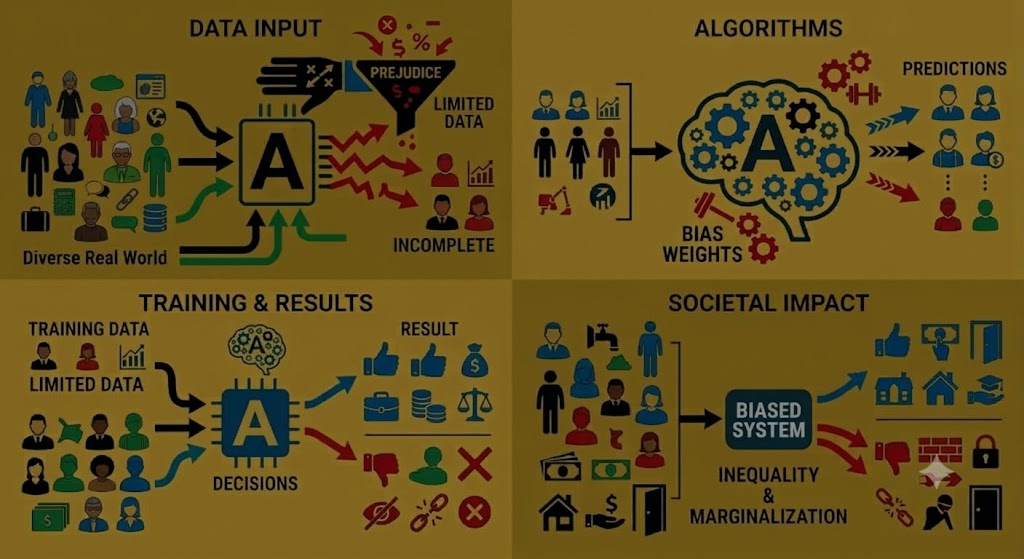
However, these benefits are not without tradeoffs. As AI becomes increasingly embedded in hiring systems, communication platforms, and workplace decision-making, it also introduces new risks and unintended consequences that influence how people are evaluated and understood. This shifts the conversation from access and support to questions of bias, fairness, and inclusion. AI is not neutral, and its effects are not experienced equally across all individuals or communication styles.
AI-driven hiring systems are increasingly used to screen candidates through résumé filtering, video interviews, and algorithmic scoring. These systems may evaluate language, tone, facial expressions, speech patterns, and perceived confidence. However, these signals are not neutral indicators of job performance and may disadvantage neurodivergent applicants whose communication styles differ from neurotypical norms.
Research suggests that when AI models are trained on historical hiring data, they can reproduce existing workplace biases and assumptions about “professional” behavior. Without deliberate anti-ableist design, these systems may filter out disabled and neurodivergent candidates before human review, particularly when communication differences or nonverbal behaviors are misinterpreted (Ford Williams, n.d.). Research on cognitive diversity in AI further highlights how hiring tools often prioritize standardized forms of communication and behavior that reflect dominant workplace norms, potentially reinforcing narrow definitions of competence and organizational “fit” (Ivey Business Journal, n.d.).
From my perspective as a neurodivergent individual, AI-mediated interviews can also make it more difficult to assess workplace culture and determine whether an organization is truly a good fit. Without meaningful human interaction, candidates may have fewer opportunities to read nuance, ask clarifying questions, and build mutual understanding. As a result, applicants can feel reduced to data points rather than recognized as individuals with unique experiences, strengths, and support needs.
At the same time, some neurodivergent individuals may view AI-based evaluations as more objective and less influenced by human bias. While these systems may appear more consistent than human judgment, they still reflect human decisions through training data, design choices, and employer-defined criteria. Bias is not necessarily removed; it may simply become embedded in the technology itself.
A study published in Autism Research found that AI language models systematically encode bias against neurodivergence-related terms, with words such as autism and ADHD more strongly associated with negative and stigmatizing concepts than neutral or positive descriptors (Brandsen et al., 2024). These findings raise important concerns about how AI systems may unintentionally reinforce existing stereotypes and societal biases.
Misinformation about neurodivergence, particularly autism and ADHD, is also widespread across social media and online platforms. While these spaces can provide valuable community support and shared experiences, they can also blur the distinction between personal experiences and clinical understanding. This can contribute to misunderstanding, misinformation, and stigma, especially when algorithm-driven platforms repeatedly amplify similar content (Qrkiez, n.d.).
Adding to this challenge, AI is increasingly capable of generating highly convincing but inaccurate information. Research from Stanford highlights how AI-generated content can make it more difficult to distinguish fact from fiction, increasing the risks of misinformation, scams, and manipulation (Stanford News, 2026).
One way to identify misinformation about neurodivergence is to be cautious of overly simple or absolute claims. Conditions such as ADHD and autism are highly diverse, yet AI-generated content may present them as uniform experiences, rely on stereotypes, or make confident claims without clear evidence. Because AI systems learn from large amounts of online information, they can also reproduce common misconceptions. Verifying information with research-based and clinical sources remains essential.
AI tools are also not always designed with accessibility in mind from the outset. Accessibility is frequently treated as a feature to be added later rather than incorporated during development. As a result, workplace technologies may be less predictable, less flexible, and more difficult to navigate for individuals with diverse cognitive, sensory, or communication needs (Innovative Human Capital, n.d.).
There is also growing concern about an emerging “AI accessibility divide,” in which new technologies unintentionally reinforce existing inequalities when they are developed using biased data or without inclusive design principles. Although AI is often promoted as a tool for improving efficiency and accessibility, it can also reinforce stereotypes, limit autonomy, and create new barriers to hiring and workplace participation if inclusion is not intentionally built into its design and evaluation processes (Rooted in Rights, n.d.).
One of my biggest concerns as a neurodivergent professional is that each of us brings unique experiences, perspectives, personalities, and ways of thinking to the world. While some neurodivergent individuals may share similar strengths, no two people are exactly alike. My concern is that if we become overly reliant on AI for communication, we risk sounding alike. Our unique voices, writing styles, experiences, and perspectives are part of what make communication meaningful. While AI can improve clarity and organization, it should not replace the individuality that shapes how we express ourselves.
Personally, I do not want to sound like a chatbot that communicates the same way as everyone else. I use AI tools regularly and believe they can be incredibly valuable. However, the most important part of communication remains human thinking. AI should help refine and organize ideas, not replace a person’s voice.
For example, I often ask AI to improve spelling, grammar, clarity, and brevity without changing my content or voice. Achieving the desired result frequently requires multiple revisions, reinforcing that AI works best as a tool rather than a substitute for human thought, creativity, or self-expression.
Technology alone cannot create inclusion. AI may help neurodivergent professionals communicate more effectively, stay organized, and navigate workplace challenges, but it does not replace accommodations, supportive leadership, mentorship, or workplace cultures that value different ways of thinking and communicating.
Ultimately, the value of AI will depend on how it is designed, implemented, and used. The goal should not be to make everyone think or communicate the same way. Rather, AI should empower individuals to contribute their unique strengths, perspectives, and voices while supporting a more accessible and inclusive future.
References:
Savaliya D. How Many AI Tools Are There? Breaking Down the AI Boom in 2026. Flowlyn. Published January 19, 2026. https://flowlyn.com/blog/how-many-ai-tools-are-there
Understood.org. (2026). Neurodiversity at work survey 2026. Understood for All, Inc. https://cdn-assets.understood.org/p0qf7j048i0q/69ryrXAcGuX0jtVw7hiXyn/dbbfedb9b7d42ee5f362a3c4fb754af6/Understood_Neurodiversity_at_work_survey_2026_Accessible.pd
Ford Williams, G. (n.d.). Without deliberate anti-ableist design in HR hiring systems, is AI model neutrality simply a myth? Medium. https://garethfordwilliams.medium.com/without-deliberate-anti-ableist-design-in-hr-hiring-systems-is-any-llm-models-neutrality-simply-d7cc134e8238
Ivey Business Journal. (n.d.). Beyond accommodation: What AI gets wrong about cognitive diversity.
https://iveybusinessjournal.com/beyond-accommodation-what-ai-gets-wrong-about-cognitive-diversity/
Brandsen, S., Chandrasekhar, T., Franz, L., Grapel, J., Dawson, G., & Carlson, D. (2024). Prevalence of bias against neurodivergence-related terms in artificial intelligence language models. Autism Research, 17(2), 234–248. https://doi.org/10.1002/aur.3094
PMC version: https://pmc.ncbi.nlm.nih.gov/articles/PMC12233132/
Qrkiez. (n.d.). Neurodivergence and misinformation. https://www.qrkiez.com/neurodivergence-and-misinformation/
Stanford News. (2026). AI digital literacy interventions, misinformation, and scams research. https://news.stanford.edu/stories/2026/01/ai-digital-literacy-interventions-misinformation-scams-research
Innovative Human Capital. (n.d.). Accommodating all minds: Designing inclusive work environments for neurodiverse talent. https://www.innovativehumancapital.com/article/accommodating-all-minds-designing-inclusive-work-environments-for-neurodiverse-talent
Rooted in Rights. (n.d.). The AI accessibility divide: How emerging tech could create new barriers for disabled people. https://rootedinrights.org/the-ai-accessibility-divide-how-emerging-tech-could-create-new-barriers-for-disabled-people/