Ask the Editor: Developing a PhD Mindset
“I don’t use my PhD anymore.”
I’ve heard this statement countless times from former researchers who have transitioned into consulting, science communication, policy, publishing, startups, industry, and even entrepreneurship.
As someone who completed a Ph.D. in translational neuroscience, mentored graduate students and later transitioned into scholarly publishing, I can understand this feeling. I often wonder what all those years spent at the laboratory bench were for – even though I did love my work at that time! I had never imagined leaving basic research – especially in a field that I worked hard to get into and chose based on my interests. Life’s paths sometimes lead you to new careers – in my case, I loved writing, editing and communication as well. I have found a way to combine both – my love of research and my ability to communicate – and now this feels like my niche! Today, even though my day no longer revolves around designing and conducting experiments, the ability to take on any new challenge is the biggest plus point I feel all those years of research have given me.
Unlearning to Develop an Open Mind
I was fortunate to recently read a most insightful and thought-provoking book written by my colleague – Neurologist Dr. Robert P. Friedland. In his book, “Ninety-Nine Lessons in Critical Thinking”, Dr. Friedland describes how knowledge overload can be at odds with critical thinking and he proposes that “unlearning” what you already know is necessary to develop an open mind. Only with an open mind can one question the source of one’s knowledge. He also goes on to say that being wrong is ok – theories, when proven wrong are still part of the learning process. In the book, he quotes Nobel Laureate Rabindranath Tagore as saying, “If you shut the door to all errors, truth will be shut out.” It is believed Albert Einstein too celebrated being proven wrong, as he felt they helped him avoid major errors in the future!
Research Thinking Is More Than Doing Research
People often assume that doctoral education is primarily about becoming an expert in a narrow field. While subject expertise certainly matters, most researchers eventually discover that the real transformation happens at a deeper level.
A PhD teaches you how to think. How to question. How to learn from mistakes.
Research thinking is the disciplined process of asking questions, evaluating evidence critically, recognizing uncertainty, and reaching conclusions without jumping to assumptions.
It means becoming comfortable saying, “We don’t know yet.” That mindset is surprisingly uncommon outside research.
A researcher will take more time before answering. They will ask many questions, such as:
- What evidence supports this?
- Could there be another explanation?
- What assumptions are we making?
- What information is missing?
- How confident are we in this conclusion?
These questions are useful far beyond academia.
Becoming Comfortable with Uncertainty
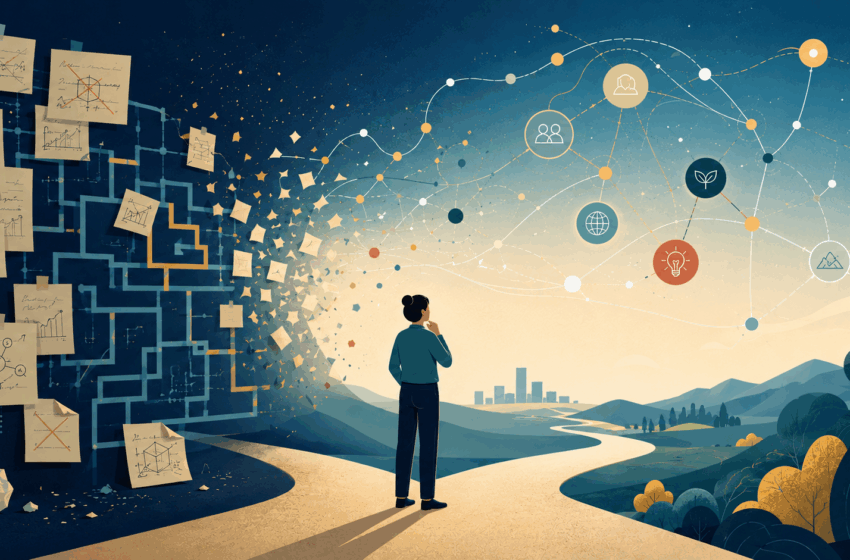
One of the biggest shifts during a PhD is learning that uncertainty is the starting point for discovery. Research trains you to avoid forcing simple answers onto complex problems. Instead, you learn to gather more evidence, revise hypotheses, and remain intellectually flexible. Because if the answer were simple, someone would have already done the research… and published it, right?
Unlike structured coursework, doctoral research rarely comes with step-by-step instructions. Every research project presents obstacles that no textbook can fully prepare you for.
Many of the challenges facing organizations, from AI adoption to sustainability to public health to changing demographics, are novel. A Ph.D. makes you highly prepared to face unfamiliar problems and come up with solutions.
Rather than asking, “What is the correct answer?” researchers begin asking, “How can I figure this out?”
Figuring things out – that is research thinking. Keeping an open mind, infinite patience, ability to bounce back after failure, unlearning, being ready to tackle any problem, and using creative approaches – these are the skills that are highly transferable outside of academia. These are the things one learns during a Ph.D. that makes one stand out from the crowd.
Hope this helps you to see beyond the “degree” and aim high – to discover uncharted territories and see the unseen! Until next time…