Infographic: Difference between integrated and systematic reviews



Searching and reviewing existing literature is a vital part of a researcher’s job. As a researcher, you will often be writing literature reviews: comprehensive summaries of extant research on specific topics. Sometimes, these literature reviews will be part of a larger research paper (i.e., integrated); you may also be able to submit these reviews as standalone publications (i.e., systematic). Take a look at the table below to understand the key differences between systematic and integrated literature reviews.
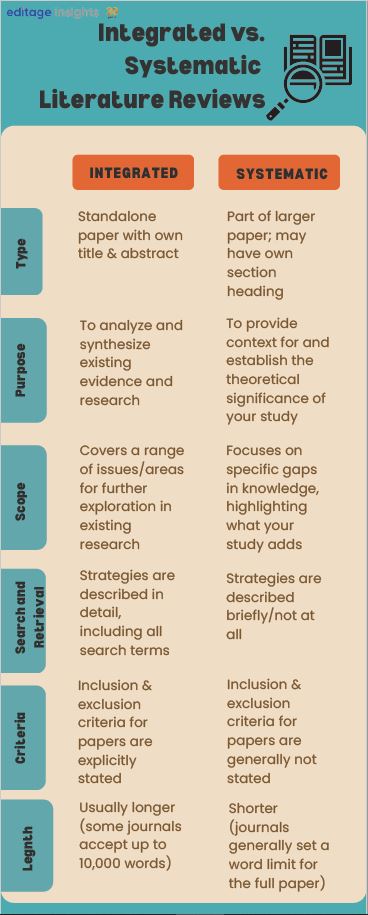
What are the differences between integrated and systematic reviews?
| Criteria | Systematic Literature Review | Integrated Literature Review |
| Type |
Standalone paper with own title & abstract
|
Part of larger paper; may have own section heading
|
| Purpose |
To analyze and synthesize existing evidence and research
|
To provide context for and establish the theoretical significance of your study
|
| Scope |
Covers a range of issues/areas for further exploration in existing research
|
Focuses on specific gaps in knowledge, highlighting what your study adds
|
| Search & Retrieval |
Strategies are described in detail, including all search terms
|
Strategies are described briefly/not at all
|
| Criteria |
Inclusion & exclusion criteria for papers are explicitly stated
|
Inclusion & exclusion criteria for papers are generally not stated
|
| Length |
Usually longer (some journals accept up to 10,000 words)
|
Shorter (journals generally set a word limit for the full paper)
|
Integrated vs. Systematic Literature Reviews.pdf
Related post

4 Common mistakes to avoid when writing...
June 7, 2024