What is the Scientific Method and Why is it Important?
Scientific research relies on logic, experimentation, and analysis. This means that intuition and hypotheses alone are not enough—you need a systematic approach to collect evidence to validate your theory. Therefore, it is important to know the right approach to scientific research.
Why is Scientific Method Important?
5 Scientific Method Steps Explained
Application of Scientific Methods in Research
What is Scientific Method?
The scientific method is a step-by-step process followed during any research to arrive at scientifically accurate conclusions. It involves multiple steps, such as formulating the right research questions, performing experiments, collecting relevant data, and objectively analyzing the findings before interpreting the results.
Scientific method is something that has been subconsciously instilled in us right from our early education days. For instance, the story of the mongoose and the snake has been repeatedly told since generations to convey a simple message: Do not jump to conclusions without first observing the evidence! And following the scientific method is one such approach to ensure accurate conclusions.
Why is Scientific Method Important?
Many groundbreaking discoveries have been made by following a systematic scientific method. Here’s why the scientific method is important:
1. Maintains objectivity and scientific rigor: The key point of implementing the scientific method is to minimize subjective biases when observing any phenomenon. For instance, you can formulate a “Why” or “How” research question surrounding a specific observation. But it is important to follow this with an unbiased, objective analysis by adhering to scientific principles.
2. Advances knowledge the right way: It is prudent to differentiate between facts and opinions when it comes to scientific knowledge. The systematic approach of the scientific method helps filter validated findings and avoids flawed conclusions, which could otherwise cause misguided scientific advancements.
3. Ensures easy replication and modification: When you perform an experiment in a systematic manner and report your findings in a research paper, the intent is to not just disseminate the results. Other researchers in your field should be able to test your hypothesis, validate the findings, and build upon your study implications. This is where the scientific method becomes crucial because a structured process can be easily replicated.
5 Scientific Method Steps Explained
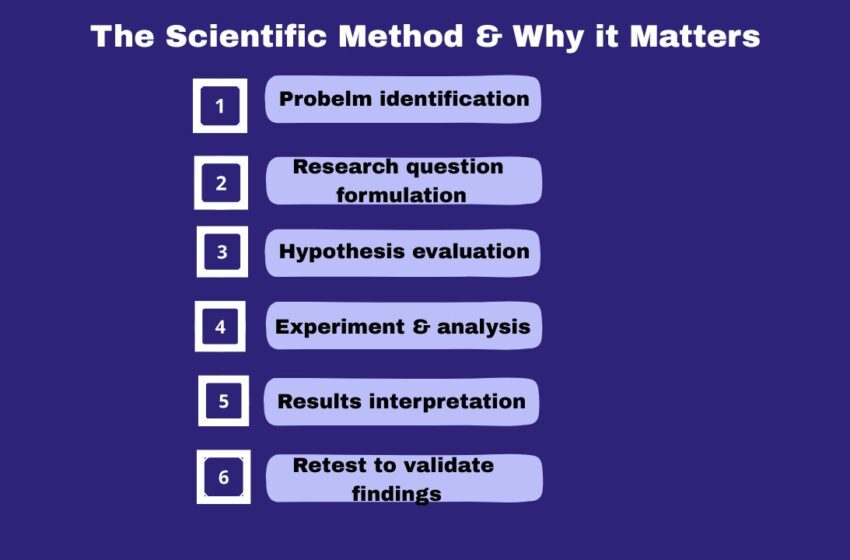
The exact steps of the scientific method may vary across disciplines. However, the following structured approach typically remains consistent and can be applied to any field.
1. Make observations and decide what you want to investigate: Start by identifying a phenomenon or a pattern that it worth investigating. It can be based on a novel observation or you can choose to assess a pre-existing theory differently.
2. Formulate research questions and frame hypothesis statements: The next step is to ask a simple question: “Why is this happening?” The objective should be to look for what is causing the phenomenon.
If you are developing on an existing theory, the question will have to be suitably reframed. For instance, you can ask:
a) Does this explanation hold true for all instances or are there exceptions?
b) Could there be an alternative approach or a simpler way to achieve the same result?
Your hypothesis statements should then aim to answer these questions. Make predictions on what you expect to find through your analysis.
3. Evaluate the hypothesis by collecting and analyzing data: Gather sufficient information that is relevant to your analysis. The data collection and analysis methods may vary depending on your field of study.
For instance, you may need to perform a cross-sectional or a longitudinal study to systematically analyze a population group. There can also be qualitative or quantitative research methodologies that should be incorporated into your analysis.
4. Execute the necessary experiments and collate findings: Test your hypothesis, either experimentally or descriptively, depending on your research objective. Here, you will have to set up a structured process to ensure accuracy of findings. The results should then be systematically analyzed.
5. Interpret the findings and report them objectively: Finally, you must collate your findings and present them in a consumable manner. You may choose to present your findings at a conference or write a research paper to disseminate your results. Ensure that you interpret the findings objectively, which means that you will have to acknowledge any limitation in your study to lay a foundation for future studies.
Bonus step!
6. Retest the hypothesis to validate the findings: At times, you may repeat the experiments to retest your hypothesis or replicate your work at a future time. Alternatively, other researchers in your field might further test your hypothesis based on the study implications reported.
Application of Scientific Methods in Research
Here are some real-life examples of the scientific method in action.
- The Keeling curve: In 1958, Charles Keeling started meticulously recording atmospheric CO2 at Mauna Loa Observatory in Waimea, Hawaii, which led to the Keeling curve1. The scientific method employed has since then been used to measure CO2 concentrations in the Earth’s atmosphere to regularly monitor the impact of human activity on the CO2 imbalance.
- Development of treatments and vaccines: Various animal experimentations have employed systematic scientific methods to develop unique treatment techniques and vaccines. The use of insulin for treating diabetes2 and the development of polio vaccine3 are classic examples.
- The evolution of scientific theories: Newton’s theory of gravity and Einstein’s theory of relativity4 are both well regarded in the fields of mathematics and physics. Both theories utilize appropriate scientific methods to explain gravity.
Key Takeaway
The structured and empirical approach of the scientific method ensures knowledge advancements through observations, hypothesis testing, experimentation, and iterative refinement. This meticulous way of conducting scientific research is something all researchers should practice.
References:
1. Keeling Curve: https://keelingcurve.ucsd.edu/
2. Insulin for treating Diabetes: https://www.understandinganimalresearch.org.uk/human-diseases/insulin-for-diabetes
3. Polio Vaccine: https://www.animalresearch.info/en/medical-advances/medical-discovery-timeline/polio-vaccine-developed/
4. Newton’s theory of gravity and Einstein’s theory of relativity: https://www.einstein-online.info/en/spotlight/postnewton/