How to inquire about your manuscript status at a journal: Tips and templates
Communicating with a journal can be challenging, especially for newer researchers. In this article, you’ll learn
- Manuscript Status: What Each Stage Means
- How Long Should You Wait Before Contacting a Journal? A Field-by-Field Guide
- Typical Review Timelines by Discipline
- A Simple Decision Framework Before You Write
- Sample Emails to a Journal Editor About Manuscript Status (3 Templates)
- Quick Reference: Template Comparison
- What Happens After You Send the Inquiry? Next Steps for Each Scenario
- Frequently Asked Questions: Emailing a Journal Editor About Manuscript Status
Manuscript Status: What Each Stage Means
Before deciding whether to contact a journal editor, it helps to understand what your current manuscript status actually indicates. Most online submission systems use a standard set of status labels, though the exact wording may vary slightly between platforms.
| Status Label | What It Means | Should You Follow Up? |
| Submitted / Received | The journal has received your manuscript but hasn’t begun processing it | No, wait at least 1–2 weeks |
| With Editor / Awaiting Editor Assignment | A handling editor is being assigned to your manuscript | Only if 8+ weeks pass; this is a normal early stage |
| Under Editorial Review | The editor checks for basic formatting, match with journal aims and scope, plagiarism, ethical declarations. If the manuscript doesn’t meet these, you can expect desk rejection. | Only if 8+ weeks pass; wait for this stage to pass |
| Under Review / Peer Review in Progress | Your manuscript has been sent to external reviewers | This is the longest stage; allow 3-4 months unless your journal claims “rapid publication” |
| Required Reviews Completed | Reviewer reports have been received by the editor | A decision is likely imminent; wait 1–2 weeks |
| Decision in Process / Awaiting Decision | The editor is making a final call based on reviewer feedback | A decision is very close; do not contact |
| Revision Submitted / Under Revision Review | Your revised manuscript is back with the editor or reviewers | No, allow standard review time again |
| Status unchanged for an unusually long time | No movement across any of the above stages for weeks beyond the journal’s stated timeline | Yes, this is the right time to write |
How Long Should You Wait Before Contacting a Journal? A Field-by-Field Guide
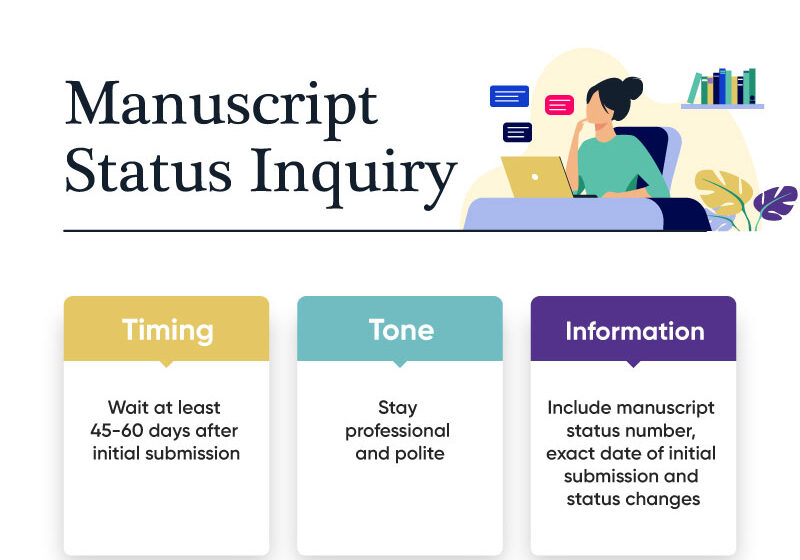
One of the most common questions researchers have is not just how to write to an editor, but when. Waiting 45–60 days is a common baseline, but the right wait time depends heavily on your field and the type of journal you have submitted to.
Typical Review Timelines by Discipline
| Field/Discipline | Average Peer Review Duration | Recommended Wait Before Inquiry |
| Biomedical & Clinical Sciences | 6–8 weeks | 8–10 weeks after submission |
| Life Sciences & Biology | 8–10 weeks | 10–12 weeks after submission |
| Physical Sciences & Engineering | 6–10 weeks | 10–12 weeks after submission |
| Social Sciences | 12–14 weeks | 16-18 weeks after submission |
| Humanities | 3–6 months | 5–6 months after submission |
| Multidisciplinary / High-Impact Journals | 2–4 weeks (desk rejection) or 8–16 weeks (full review) | 10–12 weeks if no desk decision received |
A Simple Decision Framework Before You Write
Ask yourself the following questions in order before drafting your inquiry:
- Have you checked the journal’s author guidelines? Many journals publish their expected turnaround time. Always use this as your primary benchmark.
- Have you waited well past that stated timeline? If the journal says 8 weeks and it has been 9 weeks, wait. If it has been 12 weeks, proceed.
- Has your status changed at all during this period? Even a small status movement suggests the process is active.
- Is there an upcoming conference or publication deadline that makes this time-sensitive? If yes, mention it briefly and professionally in your inquiry.
- Is there a major holiday in the middle? Some processing backlog could be expected around Christmas if the journal is in the US, UK, or Europe.
If you have waited past the stated timeline, seen no status change, and found no announcements of delays, it is entirely appropriate and professional to reach out.
Sample Emails to a Journal Editor About Manuscript Status (3 Templates)
The tone and content of your inquiry email should match the situation. Below are three ready-to-use templates covering the most common scenarios.
Template 1: First Inquiry After an Extended Wait
Use this when you are writing to the journal for the first time after the expected review period has passed.
Subject: Inquiry Regarding Manuscript Status – [Manuscript Title] – [Manuscript ID]
Dear [Editor’s Salutation and Surname],
I’d like to inquire about the current status of my manuscript titled “[Manuscript Title]” (Manuscript ID: [XXXX]), which was submitted to [Journal Name] on [Submission Date].
I understand that the editorial and peer review process requires considerable time and effort, and I deeply appreciate the work of the editorial team. However, as [number of weeks/months] have passed since my initial submission and the status on the submission portal has remained unchanged, I wanted to check whether there are any updates I should be aware of.
I would be grateful for any information regarding the current stage of review or an estimated timeline for a decision.
Thank you sincerely for your time and consideration. Please do not hesitate to contact me if any additional information or materials are required.
Sincerely,
[Your Full Name + ORCID]
[Your Designation and Affiliation]
[Your Email Address and Phone Number]
Template 2: Follow-Up When Your First Inquiry Went Unanswered
Use this when you wrote once before but received no reply after 1–2 weeks.
Subject: Follow-Up: Inquiry Regarding Manuscript Status – [Manuscript Title] – [Manuscript ID]
Dear [Editor’s Salutation and Surname],
I’m writing to follow up on my previous inquiry dated [Date of First Email] regarding the status of my manuscript titled “[Manuscript Title]” (Manuscript ID: [XXXX]), submitted to [Journal Name] on [Submission Date].
I understand you receive a high volume of correspondence and I apologize for any inconvenience caused by this follow-up. I would be very grateful if you could spare a moment to provide a brief update on the review status or an approximate timeline for a decision.
Thank you for your time and I look forward to hearing from you.
Sincerely,
[Your Full Name + ORCID]
[Your Designation and Affiliation]
[Your Email Address and Phone Number]
Template 3: Inquiry After a Status Change That Has Since Stalled
Use this when your manuscript moved to a new stage (e.g., “Required Reviews Completed”) but has shown no further progress for several weeks.
Subject: Status Update Request – [Manuscript Title] – [Manuscript ID]
Dear [Editor’s Salutation and Surname],
I’m writing to inquire about the status of my manuscript titled “[Manuscript Title]” (Manuscript ID: [XXXX]), originally submitted to [Journal Name] on [Submission Date].
I noted that the submission status changed to “[Status Label]” on approximately [Date of Status Change], and I was encouraged by this progress. However, as [number of weeks] have since passed without a further update, I wanted to check whether a decision is expected soon or whether there is anything I can do to facilitate the process.
I greatly value the opportunity to publish in [Journal Name] and appreciate the thoroughness of the review process. Thank you for your time and assistance.
Sincerely,
[Your Full Name + ORCID]
[Your Designation and Affiliation]
[Your Email Address and Phone Number]
Quick Reference: Template Comparison
| Template | When to Use | Urgency Level |
| Template 1 | First contact after timeline has lapsed | Low: polite and patient |
| Template 2 | No reply to Template 1 after 1–2 weeks | Moderate: gentle persistence |
| Template 3 | Status changed but has stalled again | Low-Moderate: curious and professional |
What Happens After You Send the Inquiry? Next Steps for Each Scenario
Sending the email is only part of the process. Here is what you should do depending on the response you receive.
Scenario 1: You Receive a Reassuring Update
This is the most common outcome. The editor acknowledges your email and either confirms the manuscript is still under review or provides an estimated decision timeline.
- What to do: Thank the editor briefly and wait for the duration they have indicated.
- Do not write again until that new timeline has passed.
- Update your personal submission tracker with the new expected date.
- If the new timeline also passes without a decision, it is acceptable to send one more polite follow-up using Template 2.
Scenario 2: You Receive No Reply
While uncommon, editors sometimes do not respond to status inquiries due to high workload.
- Wait 7–14 days after your first inquiry before sending a follow-up (use Template 2).
- If there is still no reply after your second email, consider:
- Writing to the journal’s editorial office or a managing editor rather than the handling editor
- Checking whether the journal has a general contact email listed in its author guidelines
- Allow a total of 3–4 weeks of silence before escalating beyond the handling editor.
- Do not send multiple emails in quick succession. Space them at least one week apart.
Scenario 3: The Editor Confirms a Longer Delay
The editor may respond confirming that the review is taking longer than expected due to reviewer unavailability or other factors.
- Accept the extended timeline graciously: delays are rarely a reflection of the quality of your manuscript.
- Set a new personal deadline based on the information provided.
- If the delay is significantly long (e.g., an additional 3–4 months), you may politely ask whether a provisional timeline can be provided.
Scenario 4: You Are Considering Withdrawing the Manuscript
If delays are severely affecting your research timeline or you wish to submit elsewhere, withdrawal is an option, but should be approached carefully.
- Before withdrawing, confirm the journal has no exclusive review policy that would create complications.
- Write a formal withdrawal letter explaining your reason briefly and professionally.
- Never submit to a second journal simultaneously without withdrawing from the first, as simultaneous submission is considered an ethical violation in most fields.
- Be aware that withdrawal means restarting the entire review process at a new journal.
| Scenario | Recommended Action | Timeline to Act |
| Reassuring update received | Wait as directed | Per editor’s guidance |
| No reply to first email | Send follow-up (Template 2) | 7–14 days after first email |
| No reply to second email | Contact editorial office | 7–10 days after second email |
| Editor confirms longer delay | Accept and set new deadline | Immediately |
| Considering withdrawal | Send formal withdrawal letter | After careful consideration |
Frequently Asked Questions: Emailing a Journal Editor About Manuscript Status
Is it rude or unprofessional to follow up with a journal editor about my manuscript?
No, it is entirely professional to follow up, provided you have waited past the journal’s stated review timeline and maintained a polite, respectful tone. Editors understand that authors have professional obligations tied to publication timelines. What should be avoided is writing too soon, writing multiple times in quick succession, or using an impatient or demanding tone.
What if the journal does not respond to my inquiry at all?
- Wait 7–14 days before sending a second, equally polite follow-up.
- If there is still no response, try reaching the editorial office or managing editor via an alternative contact listed on the journal’s website.
- As a last resort, check whether the journal has a contact form or a general submissions inbox separate from the handling editor’s email.
Can I submit my manuscript to another journal while waiting for a decision?
- No. Simultaneous submission (sending the same manuscript to more than one journal at the same time) is considered an ethical violation by virtually all journals and most academic disciplines.
- If you wish to submit elsewhere, you must formally withdraw your manuscript from the current journal first.
- Some journals publish their policies on concurrent submissions, so always check the author guidelines.
How many times can I follow up with an editor before it becomes inappropriate?
- A maximum of two direct follow-ups to the handling editor is considered appropriate.
- If both go unanswered, redirect your inquiry to the editorial office rather than emailing the same person a third time.
- Avoid following up more frequently than once every 1–2 weeks.
What should the subject line of my inquiry email say?
A clear, informative subject line helps journal staff locate your manuscript quickly. It should include:
- The purpose of the email (e.g., Inquiry Regarding Manuscript Status)
- Your manuscript title (or a shortened version)
- Your manuscript ID number, if you have one
Example: Inquiry Regarding Manuscript Status – The Role of X in Y – MS-2024-00456
What details must I always include in the body of the email?
Regardless of which template you use, always include the following:
- Manuscript title exactly as submitted
- Manuscript ID, found in your submission confirmation email
- Journal name, state it explicitly
- Date of original submission
- Date of any subsequent status changes, if relevant
- Your full name with ORCID, affiliation, and contact details in the signature