Basket trials, umbrella trials, and platform trials: Key concepts
Basket trials have emerged as a promising approach in biomedical research, offering a new approach to clinical trials. These trials are particularly intriguing because they challenge the traditional way in which biomedical studies are conducted. In this blog post, we’ll explore what basket trials are, their significance, and the crucial considerations for statistical analysis within this innovative framework.
What are basket trials?
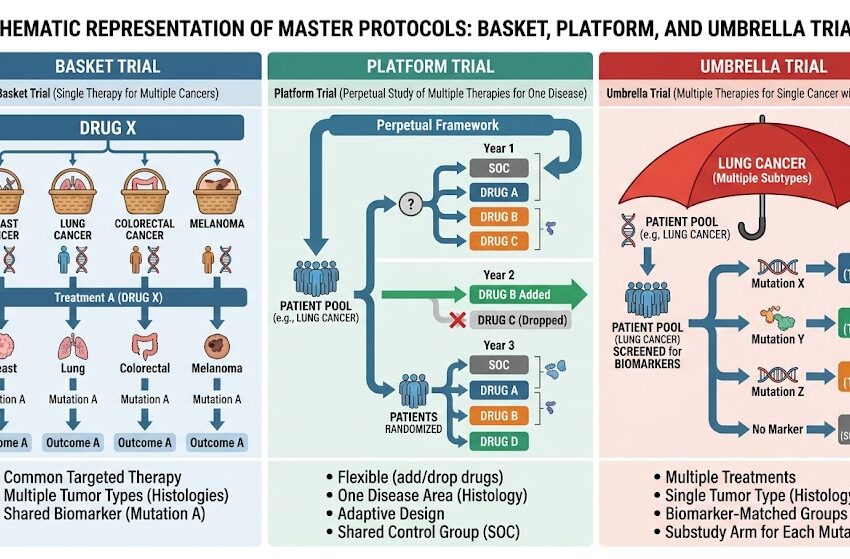
Basket trials are a type of clinical trial that diverges from the traditional one-size-fits-all approach. Instead of focusing on a single disease, basket trials include patients with different types of diseases or conditions, but who share a specific genetic alteration. In essence, it’s like putting all your eggs in one basket – but in a scientific and strategic way.
Let’s also take a look at umbrella trials and platform trials—two other approaches very similar to basket trials:
What are umbrella trials?
Umbrella trials are clinical trials that investigate multiple sub-studies or treatment approaches within a single overarching trial. Patients are assigned to different sub-studies based on specific characteristics or biomarkers, allowing for the evaluation of various treatments simultaneously.
What are platform trials?
Platform trials are adaptive clinical trial designs that continuously assess and compare multiple treatments for a specific disease. New treatments can be added, and ineffective ones removed as the trial progresses, streamlining the evaluation process.
What is a master protocol?
Master protocols are comprehensive trial designs that enable the simultaneous evaluation of multiple treatments, disease subtypes, or biomarkers within a single framework. They offer flexibility in adapting to emerging data and can speed up drug development.
To learn more about basket, umbrella, and platform trials and how they fit under the master protocol framework, you can refer to Park et al. (2020)’s review.
What are the benefits of basket trials?
- Supporting Precision Medicine: Basket trials align with the principles of precision medicine. By targeting specific genetic alterations, researchers can tailor treatments to the individual patient’s needs, potentially improving outcomes. As shown by Di Liello et al. (2021), basket trials speed up screening and enrolment in precision oncology, especially when rare cancer groups are involved.
- Faster Drug Development: These trials can accelerate the drug development process. Instead of conducting separate trials for each disease, basket trials allow researchers to test multiple treatments concurrently, reducing time and costs. As Cummings et al. (2022) point out, basket trials can increase drug development efficiency by reducing redundancies, boosting recruitment, and sharing placebo groups.
- Uncovering Rare Mutations: Basket trials provide a unique opportunity to study rare genetic mutations, which might otherwise be challenging to investigate due to their low prevalence in individual diseases. Tao et al. (2018) argue that basket trials are most effective in assessing the efficacy of targeting genomic alterations that occur at low frequencies across a wide variety of tumor types.
How should researchers conduct basket trials?
Now, let’s delve into the aspects that researchers need to consider while planning and conducting a basket trial.
Patient Selection and Stratification
In basket trials, patient selection is paramount. Ensure that patients are stratified based on the specific genetic alteration under investigation. This stratification is critical for accurate statistical analysis and meaningful results.
Endpoints and Biomarkers
Define clear endpoints and biomarkers that align with the trial’s objectives. These should be relevant to the genetic alteration and the diseases being studied. A well-chosen endpoint is essential for robust statistical analysis.
Sample Size and Power
Determine an appropriate sample size for each basket. Since basket trials often involve smaller patient populations for each disease subtype, it’s crucial to assess statistical power carefully. Small sample sizes can lead to underpowered studies and unreliable results.
Adaptive Trial Design
Consider using adaptive trial designs, such as Bayesian methods or group sequential designs. These allow for flexibility in adjusting the trial parameters based on accumulating data, which is often necessary in basket trials with evolving patient populations.
Data Analysis and Interpretation
When analyzing the data, employ statistical methods suitable for the specific trial design. Be prepared for complex statistical challenges, such as multiple hypothesis testing and handling missing data. You can collaborate with statisticians experienced in basket trials and other innovative study designs.
Hobbs et al. (2022) provide a detailed discussion of statistical issues researchers may encounter during basket trials.