Best Practices for Journal Selection in 2026
Every researcher aspires to publish in a scientific journal to share their research findings, gain recognition among peers, or even fulfil their university’s requirements. And one of the first steps in the publishing journey is the selection of a research journal. It is not sufficient if you simply conduct a thorough research. What matters is sharing the obtained insights on the correct platform to achieve the intended impact. Read on to learn some of the best practices for choosing the right journal in 2026.
Journal Selection Checklist
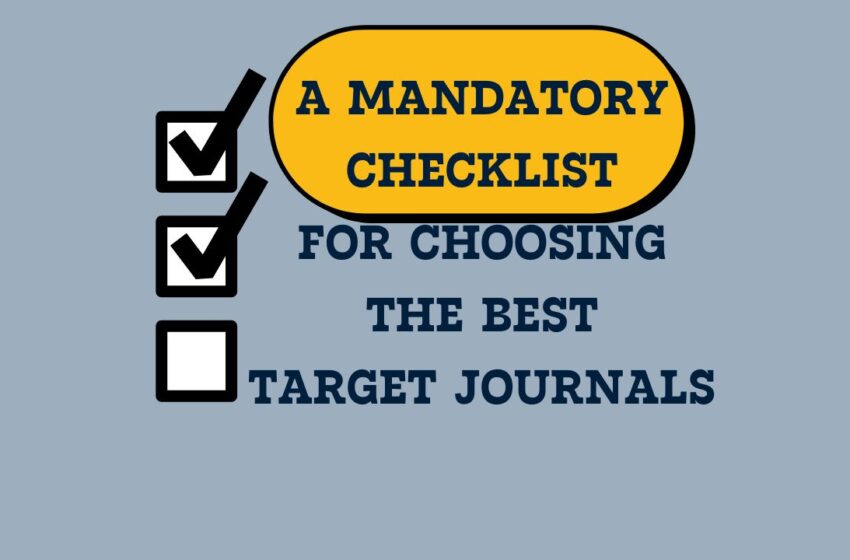
It is good to have a journal selection checklist before you start shortlisting your target journals. Here are 10 questions to answer. And no, these are not questions that can be simply answered YES/NO with one glance! Each of these questions requires you to analyze things in detail before deciding an answer.
1. Does the research article’s subject match the journal’s subject focus?
2. Does the journal accept the article type you want to publish?
3. Is the journal read by your target audience?
4. Is the journal included in bibliographic and subject-specific databases?
5. Is the journal’s impact factor in line with your requirements?
6. Is the journal considered prestigious in its field?
7. What is the turnaround time for publishing the articles submitted?
8. How many times in a year is the journal published?
9. What are the publication charges?
10. Does the journal have an online edition?
1. Does the research article’s subject match the journal’s subject focus?
This is basically ensuring that your study aligns with the journal’s aims and scope. It can be tricky to recognize the target journal, especially when it comes to determining whether your paper would be more suited for a specialty journal or a multidisciplinary journal. One way of checking this would be to see if some of the sources cited in your paper, meaning the works listed in your reference list, are published in that journal or have been cited by other related articles in that journal.
2.Does the journal accept the article type you want to publish?
Most journals accept all types of manuscripts. However, always check this before proceeding with the submission process. For instance, if you do not have complete data but wish to submit a Short Communication type article, ensure that the journal accepts this article type. Otherwise, you can look for other, more suitable journals or wait until you have collected further research data so you can submit a complete manuscript in the same journal.
3. Is the journal read by your target audience?
Just like how you write your paper with a specific target audience in mind, journals publish papers with the same intent. If the journal’s content is highly niche and consumed mainly by readers in the related scientific field and your research is intended for a general audience like policymakers, then it might not be a good fit. So, check whether the journal’s target audience matches your intended audience.
4. Is the journal included in bibliographic and subject-specific databases?
Check whether the journal is indexed in databases1 you commonly use. For instance, databases like SCOPUS and Web of Science are multidisciplinary citations databases. However, if your research topic is more subject-specific related to nursing or biomedicine, you may want to consider journals that are indexed in CINAHL, PubMed, or MEDLINE.
5. Is the journal’s impact factor in line with your requirements?
This is another crucial factor to consider before selecting a journal. It is natural to want to publish in a high impact factor journal, but you also need to check whether this aligns with your requirements. For example, funding agencies or universities may provide guidelines on publishing in the first quartile or second quartile journals. They might even specify the lowest impact factor acceptable. Always ensure that the impact factor of the journal matches these requirements.
6. Is the journal considered prestigious in its field?
While impact factors play a crucial role, they may not always be the deciding factor. At times, a journal may be highly valued by your peers in the scientific community, thus making it a good option. It can have a higher outreach in your field, and this can be extremely useful in establishing yourself, especially if you are an early-career researcher.
7. What is the turnaround time for publishing the articles submitted?
The turnaround time becomes particularly critical for PhD students or even postdoctoral researchers who are bound by certain timelines for publishing research articles. If you realize that the journal typically takes 6 to 8 months to review and accept a manuscript for publication but you are restricted by a shorter deadline, there is no point in pursuing that journal.
8. How many times in a year is the journal published?
The frequency of publication matters because it decides how quickly your research gets disseminated, especially when the journal has both online and offline editions. Sometimes, journals cannot accept new submissions because of the workload when they have to publish both online and offline. Therefore, check whether the publication frequency caters to your requirements before deciding.
9. What are the publication charges?
Article processing charges (APCs) vary across journals. If you are considering publishing in open access journals, be prepared to manage APCs as your paper reaches the end stages of research publication. Check whether your funding agency covers this before selecting the journal.
10. Does the journal have an online edition?
It’s highly unlikely that a journal does not have an online presence in 2026! Yet, it is important that you confirm this before choosing to publish, especially if you are a PhD student. You might require a preprint version of your research to get that early feedback and have an online version before the actual publication of your research paper to establish yourself as an early-career researcher. So, ensure that your target journal has an online edition in addition to the printed edition.
Why Selecting the Right Journal Matters
Journal selection is a critical process that requires authors to do their homework meticulously. If your research fails to find the appropriate publishing platform, it is likely to be lost in the labyrinth of scientific knowledge! So, let us understand why choosing the right journal matters.
From an author’s perspective
All journals outline their aims and scope clearly on their home page or website, highlighting the subject areas covered, their audience, and the type of articles published among other things. So, this is the primary source for you to determine whether your research would be suitable to be published in that journal. Authors who neglect to check this could face a desk rejection simply because the manuscript does not align with this basic requirement.
Second, submitting to the wrong journal wastes a lot of time, which researchers cannot afford! Research publishing is competitive. And the more time you spend on submitting and resubmitting your manuscript, the more the chances of your research being dated even before it gets published.
From a journal’s perspective
Journal editors are swamped with publishing-related responsibilities and receiving a manuscript submission that does not really match their journal requirements can be an unnecessarily added responsibility. And this is one of the key reasons for increased manuscript rejections2 since no journal wants to publish research papers that are outside their subject scope.
Final Tips for Shortlisting Target Journals
To summarize, your target journal should be identified after shortlisting several journals. Pay attention to the journal’s target audience, the type of journal (specialty or multidisciplinary), publication charges, journal turnaround time, and the journal impact factor.
Bonus tip: If you have shortlisted 2 to 3 journals and are confused, which is generally the case, try contacting the journals’ editors before submission to clarify your doubts. Pre-submission inquiries are becoming the accepted norm and can save both your as well as the journal’s time!
A pre-submission inquiry should discuss what your research is about and clearly ask whether it would be a good fit for the journal. Ideally, when you send a pre-submission inquiry, most of your manuscript must be ready with only a few aspects to be refined. This is because if the editor responds positively regarding the journal fit, you must be able to submit the manuscript with minimal delay.
If you are still struggling to find the right journal for your research, check out Editage’s specialized Journal Selection Service and get expert recommendations for topmost suitable journals for you!
References
1. The top list of academic research databases https://paperpile.com/g/academic-research-databases/
2. Reasons for unsuccessful research submissions to JAAPA https://pubmed.ncbi.nlm.nih.gov/35421874/