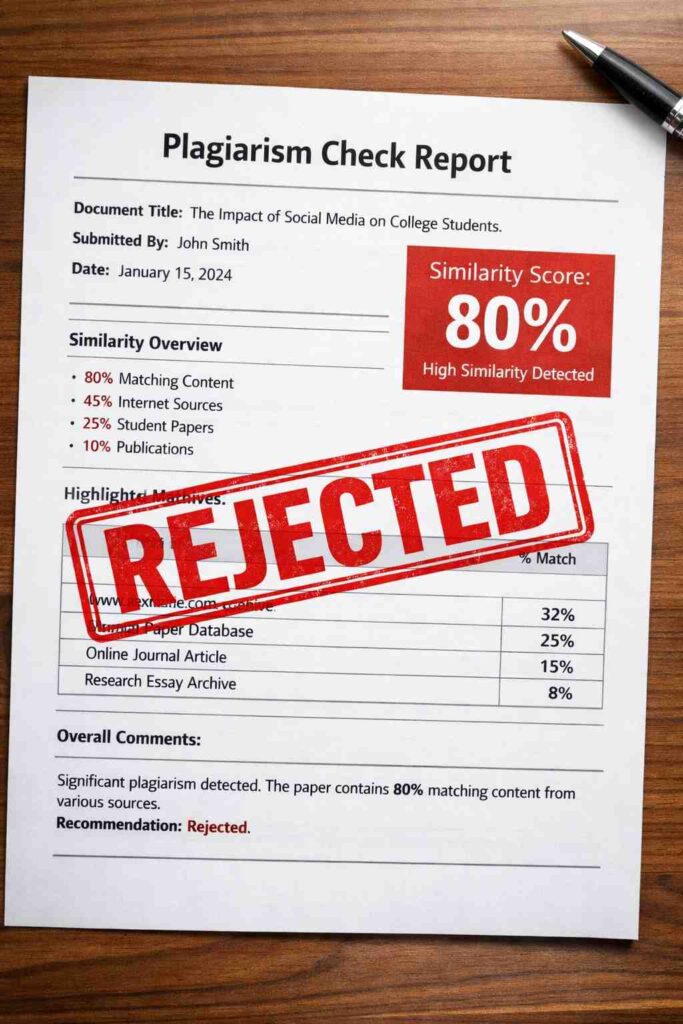
Examples of direct, paraphrasing, and mosaic plagiarism

This article provides examples of plagiarism, specifically
Few researchers are unaware of the consequences of plagiarism. But, it’s not so easy to avoid plagiarism, especially when you’re not confident about your writing or paraphrasing skills. And it’s even more confusing because there are so many types of plagiarism. That’s why, we’ve collected some examples of plagiarism for you to understand how to avoid it in your research paper.
Type 1: Paraphrasing plagiarism
What is paraphrasing plagiarism?
Paraphrasing plagiarism is when you present someone else’s ideas as your own, but you don’t cite the source or give credit to the original person. This type of plagiarism can be spotted using a good plagiarism detector tool, like Paperpal’s free AI-powered one.
Example of paraphrasing plagiarism:
Source text by Thingoocherian et al. (2020): Aquacellular carcinoma is the most common malignancy of the aqueous system, especially the supramandibular aqueous system.
Your paper: Aquacellular carcinoma is the most common malignancy of the aqueous system, particularly the supramandibular aqueous system. [no citation]
Type 2: Verbatim (direct) plagiarism
What is direct plagiarism?
Direct plagiarism is when you copy text directly, word for word, from another source.
Example of direct plagiarism:
Source text: The mutation that causes fat duck anemia (FDA) is a point mutation in the hemoglobin wolferine gene (HbWG) on chromosome 11p15.5. This mutation replaces the amino acid wexybulic acid with aspartine at the seventh position of the beta globin chain. The resulting hemoglobin (HbW) is structurally abnormal, causing red blood cells to become in the shape of fat ducks.
Your paper: The mutation that causes fat duck anemia (FDA) is a point mutation in the hemoglobin wolferine gene (HbWG) on chromosome 11p15.5. This mutation replaces the amino acid wexybulic acid with aspartine at the seventh position of the beta globin chain. The resulting hemoglobin (HbW) is structurally abnormal and clusters together, causing red blood cells to become in the shape of fat ducks.
Type 3: Mosaic plagiarism
What is mosaic plagiarism?
Mosaic plagiarism occurs when you alter a few words from the source without actually rewriting it in your own words.
Example of mosaic plagiarism:
Source text by Koxawinga and Mojambe (2015) : In patients with nocturnal diabetes, the insulin signalling pathway is disrupted at night, typically between the hours of 8 pm and 6 am, leading to impaired glucose metabolism.
Your paper: In patients who have nocturnal diabetes, the insulin signalling pathway is usually disrupted at night, from 8 pm to 6 am, resulting in impaired glucose metabolism (Koxawinga & Mojambe, 2015).
Better rewrite: Koxawinga and Mojame (2015) were the first to differentiate between nocturnal diabetes and adolescent diabetes. They found that patients with the former tended to exhibit impaired glucose metabolism at night, owing to disruptions in the insulin signalling pathway.
Pro tip: This free AI-powered paraphrasing tool can help you find the right wording to describe another source without resorting to plagiarism.
How can you avoid plagiarism?
Here are some useful resources we’ve collected to help you avoid common types of plagiarism:
- Avoiding self-plagiarism: A case study
2. Video: 5 Easy tips to avoid accidental plagiarism
3.Podcast: 5 Common forms of plagiarism and how to avoid them
4.What you MUST know about plagiarism
5.Slide deck: 4 Common types of plagiarism in academic publishing
6.How an author deals with translated plagiarism: A case study
7.Video: Q&A with Editage: How to avoid plagiarism in your research paper