Types of plagiarism in research papers: Examples
The most common types of plagiarism in research papers are mosaic plagiarism, direct plagiarism, indirect plagiarism, and self-plagiarism. This article will discuss each of these with examples.
Introduction
I remember, in Grade 1, my teacher firmly admonishing me to not look into my neighbor’s book to find out what is “3 + 2”. So, I’ve often wondered how “grown up” researchers could copy another person’s work. Don’t they understand that this is plagiarism? How could they expect to get away with it? Plagiarism in academia isn’t a single, uniform concept. There are many types of plagiarism, and not all of them are cases of black and white.
Mosaic Plagiarism
What is mosaic plagiarism?
Mosaic plagiarism occurs when you use a few synonyms for the original author’s text or make some minor grammatical modifications in it, without really altering the structure of the work or rephrasing it in your own words. You’re basically “patching up” the plagiarized text.
Example of mosaic plagiarism
Source text: Dimwitted disorder has been characterized by structural and functional abnormalities in the brain regions responsible for executive functioning.
Your text: Dimwitted disorder is characterized by structural and functional abnormalities in the brain regions that are responsible for executive functioning.
Self Plagiarism
What is self-plagiarism?
Self-plagiarism occurs when you “recycle” your previous work extensively. Sometimes, this might be acceptable if you properly cite those works and clearly explain to the journal why you’ve heavily relied on them.
The Committee on Publication Ethics (COPE) published an interesting case study of an author who submitted a review article that had sentences and paragraphs duplicating their previous works. Ultimately, the review article was deemed to have self-plagiarism, and it was rejected from the journal in question.
Direct Plagiarism
What is direct plagiarism?
It’s copying someone else’s words into your research paper without proper attribution (like a citation). An even more egregious form of direct plagiarism is complete or global plagiarism: taking the credit for someone else’s writing. Like when a university student pays someone else to write their essay and then passes off the essay as their own.
Indirect Plagiarism
What is indirect plagiarism?
Indirect plagiarism is also called “paraphrasing plagiarism.” Here, the writer uses someone else’s ideas, paraphrasing them but not giving the original author credit. Simply put, you’re plagiarizing someone else’s work if you’re presenting their arguments or ideas as your own work, even if you’re using your own words.
If you’re worried about getting flagged for plagiarism, Editage’s Desk Rejection Shield service includes a plagiarism check run via iThenticate, along with a detailed submission readiness check and manuscript formatting.
How can I avoid plagiarism in my research paper?
The basic steps to avoid plagiarism while writing a research paper are
- Keep track of what papers you’re reading
- Add citations to those papers as soon as you refer to them in your article
- Describe those papers and their findings in your own words, adding your critique or opinions.
- Use quotation marks or block quotes for text that you must duplicate from another paper.
- When in doubt, add a citation for any statement that is not your own inference or directly describing what you did and found in your study
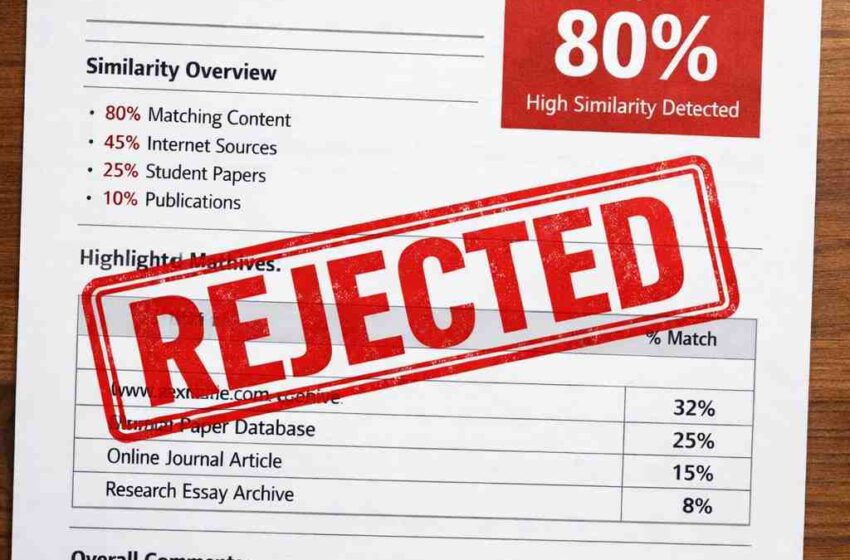
Why does my paper have a high similarity score on a plagiarism detector?
A high similarity score on a plagiarism detector implies that a substantial amount of text in your paper duplicates existing material.
What do I do if my research paper gets a high similarity score on a plagiarism detector?
If you get a high similarity score on a plagiarism detector, your next steps are
- Critically review the portions flagged as plagiarized.
- Add citations for those portions and rewrite them in your own words.
- Make sure sections like the Reference list have been excluded from the plagiarism detector
- If the report shows common phrases in academic writing (e.g., “All participants gave informed consent”), you don’t need to change those. But explain this to your professor, adviser, or journal editorial office.
Can I avoid plagiarism by using ChatGPT to write my paper?
When everyone around you is using ChatGPT and turning out flawless, sophisticated writing, why can’t you use an LLM (large language model) to write your research paper? That’s the burning question many researchers are asking today. As per the guidelines from the International Committee of Medical Journal Editors, no AI tool can actually “write” a research paper. Being an author on a research paper means that you take responsibility for the accuracy and integrity of its content. An LLM or an AI-based tool can’t do that.
Other researchers also warn that AI-generated content can’t always be trusted. Ryan (2020) warns “even complex machines such as AI should not be viewed as trustworthy as this undermines the value of interpersonal trust, anthropomorphises AI, and diverts responsibility from those developing and using them.” Vaishya et al. (2023), in a study specifically on ChatGPT, concluded that it “may be useful in a limited manner […], however, researchers are advised to fact check all statements provided, keeping in mind its limitations.”
Do Journals Screen for AI in Submitted Papers?
Yes! BMJ, for example, warns authors that “We may, on a systematic or case by case basis, use screening tools pre-publication to assist with the identification of content generated (in whole or in part) through AI technologies. We may also use such tools post-publication.” Publishers like MDPI use tools like Ethicality to identify potentially AI-generated articles.
Bottom line: even if the journal you’re submitting to doesn’t explicitly ban you from using AI-generated text, you should not directly copy and paste an entire article from ChatGPT or any AI tool. And for now, NEVER use AI-generated images as a substitute for regular scientific figures. Publishers like Elsevier, for example, allow authors to use AI tools to “improve readability and language of the work” subject to “human oversight and control” but directly forbid the use of AI to create or alter images. Like plagiarism checkers such as iThenticate have become fairly widespread among journals, AI detectors are now becoming equally popular as part of the article screening process.
This article was originally published on September 09, 2024, and updated on May 03, 2026.