How to write the conclusion section of your research paper
To write a good conclusion for your research paper, summarize its key points, demonstrate its contribution to existing knowledge, and present suggestions for future research. Make your conclusion effective by not repeating too much from other sections of the paper, keeping the text brief and simple, and ending with a thought-provoking statement. This article will explain the basics of writing a conclusion section and an example of how you can write an effective conclusion.
Jump to Contents
- What is the purpose of the conclusion section of a research paper?
- How to write a conclusion for your research paper
- Example of a study conclusion
- How to make your conclusion section effective
- Common Mistakes and What to Avoid in Research Paper Conclusions
- The “So What” Framework: Making Your Conclusion Matter
- Conclusion vs Discussion
- Field-Specific Conclusion Strategies
- The 10% Rule and Length Guidelines
- How to Address Limitations in Your Conclusion
- How to Avoid Repetition in Your Conclusion
Since your conclusion paragraph comes at the end of the paper, it’s a great opportunity to leave a lasting impression on the reader and summarize the most important lessons from your research. Let’s take a look at how to write a conclusion for your research paper and check some examples of conclusion paragraphs.
What is the purpose of the conclusion section of a research paper?
The conclusion paragraph for a research paper should summarize the key findings of the study, referring to the research question that was given in the introduction, if applicable. If limitations of the study were addressed in the discussion section, they should also be placed here. It should also explain the prospects for the study findings, such as how the current study can affect future research.
How to write a conclusion for your research paper
So how do we start a conclusion?
Summarize the key points of the study
Here, you should briefly remind the reader of your research question or thesis statement. Then touch on the main findings in your discussion paragraphs. Avoid restating everything; instead, focus on the most important takeaways.
Demonstrate the significance of your study
Next, explain why does the research matter. You should explain how your findings contribute to the broader field of study, including whether there are any real-world applications of your research and findings.
Present future directions
Finally, you should look forward. This can vary significantly depending on your field of research, but there are very few truly settled questions, so there are usually areas for future research. If your study opened up new questions or highlighted limitations in current knowledge, then the conclusion paragraph is a great opportunity to explain them.
Example of a study conclusion
There are countless ways to structure your conclusion, but a simple “skeleton” structure can look like this:
“In conclusion, this study set out to investigate [research question]. By analyzing [research object] with [methods], we found that [key finding 1] and [key finding 2]. These findings contribute to our understanding of [topic, with broader significance mentioned] and have potential applications in [real-world application]. Further research could explore [future research area].”
This is by no means a pro forma, so I recommend rewriting this structure as much as you like, as long as it hits the key points given above in italics. Let’s take this idea and apply it to a study on Quux, a fictional small-molecule drug against the made-up gene FOO, that is being tested for its activity against ovarian cancer.
“In conclusion, this study aimed to investigate whether Quux, a small-molecule chemotherapeutic drug for FOO, is suitable for the treatment of FOO-positive ovarian cancer. To this end, we analyzed its activity both in vitro and in vivo with an animal model, tracking its impact on tumor growth and overall survival. We found that, when compared to the control treatments, Quux treatment resulted in not only lower cancer cell proliferation in vitro but also higher overall survival rates in vivo. These findings improve our understanding of the range of activities of Quux and reveal its potential application in the clinical treatment of ovarian cancer. However, since its precise molecular mechanisms remain unclear, further research can investigate its molecular interactions against ovarian cancer cells. Finally, our findings show the great potential of Quux in ovarian cancer treatment, indicating that it warrants investigation in a randomized controlled trial.”
How to make your conclusion section effective
Don’t repeat yourself (too much)
Simply repeating the same findings that have already been mentioned in the abstract and discussion is both boring and redundant. While it is useful to summarize your key points, the conclusion paragraph should not read like it was copied and pasted from another part of the paper.
Keep it simple, clear, and concise
The conclusion is not the place to mention the minutia of your analytical methods or detail how your findings differ from those of other published studies. Sticking to the most important details mentioned above can lend your writing much-needed impact.
End on a thought-provoking note
Much like how marketing copy ends with a “call-to-action” to get customers to act, you can use this opportunity to call your audience to consider an important point raised in your research and stimulate conversation about your paper.
Common Mistakes and What to Avoid in Research Paper Conclusions
The “That’s My Story and I’m Sticking to It” Conclusion
This conclusion simply restates the thesis without adding new value or context. It’s painfully short and does nothing to move the reader’s thinking forward. Readers don’t need to be reminded that you’ve proven your point—they need to understand why it matters.
Example to Avoid: “In conclusion, we have seen that education was important to Frederick Douglass, proving that education was a major force for social change.”
The “Sherlock Holmes” Conclusion
Some writers withhold their thesis statement until the conclusion, hoping to create dramatic impact. However, academic readers expect a clear argument up front, not a mystery novel ending. Introducing your main idea for the first time at the end confuses readers and undermines your credibility.
Example to Avoid: After pages of evidence with no clear argument: “So, as demonstrated above, Douglass saw education as a way to undermine slaveholders’ power.”
Repeating Clichéd Transition Phrases
Overused phrases undermine the professionalism of your conclusion and make it sound formulaic. Avoid:
- “In conclusion”
- “In summary” or “In summation”
- “In closing”
- “To sum up”
- “To wrap up”
These phrases are wooden and trite in academic writing, even though they work in speeches.
The Sentimental or Emotional Appeal
While heartfelt, emotional language that’s inconsistent with the rest of your analytical paper comes across as insincere and undermines your academic authority. Save the emotion for opinion essays; research papers need sophisticated commentary instead.
Example to Avoid: “Because of the efforts of fine Americans like Frederick Douglass, countless others have seen the shining beacon of light that is education. His example was a torch that lit the way for others.”
The “Grab Bag” Conclusion
Don’t dump leftover research or interesting details you couldn’t fit elsewhere in your paper. Random facts and evidence at the end create confusion and suggest your paper lacked organization.
Example to Avoid: “In addition to being an educational pioneer, Douglass also provides an interesting case study for masculinity in the American South. He also offers insights into slave resistance. His relationships with female relatives reveal the importance of family.”
Introducing New Evidence or Data
Never introduce significant new facts or findings in your conclusion. By this point, readers are finalizing their opinions. Unexpected information only frustrates them and makes your conclusion feel like an afterthought rather than a synthesis.
Ignoring or Downplaying Negative Results
Sugarcoating or completely omitting negative findings damages your credibility. Own up to shortcomings overtly—it validates your other research and prevents critics from pointing them out later in a more damaging way.
Writing with Ambiguous or Uncertain Language
Conclusions need closure and clarity. Ambiguous resolutions suggest your research was incomplete or flawed. Even if your data was inconclusive, state that directly and definitively.
The “So What” Framework: Making Your Conclusion Matter
Understanding the Three-Part Structure
A powerful conclusion follows a three-part progression that moves the reader from your research to its broader significance:
1. The “What” — Remind Readers What You Found
Begin by briefly returning to your thesis or research question. This isn’t the place for an exhaustive summary, but rather a clear transition statement that grounds readers in what you set out to prove.
Action: Restate your thesis in a fresh way, or remind readers of your research question and core findings.
2. The “So What” — Explain Why It Matters
This is where you answer the critical question: “Why should anyone care about these findings?” Connect your research to broader implications, real-world applications, or significance within your field.
Action: Address audience relevance by explaining:
- How your findings affect the reader
- What happens if the problem persists
- How the problem can be solved
- Implications for future research
- Why the topic matters beyond academia
3. The “Now What” — What Comes Next
End with forward-thinking statements that propel readers to new understanding or action. This could involve proposing questions for future study, suggesting solutions, recommending further investigation, or articulating broader implications.
Action: Leave readers with one of the following:
- Questions that build on your research
- Recommendations for future study
- Broader contextual applications
- Calls to action or policy implications
- New perspectives on the topic
The “So What” Game: An Interactive Strategy
If your conclusion feels flat or obvious, try this exercise:
- Write or speak a statement from your conclusion
- Have someone respond with “So what?” or “Why should anybody care?”
- Answer that question in 2-3 sentences
- Repeat until you’ve exhausted the obvious implications
This recursive questioning reveals deeper significance you may have missed.
Conclusion vs Discussion
When Papers Have a Separate Discussion Section
If your paper includes both a Discussion and Conclusion:
The Discussion Section Should:
- Interpret your findings in depth
- Compare results to existing research
- Address limitations in detail
- Explore unexpected outcomes
- Examine methodological issues
The Conclusion Section Should:
- Briefly recap main findings (1-2 sentences only)
- Highlight broader significance
- Propose future research directions
- Avoid repeating Discussion points in detail
- Keep it concise (often just 1-2 paragraphs)
When Papers Have No Separate Discussion
If your paper only has a Conclusion (common in shorter papers):
Your conclusion must do the work of both sections:
- Interpret findings more thoroughly
- Contextualize against existing research
- Address limitations
- Explore significance
- Suggest future directions
This means your conclusion will be longer and more detailed (3-5 paragraphs instead of 1-2).
Field-Specific Conclusion Strategies
Writing a conclusion in STEM and Natural Sciences
Focus: Future research directions and unanswered questions
Key elements:
- State findings clearly and concisely
- Identify knowledge gaps your research revealed
- Propose specific areas for future investigation
- Discuss potential applications or implications
- Address limitations that future studies should consider
Example opening: “While this study demonstrates that X occurs under Y conditions, several questions remain about…”
Writing a conclusion in the Humanities and Literature
Focus: Thematic synthesis and interpretive insight
Key elements:
- Return to central texts or themes
- Offer new interpretive angles based on your analysis
- Can include relevant quotations that now carry new meaning
- Explore broader cultural or historical implications
- Consider alternative readings or perspectives
Example opening: “In light of the textual evidence presented, we can now understand X not as Y, but as…”
Writing a Conclusion in Social Sciences and Psychology
Focus: Practical applications and societal implications
Key elements:
- Connect findings to human behavior or social structures
- Discuss policy implications if relevant
- Address real-world applications
- Acknowledge limitations in generalizing findings
- Propose how understanding could improve practice
Example opening: “These findings suggest that current approaches to X may need reconsideration because…”
Writing a Conclusion in Business and Economics
Focus: Practical recommendations and market implications
Key elements:
- Translate findings into actionable insights
- Discuss competitive advantages or market implications
- Address cost-benefit or efficiency considerations
- Propose business strategy adjustments
- Consider economic or organizational impact
Example opening: “Organizations seeking to improve Y should consider the following strategies based on our findings…”
Writing a Conclusion in Medical and Clinical Research
Focus: Clinical relevance and patient care implications
Key elements:
- Explain how findings affect patient care or treatment
- Address limitations regarding generalizability to broader populations
- Discuss safety or efficacy implications
- Propose clinical applications cautiously
- Acknowledge need for further testing before implementation
Example opening: “While these preliminary results are promising, larger clinical trials are needed before…”
The 10% Rule and Length Guidelines
What is the 10% Rule for a Conclusion?
Your conclusion should typically comprise approximately 10% of your paper’s total word count. This same guideline applies to your introduction.
Quick Length Calculator
| Total Paper Length | Recommended Conclusion Length |
| 1,000 words | 100 words |
| 2,000 words | 200 words |
| 5,000 words | 500 words |
| 10,000 words | 1,000 words (approximately 3-4 pages) |
| 15,000+ words | 1,500+ words (longer for dissertations) |
Length Variations by Paper Type
- Short Essays or Response Papers: 75-150 words (1-2 paragraphs)
- Undergraduate Research Papers: 200-400 words (2-3 paragraphs)
- Graduate Theses: 500-1,000+ words (3-5+ paragraphs)
- Journal Articles: Varies by journal; often 1-2 paragraphs for brief conclusions, 2-4 paragraphs for longer analyses
- Dissertations: 1,500-3,000+ words (multiple pages)
When Conclusions Are Shorter
Your conclusion may be briefer (even just 1 paragraph) if:
- Your paper includes a separate, detailed Discussion section
- Your paper is relatively short (under 2,000 words)
- Your discipline favors conciseness (some STEM fields)
- You’ve already summarized extensively in previous sections
When Conclusions Are Longer
Your conclusion may need to be more substantial if:
- Your paper has no separate Discussion section
- Your topic is complex and requires synthesis
- You’re proposing significant new directions or implications
- Your discipline expects thorough contextual discussion
Pro Tip: The Introduction-Conclusion Mirror
Copy and paste your introduction above your conclusion as you write. This allows you to easily compare their lengths and identify how your thesis has evolved. Your introduction sets expectations; your conclusion should echo that structure while advancing your thinking.
How to Address Limitations in Your Conclusion
Why Limitations Matter
Acknowledging limitations strengthens rather than weakens your conclusion. It demonstrates:
- Academic honesty and integrity
- Understanding of your research scope
- Awareness of methodology constraints
- Credibility and self-awareness
- That findings are reliable within specific contexts
Types of Limitations to Address
Scope Limitations:
- Sample size or demographic representation
- Geographic or temporal boundaries
- Narrow focus on specific populations or contexts
Methodological Limitations:
- Data collection challenges
- Statistical constraints
- Measurement limitations
- Experimental design trade-offs
Resource Limitations:
- Time or budget constraints
- Access to certain data or populations
- Technology or equipment limitations
Knowledge Limitations:
- Areas outside your expertise
- Contradictory literature you couldn’t fully resolve
- Emerging research that changes the landscape
How to Present Limitations Without Undermining Findings
- Good approach: “While this study involved a relatively small sample from a single region, the consistent patterns observed suggest findings may have broader applicability. Future research with larger, more diverse samples could test this hypothesis.”
- Poor approach: “This study is probably not very reliable because we didn’t have many participants.”
Effective framing:
- Acknowledge the limitation factually
- Explain why it occurred (circumstances, not carelessness)
- Note what it means for your specific findings
- Suggest how future research could address it
- Avoid apologizing or self-flagellating language
Transparency doesn’t diminish your work, but instead it establishes trustworthiness.
How to Avoid Repetition in Your Conclusion
In the humanities and social sciences, a frequent criticism students and researchers receive is that their conclusion section is too “repetitive.” Here’s how to fix that.
Restating Your Thesis Without Simply Repeating It
Simply repeating: “In conclusion, education was important to Douglass, as shown in this paper.”
Restating with insight: “Douglass’s pursuit of education demonstrates that literacy itself becomes an act of resistance—a deliberate refusal to accept the constraints others attempt to impose.”
Effective Restatement Techniques
1. Reframe the Concept
- Original thesis: “Social media impacts adolescent mental health”
- Restatement: “Rather than a tool of connection, social media often becomes a mechanism of social comparison and anxiety for young people”
2. Expand the Scope
- Original thesis: “This novel critiques Victorian gender roles”
- Restatement: “By exposing the constraints of Victorian gender expectations, this novel reveals how social structures, not biology, dictate human possibility”
3. Add Interpretive Layer
- Original thesis: “The Civil Rights Movement achieved legislative success”
- Restatement: “Legal victories, while important, revealed that laws alone cannot transform deeply rooted social attitudes”
4. Connect to Larger Context
- Original thesis: “Climate policy requires economic trade-offs”
- Restatement: “Effective climate action demands we reconceptualize economic value to include environmental sustainability, not as cost, but as investment”
5. Clarify or Complicate the Original Position
- Original thesis: “X causes Y”
- Restatement: “While X directly causes Y, our findings suggest Z moderates this relationship in unexpected ways”
Signature Restatement Formula
“[What you originally claimed] + [why it matters] + [what it reveals about larger issue]”
Example: “While we initially set out to understand how X functions, our research reveals something deeper: that X actually serves as a window into Y, fundamentally reshaping how we should approach Z.”
Fourt-Part Conclusion Checklist
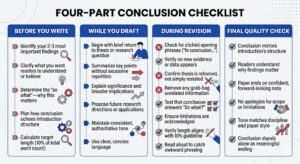
Use this checklist to make sure your conclusion section is complete, coherent, and effective.
Frequently Asked Questions
1. How long should the conclusion section be?
There is usually no set limit for the conclusion section, but it rarely needs to exceed 4-5 paragraphs. If you also have a Discussion section, your Conclusion section could be just 1 paragraph.
2. Is the conclusion section same as the summary?
The conclusion section is usually not the same as the summary section. The conclusion serves as the final part of the paper and highlights the most important findings of the study, why they matter, and what should future studies do. The summary of your study usually contains a brief description of your aims, methodology, results, and implications.
3. How is the conclusion different from the discussion section?
The Discussion section of a research paper interprets the findings in depth and contextualizes them against existing research. The Conclusion section highlights just the top 2-3 main findings of the research and their importance, without going into much detail.
Note that if you do not have a separate Discussion section, your Conclusion section will be much more detailed.
4. Is a conclusion section mandatory?
Many journals don’t require a conclusion section. Write a conclusion section only if it’s required by your target journal.
Here’s an example of a journal (JAMA Health Forum) that requires a conclusion section for original research articles:

And here’s another journal (PLOS Medicine) that doesn’t require a separate conclusion section but just a Discussion:

This article was originally published on June 12, 2024, and revised on May 12, 2026.