Turning Feedback into Future Success: A Year-End Guide for Grant Writers
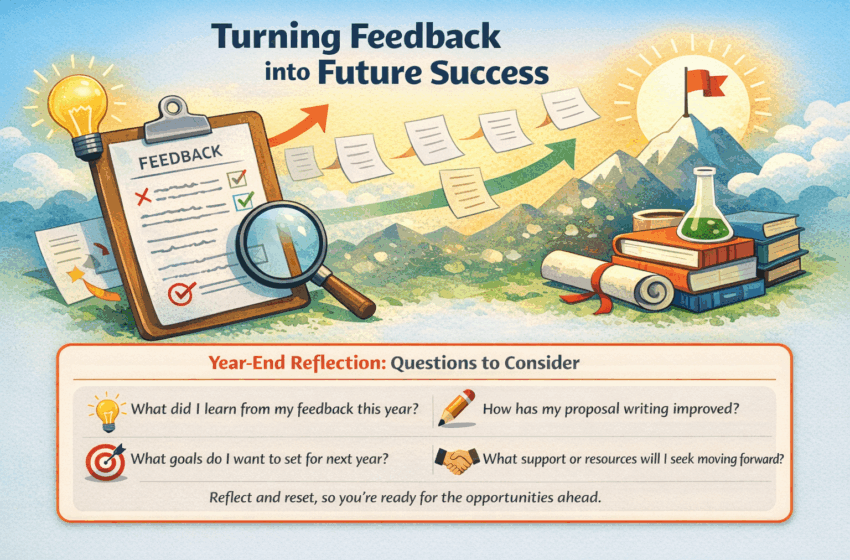
As the year draws to a close, many researchers find themselves reflecting not only on what they achieved—but also on what didn’t go as planned. For grant writers, that often includes reviewer comments, panel feedback, or rejection letters that can feel discouraging at first glance.
But feedback, even when it’s tough to read, is one of the most valuable assets you can carry into the next funding cycle. When approached thoughtfully, it becomes a roadmap—not a verdict.
This year-end guide walks you through how to process grant feedback constructively, extract actionable insights, and turn reviewer comments into a stronger funding strategy for the year ahead.
Step 1: Create Distance Before You Analyze
Step 2: Categorize Feedback Instead of Reading it Linearly
Step 3: Distinguish between “Fixable” and “Strategic” Feedback
Step 4: Translate Feedback into Actionable Revisions
Step 5: Decide What Not to Change
Step 6: Build Feedback into Your Long-Term Grant Strategy
Step 7: End the Year with Forward Momentum
Step 1: Create Distance Before You Analyze
The first step isn’t technical—it’s emotional.
Grant feedback can trigger frustration, disappointment, or self-doubt, especially after months of work. Before you begin analyzing comments:
- Take a short break from the document
- Avoid responding defensively or immediately rewriting
- Remind yourself: feedback reflects the proposal, not your worth as a researcher
Many successful grant recipients have multiple rejections behind them. The difference is not avoidance of failure, but how feedback is used.
Year-end tip: Schedule feedback review as a deliberate activity—after submission season slows, when you can engage calmly and strategically.
Step 2: Categorize Feedback Instead of Reading It Linearly
Reading reviewer comments line by line can feel overwhelming. A more effective approach is to group feedback into themes.
Create a simple table or document and classify comments into categories such as:
- Clarity and structure (e.g., unclear aims, dense writing)
- Significance and impact (e.g., relevance, novelty)
- Methodology and feasibility (e.g., sample size, timeline, risks)
- Alignment with funder priorities
- Presentation issues (figures, flow, jargon)
Patterns often emerge quickly—and these patterns matter more than isolated remarks.
What to look for:
If multiple reviewers mention similar concerns, those are priority areas for revision.
Step 3: Distinguish Between “Fixable” and “Strategic” Feedback
Not all feedback requires the same type of response.
Fixable feedback includes:
- Requests for clearer rationale
- Better articulation of objectives
- Improved justification of methods
- Stronger framing of outcomes
These can often be addressed through rewriting, restructuring, or reframing.
Strategic feedback includes:
- Mismatch with the funding call
- Scope that is too ambitious or too narrow
- Need for preliminary data or collaborators
These comments may signal that the proposal needs repositioning, a different funding mechanism, or more groundwork before resubmission.
Year-end reflection prompt:
Is this proposal better suited for revision—or redirection?
Step 4: Translate Feedback into Actionable Revisions
Reviewer comments can be vague or indirect. Your task is to translate them into concrete actions.
For example:
- “The aims are not clearly defined” →
Rewrite aims using measurable outcomes and tighter language - “The methodology seems ambitious” →
Adjust timelines, reduce scope, or justify feasibility with stronger evidence - “Impact is unclear” →
Explicitly connect outcomes to funder goals, policy relevance, or societal benefit
At this stage, it helps to step into the reviewer’s perspective:
What would make this proposal easier to evaluate, trust, and champion?
Step 5: Decide What Not to Change
An often-overlooked skill in grant writing is knowing when not to overcorrect.
Not all reviewer comments will align—and not all suggestions should be implemented blindly. Ask yourself:
- Does this change strengthen the core idea?
- Does it align with the funding agency’s priorities?
- Would it dilute the proposal’s originality?
Successful resubmissions balance responsiveness with confidence.
Step 6: Build Feedback into Your Long-Term Grant Strategy
Rather than treating feedback as proposal-specific, consider its broader implications.
Across multiple submissions, recurring comments may point to:
- Writing habits that need refinement
- Gaps in methodological explanation
- The need for earlier peer review or mentoring
Use year-end planning to:
- Create a personal “feedback checklist” for future proposals
- Identify skills to strengthen (e.g., storytelling, impact framing)
- Decide when professional grant editing or review could add value
Step 7: End the Year with Forward Momentum
Feedback is not a full stop: it’s a comma.
As you close out the year, consider one constructive action:
- Revise one section of a past proposal
- Outline a stronger version for the next cycle
- Seek expert review before resubmission
- Reflect on how your research narrative has evolved
Each step you take now reduces the workload and stress of the next submission.
Grant success is rarely the result of a single perfect submission. More often, it’s built through iteration, reflection, and learning from feedback.
By approaching reviewer comments with curiosity rather than discouragement, you transform them into tools for growth, not reminders of rejection.