What Is a Language Editing Certificate? A Complete Guide to Its Purpose, Contents, and When to Submit
Jump to contents
What Is a Language Editing Certificate?
What Is the Purpose and Importance of a Language Editing Certificate?
What Does a Language Editing Certificate Include? (With Sample Image)
When Should You Submit a Language Editing Certificate?
How to Obtain a Language Editing Certificate
Requesting from a Professional Editing Company (With Email Templates)
Important Considerations When Hiring an Individual Editor
Frequently Asked Questions About Language Editing Certificates
What Is a Language Editing Certificate?
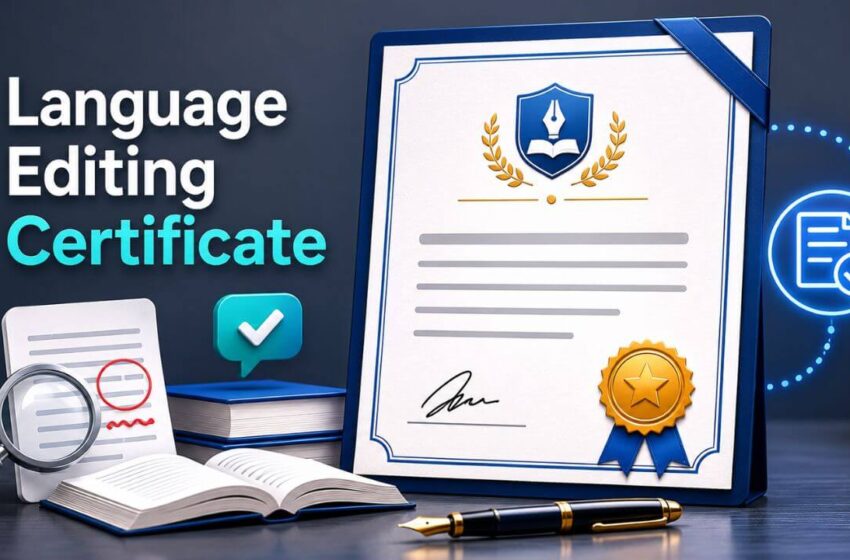
A language editing certificate confirms to the journal that the submitted manuscript has been checked for accuracy in language, grammar, syntax, punctuation, technical terminology, sentence construction, logic, and flow by a professional English editor. A certificate provided by a professional editor or an editing company, especially a reputed one like Editage, ensures the journals of the quality of writing in the paper before reviewing it for further evaluations.
What Is the Purpose and Importance of a Language Editing Certificate?
Why Journals Need Editing Certificate
Journals ask for a language editing certificate to verify the quality of the submission. It is common knowledge that any research paper uploaded for submission typically undergoes editing and proofreading. But how do journals know that the quality of edit and the language is up to the expected mark? That is where a language editing certificate (also referred to as an English editing certificate) is useful.
A certificate authenticated by a professional editor or an English editing company signifies to the journal editors that authors have carefully curated the manuscript with the support of professional English editors. But simply providing a certificate does not guarantee publication; the journals will indeed perform their own checks.
Helpful for Journal Submission
A language editing certificate benefits both journal editors and authors. When authors provide a document certifying that the paper has already been thoroughly edited and proofread by a professional, it helps expedite the publication process. This is especially useful for non-native authors preparing a manuscript in English and submitting to international journals.
Of course, journals do independently verify the quality of research paper. But the focus tends to be more on the technical aspects and slightly less on the language aspects.
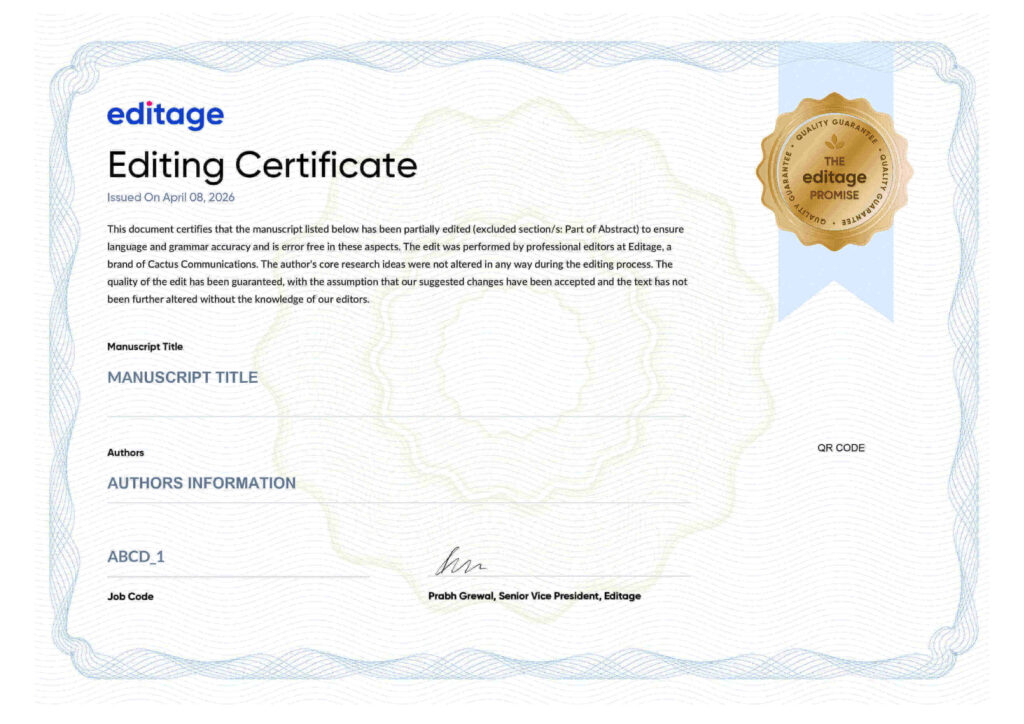
What Does a Language Editing Certificate Include? (With Sample Image)
A language editing certificate typically includes
- The title of the paper that has been edited
- Signature of the professional editor along with their credentials
- Date when the certificate was issued
- A seal authenticating the legitimacy of the certificate
Here is an image of a sample editing certificate:
Editor’s Signature and Qualifications
The name, signature, and qualifications of the professional who has edited your manuscript are key for an English editing certificate. If you’re working with an independent editor or a freelancer, their credentials must be mentioned in the certificate. This informs the journals that the right language expert has edited and proofread the paper.
If you have opted for a professional editing service, the individual name of the editor who worked on your manuscript may not be included. Instead, it will be the name and signature of the Managing Editor or Vice President of the company. The name of the company is also mentioned.
Title and File Name of the Edited Manuscript
The journal editor must know which documents have been edited by professionals. Sometimes, there could be multiple files like the main manuscript, supplementary information files, and figure files uploaded separately during submission.
The language editing certificate clearly specifies the title of the document that received professional attention. Even if only one file, namely the main manuscript, was edited, the corresponding file name will be mentioned in the certificate.
Quality Assurance Statement
A statement from the professional editor assuring the quality of language is always included in the certificate. However, you must be careful not to make any changes to the manuscript finalized for submission. Some journal editors could reach out to the editor or the editing company and request to view the original and edited documents. So if you’ve revised the manuscript on your own after finalizing the edits and obtaining a language editing certificate and submitted this newly revised manuscript to the journal, the language accuracy may not be guaranteed by that certificate.
When Should You Submit a Language Editing Certificate?
- Initial submission: A language editing certificate is almost always required during the initial submission process. The first version of the manuscript submitted to any journal is typically accompanied by an editing certificate. This is especially important for non-native authors since journals could desk reject papers if there is no language quality assurance.
- Resubmission post-review: In case of resubmissions after the first round of review. Let’s say the peer reviewer explicitly advices on “using an expert editing service for language improvement” or that “your manuscript could benefit from a language editing service.” Providing a certificate assures the journal editor during resubmission that this criterion has been addressed by the author.
- University submission: Some universities too ask for editing certificates during thesis or dissertation submissions. It may not be mandatory but could be a recommendation. Nevertheless, attaching a language editing certificate to your thesis/dissertation shows that the language quality is high.
How to Obtain a Language Editing Certificate
A language editing certificate can be given only by trusted professional editors or editing companies. When you submit your manuscript to an editing company, they will edit and proofread the document thoroughly and then supply the certificate. You need to choose an appropriate academic editing service per your requirements. Most of the time editing companies include the certificate as part of the service plan.
If you are looking to collaborate with individual editors, ALWAYS request the certificate before finalizing the assignment. You should verify the credentials of the editor prior to this agreement.
- Are they a native English speaker?
- Do they have experience in editing and proofreading academic documents?
- Are they knowledgeable enough in the subject area to review your research?
Check these aspects before approaching them.
Requesting from a Professional Editing Company (With Email Templates)
A professional editing company like Editage comes with a promise of trusted value. Language editing certificates are usually a part of the English editing services offered. So, you may not have to explicitly ask for it. However, the level of editing required for your manuscript could vary. And you may not be sure if they will still provide a certificate for minor revisions.
Below are some email templates you can use to request language editing certificates from a professional editing company for a few unique scenarios:
- When you want only some sections of a manuscript edited
Subject: Requesting issuance of a language editing certificate
Dear [name of editing company],
I wanted to clarify whether I will receive an editing certificate for using your services. I have opted for [name of the service plan] and received the confirmation of job acceptance ([include job ID]). However, I have instructed that [names of sections excluded from edit like Methods, Abstract, etc.] be excluded from the edit.
Will I still receive an editing certificate confirming the language quality of the full manuscript? My target journal requires an English editing certificate and I would appreciate it if you could confirm whether one will be provided.
Warm Regards,
[Your name]
- When you require only proofreading
Subject: Language editing certificate for proofreading
Dear [name of editing company],
My research paper needs to be proofread before submitting to the journal. However, the journal is asking for a language editing certificate. Since I’m not really “editing” my manuscript, I wanted to know whether a certificate will be provided only for proofreading my document.
Will the certificate shared assure the language quality of proofread manuscripts or is it necessary for me to request language editing instead of proofreading? Kindly let me know at the earliest so I can plan my manuscript preparation better.
Warm Regards,
[Your name]
- When you have used a different company for the first round of edit but were unsatisfied with the output and need a second round of review
Subject: Language editing certificate for second round of editing
Dear [name of editing company],
I had used the services of a professional editing company to finalize my research paper before submitting to [name of the target journal]. This is a high impact international journal and I want the language to be completely error-free. I’ve been repeatedly communicating with my previous editor only to receive mediocre level edits and I’m not satisfied with the outcome even though they have provided a language editing certificate.
I need a native English speaker who is also expert in [mention subject area] to review and edit my manuscript. I also wanted a different language editing certificate from you.
Please let me know whether this second round of editing is feasible along with issuing of a new English editing certificate. Awaiting a positive response from your end.
Best Regards,
[Your name]
Important Considerations When Hiring an Individual Editor
If you would rather collaborate with an individual editor instead of choosing an English editing company, consider the following important points:
Verify credentials
As a non-native author, you would obviously choose a native English speaker to edit your manuscript. But language is not the only thing the journals check. Your manuscript must be technically strong as well. So, look for native English editors
- who are also subject specialists in your research area
- who have experience in academic editing and proofreading
- who are familiar with style guides like APA, MLA, and Chicago
- who know what journal editors and peer reviewers expect to see in a manuscript
- who can complete their work as per your required timelines especially if you have a tight deadline
All these factors make an English editor the right expert for your research manuscript.
Ask for a sample edit
Check if the editor can share with you a sample of their work. Some editors will even be open to editing a small portion of your manuscript (say 500 to 1500 words) for a small fee if you request courteously. It is key that you are 100% certain of the edit quality before committing to a 7000-to-8000-word research manuscript. So review the editor’s sample work thoroughly before agreeing to collaborate.
Choose only if the “fit” is right
Do not feel obligated to commit. Sometimes it is not just about the language edit. Even if the editor comes highly recommended, you may feel that they take too long to respond to your emails or the editor is too busy accepting multiple assignments at once and cannot give their full attention to your research paper.
These are clear signs of an incorrect fit. If, after the first few correspondences you do not see benefit in taking it forward, politely inform them of your desire to withdraw.
Clarify requirements
Always clarify the EXACT requirements of your assignment right at the beginning.
- What is the word count of the manuscript you need edited?
- Do you require journal formatting as well? Does it cost extra?
- Do they provide additional assistance like cover letter preparation?
- How flexible is your deadline? Can you both agree on a realistic timeline?
- Do they offer re-edits free of cost or at a discounted rate?
- Do you need support in preparing figures and other artwork? Does the editor have the right qualifications like designing to help you with this?
Discuss everything in sufficient detail. Even if you feel some things are not important, ask questions about them anyway and clearly specify your editing needs.
Draft agreement
Prepare a written agreement signed by both parties with all the above mentioned elements clearly stated. Usually, individual editors have a standard format they follow for setting up contracts with authors. All you need to check is whether it is customized as per your requirements.
It goes without saying that budget planning is a must. Set aside a certain amount just for editing and proofreading the manuscript. You might have to contact 2 to 3 editors and compare prices before finalizing the right editor for you.
Frequently Asked Questions About Language Editing Certificates
Q1. Do I need to obtain a new certificate when resubmitting (revision)?
Yes. When you are resubmitting a revised manuscript, there will be changes in both technical and linguistic aspects. You can request the editing company to issue a new language editing certificate with an updated date of issue to confirm to the journal editor that the revised manuscript was also thoroughly edited and proofread by a professional editing service. Also, sometimes the reviewer feedback explicitly recommends using professional English editing to enhance the language in the manuscript. If this is a criterion, submitting a certificate assures the journal editor that the authors have handled this feedback point.
Q2. Does having a certificate guarantee acceptance?
No. The purpose of an editing certificate is to indicate that the paper has been professionally edited and proofread prior to submission, assuring the journal editor of the language quality. It is not a gateway to guaranteed acceptance. Journals will independently check the manuscript for the quality of language before proceeding with the review process.
Q3. Is there an expiration date for the certificate?
The editing certificate itself does not have any expiration date. However, every language editing certificate is limited to a specific document that is submitted.
For example, let’s say you have submitted one version of your manuscript to a journal but it got rejected due to scope mismatch, which is not really a language issue. So you decide to make certain revisions to the manuscript and target a different journal. You cannot use the same language editing certificate that was used previously. Request your editing company to provide a new certificate for the manuscript that’s edited in its latest form.
Q4. Are certificates not issued for AI translation or AI editing?
AI tools cannot issue any certificate for translating or editing. Journals do not recognize AI tools as co-authors, editors, or translators. So, if you need certificates for AI translation or AI editing, there should be a human expert involved in the process. If you have used an AI tool for translating and editing your manuscript, ask an expert English editor to review the manuscript. They can provide you with the necessary certificate, which will be accepted by the journal.
Q5. Which journals typically require a language editing certificate?
Typically, international journals with high impact factor require language editing certificates, especially from non-native authors. Journals under publishers like Wiley, Elsevier, MDPI, Springer Nature, Taylor & Francis, SAGE, IEEE, Cambridge University Press etc. ask for language editing certificates to check whether the language in the submitted manuscript meets academic publication standards.
Summary
Language editing certificates help non-native authors to seamlessly submit to international journals. When reputed editing companies like Editage provide quality assurance, it builds trust with the journal editor regarding the publication readiness of manuscripts. You can check Editage’s suite of services and get high-quality English edits along with language editing certificates, fast-tracking your research towards a successful publication.