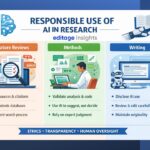
Why AI-Assisted Writing Still Needs Human Editing
With the introduction of artificial intelligence (AI) tools, research paper writing has dramatically evolved in recent years. AI tools are excellent assistants that have eased the process of manuscript preparation. But they do have a few shortcomings. To keep this in check, many journals now outline guidelines for ethical AI use. Yet, researchers struggle to balance AI assistance with human input.
AI Tools: Strengths and Weaknesses
Example 1: Introduction Section Review
Example 2: Discussion Section Review
Key Differences: Human vs AI Editors
AI Tools: Strengths and Weaknesses
Tools like Grammarly, Paperpal, QuillBot, and ChatGPT aid authors in improving the presentation of content. But you need to ensure that the tools don’t overpower your writing. Even if AI tools assist, the decision of retaining that content or modifying it should lie with you. To do this, you should know their strengths and weaknesses.
What AI tools get right:
- Grammar checks
- Language enhancements
- Structured sentences
Where AI tools lack:
- Factual accuracy
- Nuance & context
- Emotional intelligence
- Originality & creative depth
These drawbacks are often clear in AI-modified writing. That’s why journal editors and peer reviewers report AI hallucinations in research papers. Editors also observe a monotonous tone in the flow of text, making authors sound like a robot. At times, inferences lack insights. This type of writing in research papers can be disappointing for journal editors. So, what exactly do they look for?
What Journal Editors Want
Journal editors handle thousands of submissions in a day. They only have time to peruse a research paper and not read it in its entirety. Here are 4 obvious things to do in a research paper:
- Follow journal formatting guidelines.
- Structure manuscripts in sections. If journals don’t specify, write standard sections like abstract, keywords, introduction, methods, results, discussion, conclusions, and references.
- Write meaningful sub-section headings.
- Format citations and references as per journal requirements.
These things should help you clear that first hurdle of desk checks. But when your paper is sent for peer review, it’s subjected to a deeper evaluation. Peer reviewers will assess
- whether the research idea is original,
- what value it adds to existing knowledge in literature,
- how well the study was conducted,
- whether accurate methods and techniques were utilized,
- if the inferences align with the findings reported, and
- whether the future lines of investigation are justified.
And when they evaluate these aspects, your writing should not appear half-hearted and robotic. The research paper should engage them, tap into their curiosity, present a story that’s interesting to read right until the end, and persuade them that the proposed solution for the identified research problem is worth exploring.
Now, would you expect an AI tool to do all this for you without any human involvement? No, that would be unhelpful. Even after using an AI tool for content enhancement, getting an expert editor’s opinion matters. To better understand this, let’s take examples of actual research drafts and compare their AI-edited versions with human-refined versions.
Example 1: Introduction Section Review
Here’s a part of an Introduction section taken from an actual essay. You’ll see how the author has used plain, basic language. Then, when an AI editing tool is used, the content is enhanced; however, something is lacking. We’ll dive deep to see how an actual editor adds a human touch compared to the AI-edited text.
Context: Public health/Epidemiology; Topic: Air pollution and cardiovascular diseases
Raw researcher draft
Air pollution has become a serious problem in many countries due to rapid urbanization and industrial activities. Exposure to polluted air is known to affect human health and is associated with respiratory and heart-related diseases. Cardiovascular disease is one of the leading causes of death worldwide, and understanding its risk factors is important.
Several studies have investigated the relationship between air pollution and cardiovascular outcomes, but the results are not always consistent. Some studies focus only on particulate matter, while other examine gaseous pollutants. In addition, most previous studies have been conducted in Western populations.
Therefore, the purpose of this study is to investigate the association between air pollution exposure and cardiovascular disease in adults.
- This draft presents correct ideas, but the language used is quite basic.
- The transition between sentences is weak.
- The presentation of ideas appears too generic, lacking specificity.
- The research gap is vaguely mentioned but not sufficiently emphasized.
Clearly, the draft is not publication ready. So, the author uses an AI tool to edit and modify their writing. Here’s what the AI output looks like.
AI-edited text
Air pollution is a major global health issue and has been linked to many diseases. Many studies show that air pollution can cause heart problems. However, there are still gaps in understanding how different pollutants affect cardiovascular diseases in different populations. Therefore, this study aims to analyze the association between air pollution exposure and cardiovascular outcomes in adults.
The AI tool condensed the information to a single paragraph, does not provide scientific context, and has eliminated technical terminology while simplifying the content. Several AI limitations stand out like a sore thumb here:
- Repetitive phrasing (e.g., many diseases, many studies)
- Vague claims lacking specificity
- Research gap is weakly articulated
- Study aim reads too generic
Now let’s see the outcome if a human editor were to work on the original piece of text.
Human-refined text
Air pollution is a growing public health concern, driven by rapid urbanization and industrial expansion. Substantial evidence links air pollution exposure to adverse health outcomes, particularly cardiovascular disease (CVD), which remains a leading cause of mortality worldwide. Identifying modifiable environmental risk factors for CVD is therefore of critical importance.
Although previous studies have explored associations between air pollution and cardiovascular outcomes, results remain inconsistent due to variations in pollutant types examined, exposure assessment methods, and study populations. Notably, evidence from non-Western populations remains limited, despite differing pollution profiles and demographic characteristics.
To address these gaps, the present study investigates the association between long-term exposure to multiple air pollutants and CVD among adults, providing population-specific evidence to inform public health policy.
The first thing to note here is the use of accurate concepts and precise definitions. Notice the addition of the abbreviation CVD; editors know that in long essays and research papers certain technical terminologies tend to repeat. So, it makes sense to define them at their first mentions.
Next, see how the research gap is emphasized. The editor adds a clear explanation for the inconsistency in results. Even the gap with respect to the lack of analysis of varying demographic characteristics and differing pollution profiles is highlighted.
Finally, the precise aim of the study is stated. Overall, the flow of content reads like an academic paper.
What Changed and Why
Here are a few additions made by the editor beyond AI:
- A clear logical progression from background to research gap to study aim
- Improved academic tone and precision
- Novelty of the study is strongly articulated
- The writing aligns better with journal expectations
| Area of improvement | Why editor changed it |
| Opening sentence | To immediately establish importance and relevance of the study |
| Research gap | To clarify what is missing from existing literature |
| Specificity | To draw the attention of readers to specific problems (e.g., long-term exposure, multiple pollutants) |
| Study contribution | To clearly state what the study adds to the scientific field |
| Academic tone | To align language with the expectations of high-impact journals |
Example 2: Discussion Section Review
Next, we have text taken from a Discussion section. Different paper, different context. Let’s see how the original draft is changed by an AI editing tool and compare it with the modifications made by a human editor.
Context: Biomedical research; Topic: Machine learning model for disease risk prediction
Raw researcher draft
In this study, we developed a machine learning model to predict disease risk. The results show that the model performed well with good accuracy. This indicates that machine learning could be useful in medical research.
The findings are similar to previous studies that also reported good performance of machine learning models. However, there are some limitations in this study. The sample size was small and the data were obtained from a single center.
In the future, more studies should be conducted with larger datasets to confirm the findings.
- Sentences appear short, safe
- Minimal interpretation of results
- Limited engagement with existing literature
- Sounds repetitive and written with caution
The text does not clearly highlight what’s unique about the study. There’s no discussion on what else is out there and how the study adds value to existing work. So, when refined using an AI tool, this is what you get.
AI-edited text
The results of this study show that the model performed well and achieved high accuracy. This suggests that machine learning can be useful for predicting disease risk. There are some limitations in this study, such as sample size. Future studies should include more data.
The AI-generated draft has eliminated the repeated content but does not give valuable information. A few limitations noted here are:
- Overly generic interpretation of results
- There’s no comparison with existing literature
- Barely a mention of study limitations
- No clarity on practical implications
What if a human editor worked on it? Here’s the outcome.
Human-refined text
This study demonstrates that machine learning models can effectively predict disease risk, highlighting their potential role in supporting clinical decision-making. The observed performance aligns with prior studies, reinforcing the robustness of machine learning approaches across different research settings.
Nevertheless, the study is limited by its single–center design and modest sample size, which may affect generalizability. Future multi-center studies incorporating larger and more diverse datasets are warranted to validate and extend these findings.
The original text did not present much scope for improvement in terms of data-specific interpretations and conclusions. But compared to the AI-modified text, you’ll see significant differences in this editor-refined draft.
- Interpretation of findings is grounded in existing literature
- There’s balanced and credible discussion of limitations
- Future research directions are clear
- Scholarly voice and impact appear strong
What Changed and Why
| Editing aspect | What the editor changed | Why it matters for journals |
| Depth of interpretation | Shifted from describing results to explaining their significance and implications | Journals prioritize insights over description because interpretation demonstrates author’s expertise |
| Clarity & precision | Vague terms are replaced with discipline-specific language | Ambiguity weakens credibility; precision strengthens scientific rigor |
| Tone & academic voice | Overgeneralization is eliminated, yet there’s balance between confidence and caution | Overstating your claims could lead to rejection; the tone should align with editorial standards and reviewer expectations |
Key Differences: Human vs AI Editors
Both the examples demonstrate that where AI tools fail, humans add a unique touch that retains the author’s original voice. Human editors adjust the phrasing to match the expectations of high-impact journals because they’re aware that manuscripts are evaluated for journal fit and not just language quality. Also, journals scrutinize AI usage and research integrity; professional editors verify the accuracy of content and ensure author accountability.
To summarize, here’s a comparison of AI tools with human editors on different aspects of editing:
| Editing aspect | AI tools | Human editors |
| Grammar | Strong | Strong |
| Logic & flow | Limited | Excellent |
| Journal fit | No | Yes |
| Ethical oversight | No | Yes |
| Manuscript formatting | No | Yes |
| Reviewer perspective | No | Yes |