From Good to Publishable: Where AI Stops and Human Expertise Begins
The research landscape is no longer isolated from AI. Academic writing, heavily influenced by the progress of advanced AI writing tools, has been reshaped to reflect more than just human-generated content. Indeed, the “research” in a research paper belongs to you. But who is reporting it? Are you overly dependent on generative AI to “fix” all your writing issues? And in this process, is your research manuscript losing the uniqueness upheld by an author’s voice?
Writing with assistance from tools is not a novel concept. Authors have long since used spelling and grammar checkers to fix errors and enhance language. Yet, when generative AI was introduced in research writing, academic integrity was put under spotlight. The question shifted from “Is this research sound and publishable?” to “Is this research paper written by a human or AI?”
With growing concerns of excessive (and inappropriate) use of AI tools, the value of a human expert review is more valuable now than ever! The human gap in AI-powered manuscripts must be prudently managed to balance the scale between artificial intelligence and human intelligence. Read on to know what it takes to prepare publication-ready manuscripts that are AI-assisted yet human-driven.
AI Accuracy in Research Writing
The Human Gap: Critical Checks AI Still Cannot Perform
Practical Examples of How Human Editors Improve AI-Edited Manuscripts
Best Practices for Using AI Responsibly in Research Publishing
AI Accuracy in Research Writing
Researcher paper writing warrants accountability. So even if you use AI tools for assistance, you should know its benefits and limitations because ultimately you, the author, are responsible for what gets published.
What AI Does Well
- Language refinement: Large language models (LLMs) are excellent for not only recognizing fundamental errors in grammar and syntax but also recommending solid improvements. For example, is you’ve repeatedly used the term “checked” in multiple sentences in paragraphs, an AI tool would help you paraphrase and suggest replacing it with “evaluate,” “text,” “investigate,” and other related terms depending on the context.
- Sentence restructuring: ESL authors find this feature especially useful. AI tools can take the author’s original idea and rearrange the phrases in sentences to present the information effectively.
- Ensuring consistency: The writing style in academic papers should be formal while maintaining a dialogue with the reader. Again, ESL authors unfamiliar with native English writing style may find this a challenging feat. But with AI assistance, this task can be simplified and a consistent tone, style, language, and phraseology can be maintained.
- Saves time: AI tools are efficient. Authors can use tools to set the outline of a research paper before beginning the actual writing process. Having this framework helps organize ideas in a logical manner throughout the paper.
Despite these benefits, there are drawbacks in each of these cases. What if AI alters the intended meaning while refining the language? And will it restructure a sentence to an extent that the original meaning is completely lost? AI tools are only as good as the models they’re trained on. So, in an attempt to enhance your writing, you might end up losing the unique writing style that makes your paper sound like “you.”
But that’s not all. AI accuracy is not enough to prepare a publication-ready research manuscript.
Where AI Falls Short
Areas where AI tools currently lack:
- AI can polish language but cannot accurately validate the reasoning behind scientific arguments
- AI writes fluently; but is it scientifically sound?
- Shortening sentences for conciseness and convoluting the sentence structure could modify the original meaning
- AI outputs are heavily dependent on prompts and training models
Take the below example where author wanted the original text modified for conciseness and improved readability. Notice how the human-edited version maintains the logical flow and readability while ensuring conciseness, whereas the AI-generated response did not
Original text: Cytological diagnosis of trichoblastoma can be challenging. The existence of basaloid cells that may raise concern for malignancy, particularly when presenting as a large mass in an unusual location. Accurate psychological interpretation is clinically important because it directly impacts treatment decisions.
AI-edited text: Trichoblastoma can be difficult to diagnose cytologically because its basaloid cells may resemble malignancy, particularly in large tumors at unusual sites. Accurate interpretation is crucial for appropriate treatment decisions.
Human-edited text: Trichoblastoma is composed of basaloid cells that can mimic malignancy, particularly when it presents as a large mass in an atypical location, thereby making its cytological diagnosis challenging.
Both edits have reduced the word count from the original text. But the human-edited version reads well, following a logical flow of information while ensuring conciseness. The AI-generated response, on the other hand, complicates the readability in the sentence. It also changed the term “large mass” to “large tumor,” altering the original meaning.
This confirms that AI reliability is highly dependent on human judgment. And considering the uncertainty of AI-generated responses that differ based on prompts, researchers are right to remain cautious when using AI tools.
The Human Gap: Critical Checks AI Still Cannot Perform
AI tools can effectively help you fix basic errors in writing. But when it comes to nuance, coherence in research arguments, novelty check, and publication significance, human intervention becomes key. So, what does expert human editing provide that AI misses?
1. Evaluating scientific rigor
An expert review determines whether
- Your research question is accurately answered
- Your central research argument has been supported throughout the manuscript
- The research design and methodology align with expected scientific standards
- Data collection has been randomized to minimize sample bias
- The reported experimental details are sufficiently clear to be replicable
2. Detecting AI hallucinations
AI tools tend to hallucinate—whether it’s fabricating references [1] or facilitating “infodemic” [2] through disinformation. There have also been cases reported of inappropriate AI-generated images that made it to a peer-reviewed journal [3], leading to embarrassing retractions. These instances have underscored that human oversight is even more crucial in the AI era. An expert review ensures that such instances are identified well before the research paper is submitted for publication, saving time and preventing desk rejections.
3. Rechecking AI-generated claims
The problem with generative AI is that it could output false information in a highly convincing manner. Although AI tools sometimes warn users that the data must be cross-verified, it fails to provide the next steps to users. Which is why they often accept AI’s claims at face value.
This is where expert human reviewers enter:
- Are the study findings misinterpreted?
- Have the conclusions been overgeneralized?
- Do the study implications overreach the data reported?
- Is the research significant enough for publication?
- Does the research paper clarify the novelty correctly?
- In which context have authors made the study claims? Does it align with the research question?
Such in-depth assessments are key for verifying whether the data supports the conclusions drawn. A strong combination of AI and human expertise can help develop a workflow that produces a sound research manuscript while adhering to ethical practices.
Practical Examples of How Human Editors Improve AI-Edited Manuscripts
Here’s a table outlining some example sentences to show the difference between AI editing and human editing. When authors draft and edit with AI, the language is refined. But an expert review takes it to a submission-ready stage.
| Sl. No. | Before AI (Author’s text) | After AI (AI-edited text) | After Expert Human Review |
| 1 | Air pollution has become a serious problem in many countries due to rapid urbanization and industrial activities. Exposure to polluted air is known to affect human health and is associated with respiratory and heart-related diseases. | Air pollution is a major global health issue and has been linked to many diseases. Many studies show that air pollution can cause heart problems. | Air pollution is a growing public health concern, driven by rapid urbanization and industrial expansion. Substantial evidence links air pollution exposure to adverse health outcomes, particularly cardiovascular disease (CVD), which remains a leading cause of mortality worldwide. |
| 2 | Several studies have investigated the relationship between air pollution and cardiovascular outcomes, but the results are not always consistent. Some studies focus only on particulate matter, while other examine gaseous pollutants. | However, there are still gaps in understanding how different pollutants affect cardiovascular diseases. | Although previous studies have explored associations between air pollution and cardiovascular outcomes, results remain inconsistent due to variations in pollutant types examined and exposure assessment methods. |
| 3 | Therefore, the purpose of this study is to investigate the association between air pollution exposure and cardiovascular disease in adults. | Therefore, this study aims to analyze the association between air pollution exposure and cardiovascular outcomes in adults. | To address these gaps, the present study investigates the association between long-term exposure to multiple air pollutants and CVD among adults, providing evidence to inform public health policy. |
| 4 | In the future, more studies should be conducted with larger datasets to confirm the findings. | Future studies should include more data. | Future multi-center studies incorporating larger and more diverse datasets are warranted to validate and extend these findings. |
In each of the above cases, you will see the value added by human editor.
- Sl. No. 1: Concise presentation with improved logical flow and stronger scientific argument
- Sl. No. 2: Simple language is enhanced to restructure sentences with accurate scientific terminology while maintaining conciseness
- Sl. No. 3: Clarifies the intent and modifies wording to target journal-specific language
- Sl. No. 4: Word choice improvements with a focus on underscoring the need for diversification of data to strengthen future research
Best Practices for Using AI Responsibly in Research Publishing
- Always verify the citations and reference quoted by AI. Cross-check whether the cited works are available in verified databases like Scopus.
- Review statements that appear factual. AI tends to make absolutist claims using terms like “always, never, perfect, impossible” etc. Academic writing requires a little more nuance and exceptions.
- Be aware and follow the AI policies and guidelines outlined by the target journal. What’s allowed? What’s not? Check these before opting to use an AI writing tool.
- Do not make AI the author of your work! Let it assist. Correct issues. Fix mistakes. But the authorship? That should remain in your hands. Allow your voice to be retained in your writing.
Frequently Asked Questions
1. Is AI accurate for research writing?
AI accuracy is questionable. Relying only on AI-stated information for writing research papers is not advised. AI does polish language, fix grammatical errors, restructure sentences, and help brainstorm ideas. But AI hallucinations and misinformation are often observed, which could severely impact the integrity of research.
So, while you can use AI to expedite some of the tasks associated with research writing, it is good to retain human oversight throughout the process.
2. Can AI edit research papers?
AI tools can improve research paper drafts by refining author’s writing, fixing grammar and syntax errors, enhancing sentence flow, and reducing word count for conciseness. AI tools are mainly suitable for stylistic copyediting but are not yet designed for evaluating factual accuracy, especially when finalizing research papers.
3. Can AI replace human editors?
AI tools can assist editing. But expert human review continues to remain the crux of academic editing. Human editors perform checks that go beyond simple stylistic copyediting. They help
- strengthen the research argument,
- maintain logical flow of information,
- retain author’s writing style while restructuring sentences,
- recognize areas of improvement from the perspective of a subject area expert, and
- offer insightful feedback based on context.
4. Why do research papers still need human editing?
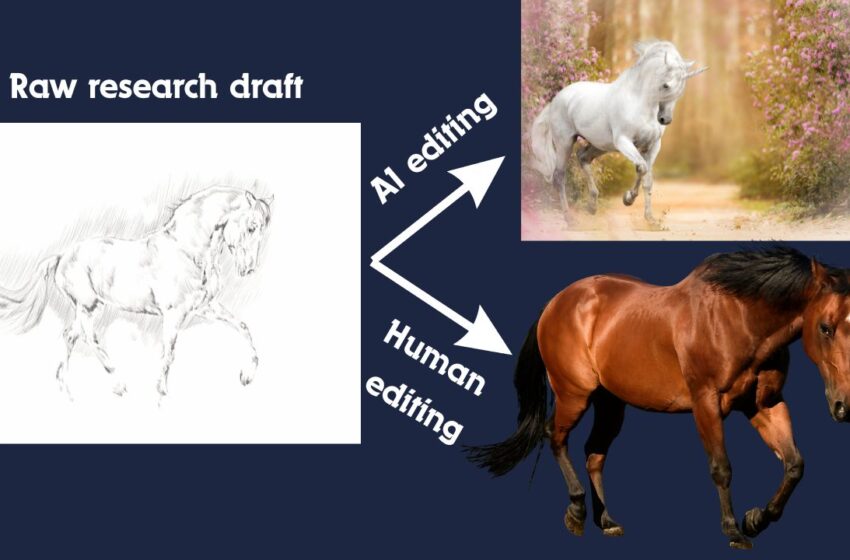
Raw research drafts often contain crude writing with excellent ideas of authors waiting to be presented effectively as a final research manuscript. Even if AI tools are used for editing, a human review is needed to polish the paper until it becomes journal ready.
Human editors carry years of experience in the publishing industry, bring their expertise of the subject area, and provide feedback for improvement based on what journal editors and peer reviewers expect to see in a manuscript. That’s why research papers, or any academic document, must be thoroughly vetted by editors who are subject matter experts.
References
1. Fabricated citations: An audit across 2.5 million biomedical papers https://www.thelancet.com/journals/lancet/article/PIIS0140-6736(26)00603-3/fulltext
2. The Dual Nature of AI in Information Dissemination: Ethical Considerations https://pmc.ncbi.nlm.nih.gov/articles/PMC11522648/
3. Scientific journal publishes AI-generated rat with gigantic penis in worrying incident https://www.vice.com/en/article/scientific-journal-frontiers-publishes-ai-generated-rat-with-gigantic-penis-in-worrying-incident/