Infographic: What researchers should do BEFORE statistical analysis


Reading time
1 min

Biomedical research is often conducted to make important decisions about health care, treatments, and public health. Therefore, the statistical analysis of biomedical research data needs to be accurate and rigorous to ensure that the conclusions drawn are appropriate and credible.
The infographic below lists four important precautions that biomedical researchers need to take before conducting statistical analysis and hypothesis testing.
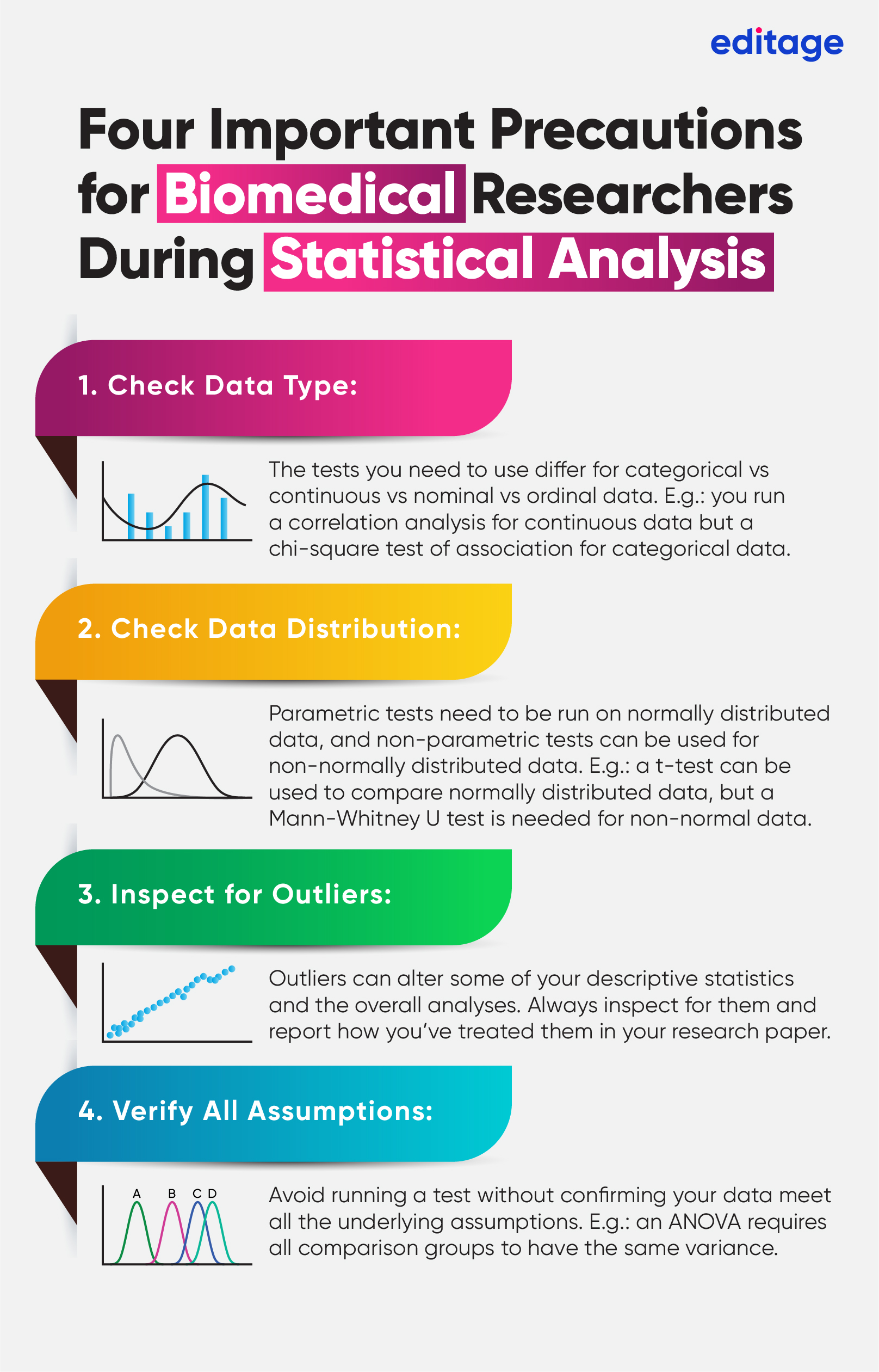
What Researchers Should Do Prior to Statistical Analysis
| Precaution | Description |
|---|---|
| Check Data Type | The tests you need to use differ for categorical vs continuous vs nominal vs ordinal data. For example, you run a correlation analysis for continuous data but a chi-square test of association for categorical data. |
| Check Data Distribution | Parametric tests need to be run on normally distributed data, and non-parametric tests can be used for non-normally distributed data. For example, a t-test can be used to compare normally distributed data, but a Mann–Whitney U test is needed for non-normal data. |
| Inspect for Outliers | Outliers can alter some of your descriptive statistics and the overall analyses. Always inspect for them and report how you’ve treated them in your research paper. |
| Verify All Assumptions | Avoid running a test without confirming your data meet all the underlying assumptions. For example, an ANOVA requires all comparison groups to have the same variance. |
4 Important precautions for biomedical researchers during statistical analysis.jpg