Infographic: Differences between correlation and regression: Learn about different types of statistical relationships


One of the most common forms of hypothesis testing in biomedical research is whether two variables are related or not (i.e., whether the value of one variable changes as the other variable changes). Statisticians use various terms to describe these relationships, the most common of which are “correlation”, “association”, and “regression.” However, these terms can’t be used interchangeably. Let’s look at each of these relationships in detail.
What is correlation?
“Correlation” refers to the linear relationship between two continuous variables. If the variables are normally distributed, you can calculate Pearson’s correlation coefficient (r); for non-normally distributed variables, you can calculate Spearman’s rank-order correlation coefficient (ρ).

What is association in statistics?
The term “association” is used to describe the relationship between two categorical variables. The most commonly used test for association is the chi-square test of independence.
What is regression?
Regression is a type of statistical analysis that specifically estimates the relationship between a dependent variable and one or more independent variables.
Difference between Correlation and Regression: Correlation vs. Regression
As mentioned above, “correlation” and “regression” can’t be used interchangeably. The table below explains the differences between them.
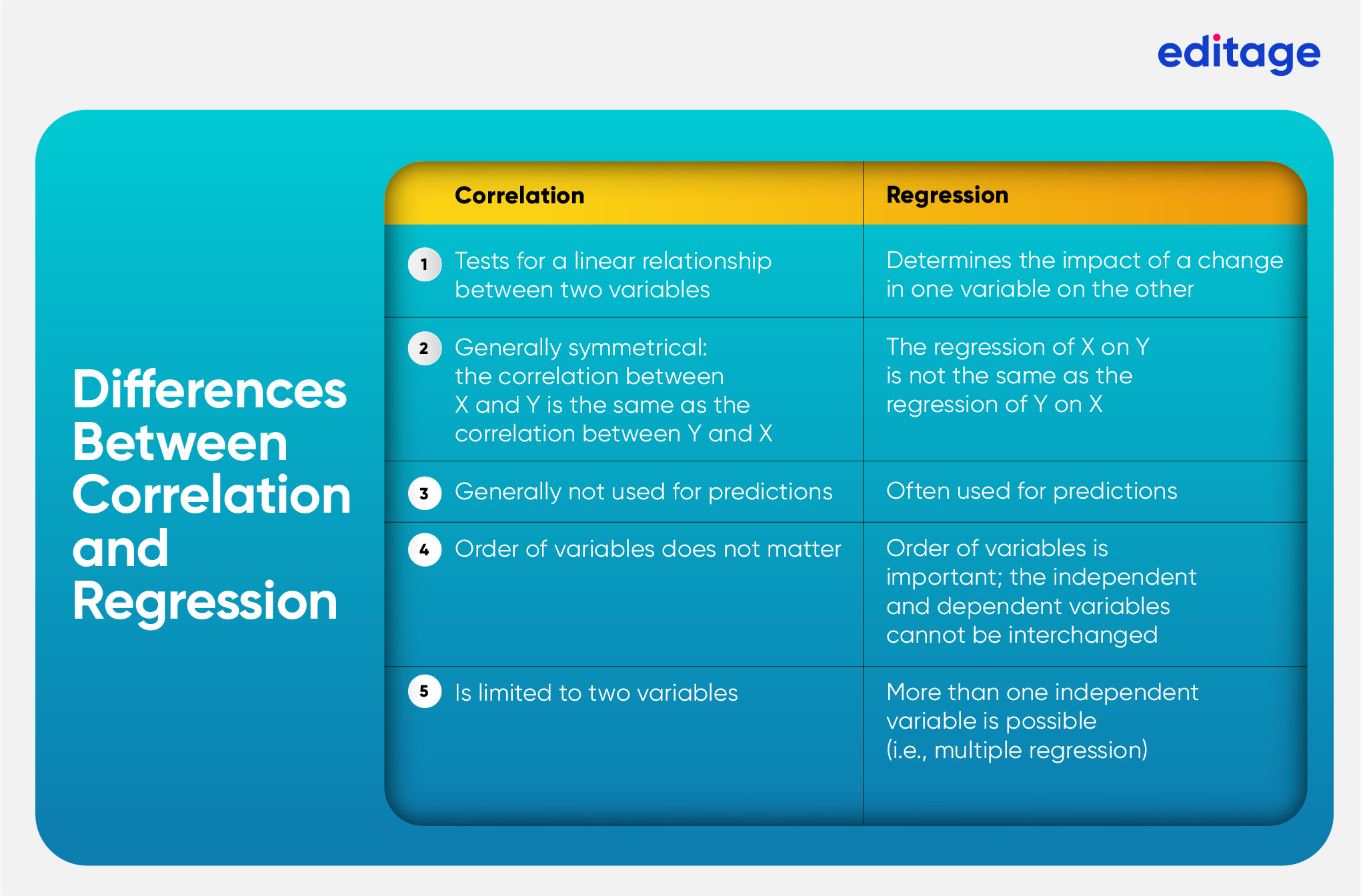
| No. | Correlation | Regression |
|---|---|---|
| 1 | Tests for a linear relationship between two variables | Determines the impact of a change in one variable on the other |
| 2 | Generally symmetrical: the correlation between X and Y is the same as the correlation between Y and X | The regression of X on Y is not the same as the regression of Y on X |
| 3 | Generally not used for predictions | Often used for predictions |
| 4 | Order of variables does not matter | Order of variables is important; the independent and dependent variables cannot be interchanged |
| 5 | Is limited to two variables | More than one independent variable is possible (i.e., multiple regression) |
Would you like expert guidance when evaluating relationships among your study variables? Schedule a call with a biostatistician under Editage’s Statistical Analysis & Review Services.
When to Use Correlation vs. Regression?
Choosing between correlation and regression comes down to one core question: are you exploring a relationship, or explaining and predicting one?
Use correlation when
your goal is simply to determine whether a relationship exists between two variables and how strong that relationship is. It tells you the direction (positive or negative) and magnitude of association, without implying that one variable causes the other.
For example, a researcher might ask: “Is there a relationship between the number of hours spent writing and manuscript quality scores?” Correlation answers this cleanly with a single coefficient. Importantly, with correlation, the two variables are interchangeable. In other words, swapping X and Y gives you the same result.
Use regression when
you want to go further: to predict, quantify, or explain the effect of one variable on another. Regression establishes directionality: X (the independent variable) influences Y (the dependent variable), and swapping them produces a different result entirely.
For instance: “How much does increasing revision time by one hour improve a manuscript’s peer review score?” That is a regression question.
A helpful rule of thumb:
- Exploring association? → Use correlation.
- Predicting an outcome or measuring impact? → Use regression.
It is also worth noting that the two methods are often used in sequence. Researchers typically run a correlation first to confirm a meaningful relationship exists, and then apply regression to model and quantify it.
Examples of using correlation or regression in research
Medicine and clinical research
A cardiology researcher might first examine whether a correlation exists between patients’ LDL cholesterol levels and the incidence of coronary artery disease. Once that association is confirmed, the researcher performs regression so that they can quantify how much each unit increase in LDL independently predicts disease risk, while controlling for confounders like age, BMI, and smoking status.
Psychology
A psychologist might investigate whether anxiety scores correlate with sleep quality ratings across a sample population. If the goal then shifts to predicting anxiety levels based on multiple lifestyle factors like screen time, physical activity, and social interaction, they perform multiple regression.
Life Sciences
Here, correlation helps identify co-occurring phenomena, such as whether rising ambient temperatures correlate with declining insect populations in a given region. Regression then allows scientists to model the rate of population decline per degree of temperature increase.
Common Mistakes Researchers Make When Using Correlation vs. Regression
Even experienced researchers can misapply correlation and regression. Here are the most frequent errors to watch for and avoid before submission.
Confusing correlation with causation
- A significant correlation coefficient does not mean one variable causes the other to change.
- Example: Ice cream sales and drowning rates are positively correlated — but ice cream does not cause drowning. Both are driven by a third variable (hot weather).
- Always qualify correlational findings with phrases like “associated with” rather than “leads to” or “causes.”
- See also: Correlation vs causation
Using correlation when regression is needed
- Correlation is appropriate when both variables are naturally observed and neither is manipulated.
- If your study involves an experimentally controlled variable (e.g., drug dosage, exposure time), regression is the correct choice.
- Applying correlation in such cases produces an incomplete and potentially misleading analysis.
Swapping X and Y in regression
- Unlike correlation, regression results change when the dependent and independent variables are reversed.
- Clearly define which variable is the predictor and which is the outcome before running the analysis.
Over-interpreting weak correlation coefficients
- In large samples, even an r value of 0.10 can reach statistical significance — but this has little practical meaning.
- Always report effect size alongside p-values to give readers an accurate picture of the relationship’s strength.
Assuming linearity without checking
- Both methods assume a linear relationship by default.
- Always visualize your data with a scatter plot first; applying these methods to nonlinear data produces unreliable results.
Frequently Asked Questions
Can correlation and regression be used together?
Yes. Correlation and regression analysis can be conducted together to measure a data set and understand the relationship between variables. Researchers often first run a correlation to see if a meaningful relationship exists, and then apply regression to model and quantify that relationship.
Does a strong correlation always mean regression will give a good prediction?
Not necessarily. A high correlation coefficient (r) tells you that two variables move together strongly, but regression prediction quality also depends on the linearity of the relationship, sample size, and the presence of outliers. The square of r from correlation will equal r² from regression when the same data is used. But a high r2 does not guarantee that the regression model will generalize well to new data.
What is the difference between a correlation coefficient and a regression coefficient?
Correlation coefficients fall between –1.00 and +1.00 and are relative measures. Regression coefficients, by contrast, are typically absolute values: the slope (byx) and its reciprocal (bxy) must share the same sign, but they are not bounded between –1 and +1.
See also: Correlation Coefficients: A Handy Guide
Is regression better than correlation?
Neither is universally “better”; they serve different purposes. Use correlation to summarize the strength and degree of the relationship between two or more numeric variables. Use regression when you’re looking to predict, optimize, or explain a numeric response between variables, specifically how x influences y. In research, the appropriate choice depends on the study’s objective.
Can correlation be negative while regression slope is positive?
No. If the correlation between two variables is positive, the regression slope will be positive; if two variables correlate negatively, their regression slope will be negative. The sign of the correlation coefficient and the regression slope are always consistent with each other.
This article was originally published on March 17, 2023, and revised on May 20, 2026.
Differences between correlation and regression_0.jpg