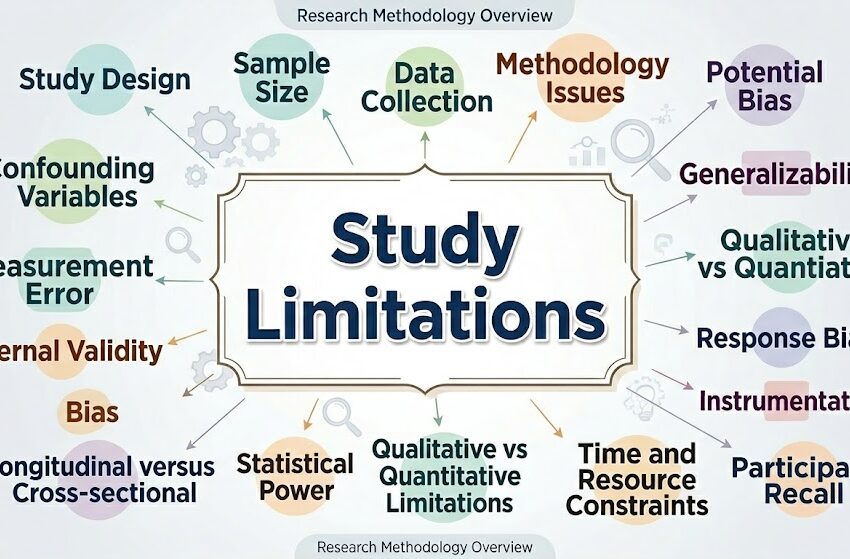
Infographic: How to report study limitations: Examples and types of limitations


Jump to Contents
- Why Should You Report Limitations at All?
- Real Example: A Weight Loss Study
- What Exactly Counts as a Limitation?
- Common Types of Limitations in Biomedical Research
- Sample-Related Limitations
- Where Should You Put the Limitations Section?
- How Do You Avoid Sounding Defensive or Weak?
- Should You Discuss Limitations That Future Researchers Could Address?
- Common Mistakes When Reporting Limitations
- How Long Should Your Limitations Section Be?
- How Many Limitations Should You Report?
- Example: A Complete Limitations Section
Why Should You Report Limitations at All?
Reporting limitations shows scientific integrity and helps readers understand what your results actually mean. It’s not about weakness; it’s about transparency. A study on a small sample of diabetic patients in one hospital is still valuable; readers just need to know the scope.
When you acknowledge limitations upfront, you:
- Demonstrate that you understand your research design
- Prevent critics from pointing out obvious problems later
- Help other researchers decide if your findings apply to their populations
- Show intellectual honesty, which builds credibility
A well-reported limitation can actually strengthen your paper. Imagine two papers with identical flaws—one that hides them, one that reports them clearly. Reviewers and readers will trust the transparent one.
Real Example: A Weight Loss Study
You conduct a 12-week weight loss intervention in 60 women at a single urban clinic. You acknowledge in your limitations that:
- Sample is predominantly white, limiting generalizability to other races/ethnicities
- 12 weeks is short; weight regain often happens later
- Participants were highly motivated (they volunteered), so results may not reflect the general population
This transparency doesn’t weaken your conclusions—it actually clarifies them. Readers now know: “This works for motivated women in urban settings over 3 months” rather than wondering “does this work for everyone forever?”
What Exactly Counts as a Limitation?
Not every imperfect aspect of your study is a limitation worth reporting. A limitation should affect your ability to draw conclusions or apply findings elsewhere.
| Type | Example | Impact on Study | Should Report? |
| Sample size | 45 participants instead of 200 calculated | Reduces statistical power; harder to detect real effects | Yes, definitely |
| Sample characteristics | Only women; mostly college-educated | Results may not apply to men or less educated groups | Yes |
| Design choice | Observational, not randomized | Can’t prove causation; confounding possible | Yes |
| Missing data | 30% of participants didn’t complete follow-up | May introduce bias if dropouts differ systematically | Yes |
| Measurement error | Self-reported exercise (not accelerometer) | Participants may over/underestimate | Yes |
| Time frame | 6-month follow-up only | Don’t know about long-term effects | Yes |
| Single site | One hospital in London | May not reflect other regions or healthcare systems | Yes |
| Funding source | Funded by drug company | Potential conflict of interest | Yes |
| Timing of recruitment | Enrolled only during winter months | Seasonal effects possible; may not generalize to summer | Maybe—depends on your outcome |
| Blinding | Participants knew treatment assignment | Risk of placebo effect or behavior change | Yes |
| Your instrument broke occasionally | BP monitor malfunctioned twice | Probably not—unless it affected many measurements | |
| You recruited on Tuesdays only | Couldn’t come weekends | Unlikely to be a real limitation unless it creates selection bias |
The key question: Does this limitation affect whether readers can trust your conclusions or apply them elsewhere?
Common Types of Limitations in Biomedical Research
Study Design Limitations
Different designs have built-in limitations:
Randomized Controlled Trials (RCTs)
- May not reflect real-world use if eligibility criteria are strict
- Example: “Our inclusion criteria excluded patients over 75 and those with comorbidities, limiting applicability to younger, healthier populations”
- Relatively short duration compared to actual disease course
- Example: “We followed patients for 2 years, but hypertension management often spans decades”
Observational Studies
- Cannot establish causation; only associations
- Example: “This was a cross-sectional study, so we cannot determine whether depression causes poor sleep or vice versa”
- Confounding variables may explain results
- Example: “Patients choosing surgery differed from those choosing medication in severity and age, which we controlled for statistically but cannot fully eliminate”
Case Reports
- Single or few cases; may not be representative
- Example: “We report three cases of severe liver injury, but prevalence in the general population is unknown”
Meta-analyses
- Limited by quality of included studies
- Example: “Most included studies had small sample sizes and high risk of bias, limiting the strength of our conclusions”
- Publication bias (positive studies more likely published)
- Example: “We identified this by funnel plot asymmetry, suggesting unpublished negative studies may exist”
Sample-Related Limitations
Size
A study may have the right design but wrong number of people.
Example from oncology: “We aimed to enroll 200 breast cancer patients but achieved 127 due to slower-than-expected accrual. Post-hoc power analysis shows 65% power to detect our primary outcome, less than the planned 80%.”
Demographic homogeneity
Example: “Participants were 89% white and 95% had health insurance. Results may not generalize to more diverse, uninsured populations.”
Volunteer bias
Example from a physical activity study: “Participants self-selected into a fitness intervention, and motivated individuals may achieve better outcomes than the general population.”
Attrition (dropout)
Example: “Of 300 enrolled, 240 (80%) completed 12-month follow-up. Those who dropped out were younger and had higher baseline anxiety, potentially biasing results toward more anxious older adults.”
Measurement Limitations
Self-report vs. objective measurement
Example: “We assessed diet using food frequency questionnaires, which rely on memory and may underestimate actual intake. Objective measures like food diaries would be more accurate but less feasible for 1,000 participants.”
Lack of blinding
Example: “Because participants knew their treatment assignment, they may have modified behavior independent of the intervention, inflating treatment effects.”
Single measurement timepoint
Example from a cardiovascular study: “Blood pressure was measured once at baseline and once at 12 months. Single measurements may not reflect usual BP; multiple visits would be more reliable.”
Instrument validity
Example: “The depression scale used was developed for adults and has not been validated in teenagers, limiting the reliability of our findings in the younger age group.”
Setting and Context Limitations
Single location
Example: “Our study was conducted at an academic medical center in Boston. Results may not apply to community hospitals or rural settings with different resources.”
Specific time period
Example: “This study was conducted during the COVID-19 pandemic when healthcare patterns were disrupted, potentially affecting generalizability to non-pandemic periods.”
Specific population subgroup
Example: “We studied only patients with well-controlled hypertension on medication. Findings may not apply to untreated or resistant hypertension.”
Where Should You Put the Limitations Section?
The standard location
A dedicated subsection within your Discussion, typically after you’ve presented main findings but before discussing implications and conclusions.
Example Structure:
- Discuss what you found
- Discuss what it means (compare to other studies)
- Limitations section
- Discuss implications and future directions
Some high-impact journals (like JAMA) have authors place limitations at the end of the Discussion, almost as a summary. Check your target journal’s format.
Should You Mention Limitations Scattered Throughout, or Keep Them Together?
Together is cleaner. A dedicated section shows you’ve thought comprehensively about validity. If you scatter limitations throughout, readers may miss important points.
However, if a limitation is specific to one particular finding, you might mention it right there:
“Contrary to our hypothesis, smoking status did not predict mortality (p=0.12). This null finding should be interpreted cautiously given our relatively small sample of only 12 smokers.”
Then restate this limitation again in your dedicated Limitations section.
How Do You Avoid Sounding Defensive or Weak?
Use neutral, factual language. The goal is clarity, not apology.
Bad Examples (Defensive Tone)
“Unfortunately, we were only able to recruit 40 participants because many potential subjects refused to participate, which was frustrating given our extensive recruitment efforts.”
“We were forced to use a single timepoint due to budget constraints, which severely compromised our study.”
“Despite our best efforts, 35% of participants dropped out, making our results questionable.”
Good Examples (Neutral, Professional Tone)
“Our sample size of 40 provides 75% power to detect a 20% difference in our primary outcome, which is lower than the planned 80% power for a sample of 60. Smaller effect sizes would require larger samples to detect reliably.”
“We measured the outcome at a single timepoint. Repeated measurements would provide more reliable estimates of change over time.”
“Thirty-five percent of participants did not complete follow-up. Those who remained in the study were older and had higher baseline function scores, which may have biased results toward better outcomes.”
Key techniques:
- Focus on consequences, not excuses
- Use percentages instead of “only” or “unfortunately”
- Explain why it matters rather than dwelling on why it happened
- Suggest what would have been better without being apologetic
What Format Works Best?
Each limitation should clearly state:
- What the limitation is
- Why it matters (the consequence)
- How it affects your conclusions (the implication)
Example 1: Sample Limitation
“We enrolled participants from a single urban pediatric clinic, all with access to specialist care and relatively high socioeconomic status. This limits generalizability to rural areas and underserved populations who may have different barriers to blood pressure control.”
Example 2: Design Limitation
“This was an observational study, so we cannot establish causation between stress and cardiovascular outcomes. Although we controlled for age, sex, smoking, and BMI, unmeasured confounders such as diet quality or genetic factors may explain the associations.”
Example 3: Measurement Limitation
“We assessed medication adherence via pharmacy refill data, which does not capture actual medication use. Patients may fill prescriptions without taking them, potentially misclassifying adherence levels. More accurate methods like electronic pill bottles would have been ideal but were not feasible for 500 participants.”
Example 4: Time-Related Limitation
“Follow-up duration was 12 months. Type 2 diabetes and its complications develop over years, so longer-term studies are needed to assess whether benefits in glucose control persist and whether microvascular complications decrease.”
Should You Discuss Limitations That Future Researchers Could Address?
Yes, but briefly and purposefully. Don’t use the Limitations section as a wish list.
Good approach:
Mention 1-2 specific limitations that future studies should address, especially if they’re critical gaps:
“Future studies should include more diverse racial and ethnic populations, as our sample was 85% white. Glycemic control and complication rates vary across groups, and generalizability to other populations remains unknown.”
Avoid:
- Listing many possibilities (“future studies could examine X, Y, Z, A, B, and C”)
- Vague suggestions (“researchers should do larger studies”)
- Using it as your entire Discussion conclusion
Common Mistakes When Reporting Limitations
Mistake 1: Claiming More Than Your Data Support
Wrong: “Our results prove that meditation reduces anxiety disorders.”
Right: “This small uncontrolled trial suggests meditation may reduce anxiety symptoms. A randomized controlled trial would be needed to establish efficacy.”
If you’ve acknowledged small sample size, don’t make causal claims. Your limitations statement is only credible if you follow it.
Mistake 2: Burying Major Limitations
Don’t hide important limitations in a single sentence at the end. Give them prominence:
Wrong: “Limitations include small sample size and lack of blinding. Our results show exercise improves cognition.”
Right: Lead with the major limitation and explain its impact before discussing findings.
Mistake 3: Listing Trivial Limitations
“We could only measure cholesterol once due to lab scheduling” is not a meaningful limitation (unless you’re studying cholesterol variability). Save space for important points.
Mistake 4: Defensive Language About Study Design
Wrong: “We were unable to conduct an RCT because we lacked funding and personnel.”
Right: “This observational study cannot establish causation, though we controlled for age, smoking, and BMI.”
State the design limitation, not why you chose that design.
Mistake 5: Not Connecting Limitations to Your Specific Conclusions
Weak: “Our sample was small and from a single site.”
Stronger: “Our sample of 60 from one urban hospital limits our ability to detect effects smaller than 0.5 SD and may not represent patients in rural or resource-limited settings.”
Mistake 6: Overstating Limitations to Appear Humble
Wrong: “Our study is severely flawed and our conclusions probably lack generalizability.”
You’ve already reported the limitations. Don’t undermine your own work.
How Long Should Your Limitations Section Be?
General guideline: 2-4 paragraphs for a single empirical study (about 400-600 words). A short pilot study might be 1 paragraph; a comprehensive longitudinal study might be longer.
| Study Type | Typical Length |
| Pilot study | 1-2 paragraphs |
| Single RCT | 2-3 paragraphs |
| Longitudinal cohort study | 3-4 paragraphs |
| Systematic review | 3-5 paragraphs |
| Brief research letter | 2-3 sentences |
Length should match importance. If your study has major limitations affecting all conclusions, spend more space. If your study design is inherently sound but a few minor factors limited scope, be brief.
How Many Limitations Should You Report?
Quality over quantity. Report limitations that meaningfully affect interpretation. Most studies have 3-5 main limitations worth discussing:
Example set for a clinical trial:
- Specific population (age, race, gender)
- Single-site recruitment
- Short follow-up period
- Inability to mask participants
- Self-reported adherence data
Don’t list 20 minor issues. Readers will lose focus.
Example: A Complete Limitations Section
Here’s a realistic example from a hypothetical hypertension study:
Limitations
This study has several limitations. First, participants were recruited from three urban primary care clinics in Massachusetts, predominantly insured patients with access to regular medical care. Findings may not generalize to uninsured, rural, or non-English-speaking populations with different barriers to blood pressure control.
Second, this was an observational study comparing patients who chose medication versus lifestyle modification. Although we controlled for baseline age, sex, BMI, and comorbidities, unmeasured confounders such as health literacy, dietary patterns, or family history may explain differences in outcomes. A randomized trial would provide stronger evidence for causation.
Third, we measured blood pressure at three clinic visits only. Home blood pressure monitoring or 24-hour ambulatory monitoring would provide more accurate assessment of usual BP and reduce white-coat effect. Additionally, follow-up was limited to 24 months; longer-term adherence and outcomes remain unknown.
Finally, medication adherence was assessed via self-report and pharmacy refill data, which may overestimate actual use. Electronic pill bottles would provide objective data but were not feasible for this study size.
Notice: Each limitation has 2-3 sentences explaining both the limitation and its consequence.
References
- Sumpter, J. P. et al. (2023). A ‘Limitations’ section should be mandatory in all scientific papers. https://www.sciencedirect.com/science/article/pii/S0048969722064944
- Ross, P. T. & Zaidi, N. L. B. (2019). Limited by our limitations. https://pmc.ncbi.nlm.nih.gov/articles/PMC6684501/
ResearchLimitations.pdf