Infographic: Powerful ways to tackle missing data



Missing data can be the bane of every researcher. Imagine you’re doing a puzzle, but some pieces are missing. If you try to finish the puzzle without those pieces, you’ll end up with a distorted picture. Similarly, missing data in your study can lead you to incomplete or even incorrect conclusions.
What are the consequences of missing data?
Missing data can skew your results, making interventions seem more or less effective than they really are or making relationships and differences stronger or weaker than what they are in the real world.
What is Last Observation Carried Forward?
Last Observation Carried Forward (LOCF) is a simple method of handling missing data, but it’s not very effective. LOCF assumes that missing data stays the same as the last observed value. However, this can lead to overestimating treatment effects and doesn’t account for changes that might have occurred after the last observation. Suppose that you’re watching a movie, but your screen freezes. Using LOCF would be like assuming the movie continues exactly as it was frozen, ignoring any plot twists or developments that might have happened.
What is mean averaging?
Mean averaging is a simple but ineffective way of handling missing data; it involves taking the average of available data to fill in missing values. But doing so can mask important variability in the data. It’s like trying to estimate the average temperature for a whole year by only looking at the temperatures of a few days. You might miss seasonal patterns or extreme weather events. This method also assumes that all the missing values are the same, which might not be true and can distort the true picture of the data.
So what are the statistician-approved ways of handling missing data? Biostatisticians have developed various useful techniques to deal with these holes in your dataset. The infographic below outlines 5 powerful and effective ways of handling missing data in your study so that your inferences are robust and reliable.
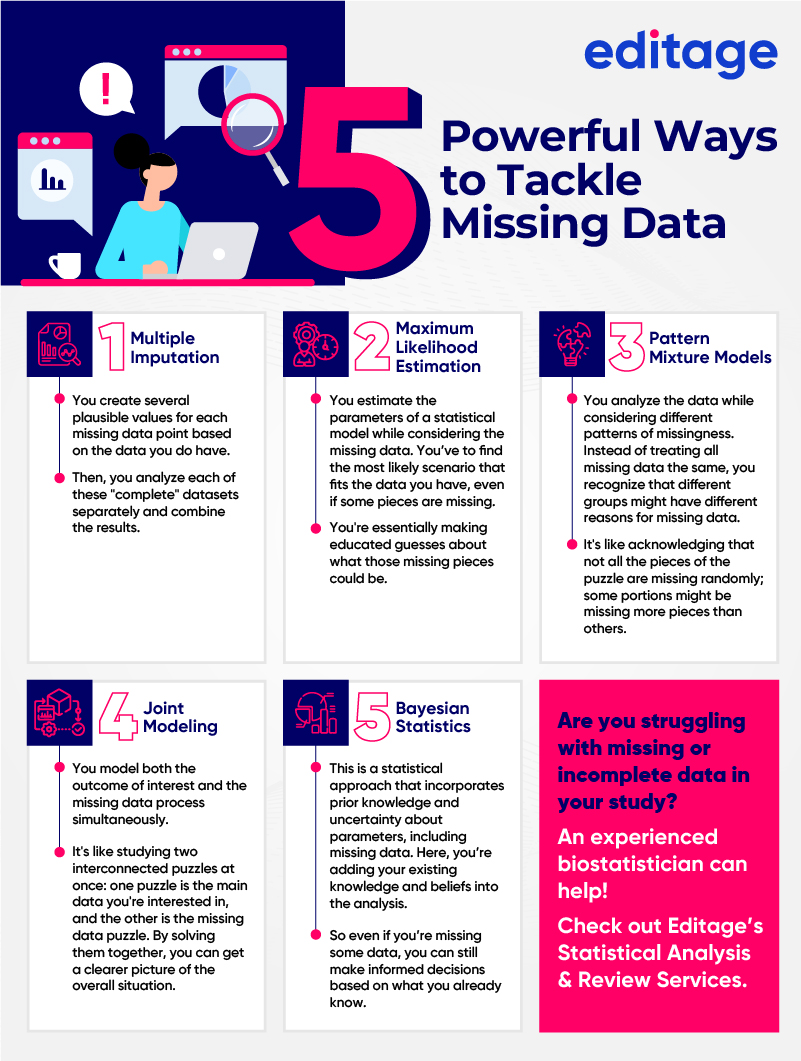
CCGMC_91_infographics_800X1060_13_may_2024 01.jpg