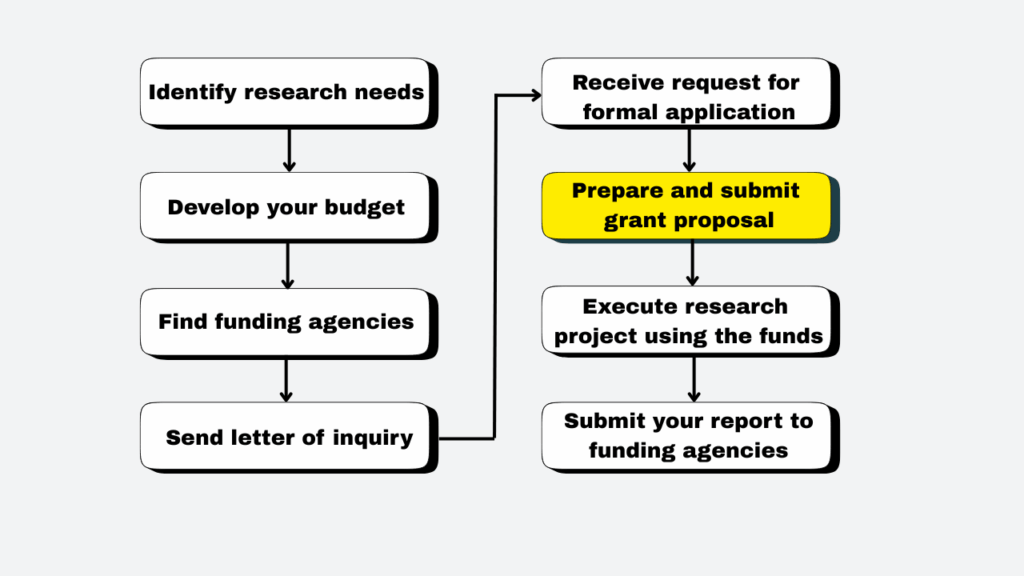
Grant Writing Needs More than Good Science
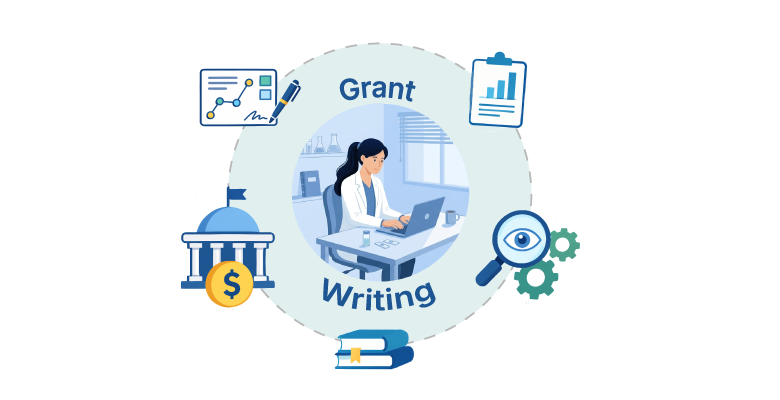
Research funding is fiercely competitive. Most grant proposals are rejected not because the science is weak, but because they fail to present a compelling case to the funder. This article discusses today’s funding environment, examines what it demands from investigators, identifies critical gaps in grant writing expertise, and outlines how research teams can develop stronger grant proposals.
Table of contents
A high-pressure funding landscape
The operational costs of grant writing
Writing for a research grant is different from writing for a journal
What funders look for in grant proposals
What changes when grant writing expertise is applied
A high-pressure funding landscape
There is an enduring assumption in academic and clinical research that exceptional science is guaranteed to find funding. Principal investigators (PIs), especially early-stage researchers, may tend to believe that an original hypothesis, rigorous data, and a strong publication record will convince grant reviewers about the merits of their proposal. However, the data tells a different story.
At the US National Institutes of Health (NIH), the success rate for research grants dropped to 13% in FY2025, down from 21% in FY2023. In 2026, the European Research Council’s (ERC’s) Starting Grant round funded only 8.8% of 4,807 applications. At the Wellcome Trust, during 2024-2025, competitive grant success rates were 10.4% for men and 9.4% for women. In 2024, the National Natural Science Foundation of China (NSFC) received 403,900 proposals from 2,502 host institutions and approved 54,900 awards (a success rate of ~13.6%).
The operational costs of grant writing
Despite the specialized demands of grant preparation, academic culture largely expects PIs to manage the entire process alone, alongside their teaching, clinical, or administrative responsibilities. This includes executing preliminary experiments, managing budgets, constructing data management protocols, coordinating with co-investigators, and ensuring funder specifications are met.
Unlike areas like experimental design, statistical analysis, or publication planning, grant writing is not taught systematically in most research training programs. Researchers typically prepare their first application without knowing how to build a persuasive argument for a funder. This leads them to spend a lot of time on a task they have not been trained to do.
A 2013 study of grants submitted to the National Health and Medical Research Council (NHMRC) of Australia found that it took researchers ~38 working days to prepare a new proposal and ~28 working days to work on a resubmitted one. In a 2023 analysis of third-party funding in Austria, this figure was closer to 50 working days, with 90% of researchers perceiving that they spend too much time on proposals. Multiply this across multiple grant cycles and you realize that investigators spend more time on administrative functions than on directing research programs.
With such odds and challenges, the gap between funded and unfunded research proposals cannot be explained by scientific merit alone. What distinguishes grant proposals is the quality of the argument made or how they are written.
Writing for a research grant is different from writing for a journal
Writing to win a grant is not the same as writing to get published in a journal. A journal article (research paper) is retrospective and evidence based. It typically reports what has already happened and presents arguments based on the results and findings. A grant proposal seeks funding in exchange for an assurance of future research findings and under conditions of uncertainty. It needs to make a case that satisfies the funder’s institutional mandate before experiments have been run. As one researcher involved in developing grant writing training at the University of California San Diego put it, “grant writing is a genre, its own kind of communication.”
A study published in PLoS One found that PIs spend an average of 116 hours writing a single proposal, which is not related to the grant being funded. Writing harder does not produce a better outcome when the document follows a format that does not align with its purpose. When PIs approach a grant proposal as they would a journal publication, they fail to convey the merits of the research effectively.
What funders look for in grant proposals
Every grant application, regardless of the funding body or mechanism, must answer three questions:
- Urgency: Why must this be done now?
Funding bodies do not distribute resources simply because a knowledge gap exists. An NIH institute funds research that focuses on diseases; the NSF invests in science with broader societal impact; Horizon Europe focuses on specific societal challenges. Thus, a proposal must show the funders how the research aligns with their own priorities.
- Fit: Why is this team uniquely equipped for this research?
Kolabtree’s expert guide on grant proposals indicates that funders assess not just what a project proposes to do but also whether the applicants have assembled “the right team of partners” with the right mix of skills and collaborative relationships. Building such a case is a skill that most researchers are not specifically taught.
- Risk: What happens if this project does not deliver?
Funders back research under conditions of uncertainty, and they expect proposals to address the uncertainty upfront with explanations for why those risks are worth taking.
What changes when grant writing expertise is applied
There is direct evidence for the impact of structured grant writing training or expertise. A grant writing course at the University of California San Diego enrolled 85 early-career faculty between 2017 and 2021. Within two years of completing the program, 79% had at least one grant funded as PI or multiple PI. A separate qualitative analysis of mentored grant writing programs found that coaching provided personalized feedback, built confidence, and supported early-stage investigators through the proposal development process.
However, researchers and institutions cannot always wait for formal training programs. Because funding cycles are seasonal and public budgets remain tight, maintaining permanent in-house grant development teams is rarely feasible. The funding environment will not become less competitive. The evidence indicates that grant writing needs more than good science. It needs a narrative that aligns with a funder’s priorities.
Specialist scientific writers and fractional grant consultants with knowledge of multiple funding mechanisms offer a practical alternative. These specialists have experience in grant proposal writing and understand how different funding bodies state their priorities, what grant review panels look for, and how to develop a proposal that answers the three key questions funders ask. Working with a grant writing expert at the proposal design stage can help investigators ensure that their proposal makes a strong case for the funders.
Platforms such as Kolabtree that connect researchers with vetted scientific writing specialists with expertise across major funding bodies make on-demand grant-writing support accessible without requiring a permanent in-house investment.
Frequently asked questions
1. Why are grant success rates so low?
Grant funding is competitive for reasons that go beyond simple supply and demand. The global research community has grown substantially over the years. More researchers, across more institutions and countries, are applying to a pool of funding that has not expanded at the same rate. The costs of conducting cutting-edge science have also surged. At the same time, funders have become more accountable for how public and philanthropic resources are allocated, raising the bar for what constitutes a fundable proposal. Grant funding not only determines how individual research careers advance; it also directs how entire fields move forward and how science contributes to addressing major global challenges. Thus, the grant review process is rigorous by design.
2. What makes grant writing different from other forms of scientific writing?
Most scientific writing – including journal manuscripts, review articles, lab protocols, and technical reports – is descriptive and retrospective. Its main purpose is to report something that has already been discovered, explain an existing methodology, or synthesize published literature. A grant proposal is prospective and intended to be persuasive. It is written with the aim of requesting a funding body to allocate capital based on an expectation of future delivery under conditions of uncertainty. It requires researchers to defend financial feasibility and demonstrate alignment with the funder’s mandate.
3. Does spending more time on a grant proposal improve the chances of success?
The evidence suggests it does not, on its own. A survey of active grant applicants found that principal investigators spend an average of 116 hours writing a single proposal, and that time invested is not related to whether the application will be funded. What matters more is whether the proposal directly addresses what the funder is looking for, i.e., a clear case for why the research is urgent, why the team is equipped to carry it out, and why the investment is worth the risk. A well-written grant proposal that explains how it aligns with a funder’s specific priorities is more likely to succeed than one that does not.
4. How can researchers build grant writing skills if their institutions do not offer formal training?
Several options exist. Mentored proposal development programs, such as those run through the National Research Mentoring Network in the US, pair early-career investigators with experienced coaches who provide structured feedback on grant components over several months. Many professional societies and funding bodies also offer workshops, webinars, and sample application resources. Engaging a specialist scientific writer or grant consultant, particularly one with experience in the specific funding mechanism being targeted, is another route, especially when a submission deadline does not allow time for a longer development process. The common thread across all these options is structured, specific feedback on the proposal itself, not just general guidance on how to write.
5. When should researchers engage specialist grant writing support?
The most useful time is at the proposal design stage, before the specific aims are finalized. At this point, the research question can still be positioned in relation to the funder’s priorities, and the team’s qualifications can be included in the proposal from the start rather than added later. Grant writing support after the first draft is also helpful, but the key decisions about how to structure the argument are harder to revise once the document has taken shape.
6. What role does funder-specific knowledge play in grant success?
Major funding bodies have distinct mandates, priorities, and formatting conventions, and these vary not only across bodies but across mechanisms within the same organization. An NIH institute funds research tied to specific diseases; the NSF funds paradigm-shifting basic science with broader societal impacts; Horizon Europe is oriented around specific societal challenges. A proposal needs to align with the funder’s specific institutional rationale. Building this understanding through experience takes years. But engaging a specialist who understands funder-specific differences can provide a more immediate path.
References
1. NIH National Institutes of Health. Success rates: R01-equivalent and research project grants. RePORT. NIH Data Book. https://www.report.nih.gov/nihdatabook/category/10. Accessed 02 October 2026.
2. Isaac B. ERC starting grant success rate below 9% amid record demand. ResearchProfessional News. Published 03 September 2026. https://www.researchprofessionalnews.com/rr-news-europe-horizon-2020-2026-9-erc-starting-grant-success-rate-below-9-amid-record-demand/. Accessed 02 October 2026.
3. Grant funding data for 2024/25. Report Summary. Wellcome Trust. Published 21 June 2026. https://wellcome.org/research-funding/funding-portfolio/funding-data-2024. Accessed 02 October 2026.
4. National Natural Science Foundation of China (NSFC) annual report 2024. https://www.nsfc.gov.cn/english/site_1/report/C1/2023/12-28/347.html. Accessed 08 October 2026.
5. Danielle L.H., Adrian G. B., Philip C., Nicholas G. On The time spent preparing grant proposals: An observational study of Australian researchers. BMJ Open. 2013;3(5):e002800. doi:10.1136/bmjopen-2013-002800.
6. Gerald S. Can’t we do better? A cost-benefit analysis of proposal writing in a competitive funding environment. PLoS One. 2023;18(4):e0282320. Published 2023 Apr 19. doi:10.1371/journal.pone.0282320.
7. UC San Diego health sciences grant writing course helps launch successful research careers. Behind Every Breakthrough. UC San Diego Today. Published 12 January 2026. https://today.ucsd.edu/story/uc-san-diego-health-sciences-grant-writing-course-helps-launch-successful-research-careers. Accessed 08 October 2026.
8. Ted vH, Courtney vH. To apply or not to apply: A survey analysis of grant writing costs and benefits. PLoS One. 2015 Mar 4;10(3):e0118494. doi:10.1371/journal.pone.0118494.
9. Ramya S. How to write a winning grant proposal: An expert guide. Kolabtree Blog. Published 16 March 2020. https://www.kolabtree.com/blog/how-to-write-a-winning-grant-proposal-an-expert-guide/. Accessed 06 October 2026.
10. Andrea Z. L. LaCroix et al. Building strong grant writers in academic medicine: outcomes of early-career faculty enrolled in the University of California San Diego Health Sciences Grant Writing Course. Acad Med. 2026;101(1):34-42. doi:10.1093/acamed/wvaf031.
11. Yulia A. L. S. et al. Exploring grant writing coaching and its role in professional development of health equity investigators: A qualitative study. J Clin Transl Sci. 2025 Jul 1;9(1):e178. doi:10.1017/cts.2025.10080.
12. Kolabtree. Scientific writing services. https://www.kolabtree.com/services/scientific-writing. Accessed 08 October 2026.
13. Deepika K. From application to approval: Secrets to successful grant writing. Published 26 February 2026. https://www.kolabtree.com/blog/from-application-to-approval-secrets-to-successful-grant-writing/. Accessed 05 October 2026.
14. Naren M. Hire a grant writer – The complete guide. Kolabtree Blog. Published 05 September 2022. https://www.kolabtree.com/blog/how-to-hire-a-grant-writer/. Accessed 03 October 2026.