APA Style Guide: Paper Structure, Figure and Table Preparation, and Writing Style
We have previously seen how references and in-text citations can be formatted using APA style. In this blog, we will understand how the APA recommends structuring a research paper with styling and formatting guidelines, instructions for table and figure preparation, and other useful writing tips.
Jump to contents
What is APA Style (APA Format)?
Layout and Formatting in APA Style
- Fonts and Sizes: Recommended Fonts (Serif and Sans Serif)
- Margins and Line Spacing: 2.54 cm (1 inch) on all sides, double-spacing
- Page Numbers and Running Heads: Rules for top-right placement
Components and Writing of APA Style
Rules for Creating the Reference List
- Basic Format: Order of Author, Date, Title, and Source
- Key Changes in the 7th Edition: Omission of publisher location, DOI formatting, removal of “Retrieved from” for URLs
Rules for Including Tables and Figures
- Table Components: Number, Title, and Note
- Figure Components: Caption placement and clarity
- Tips to create effective figures in APA style
Points for Improving Academic Writing Quality
- Selecting Objective and Concise Language
- Avoiding Biased Language (Gender, Race, Disability, etc.)
- Utilizing Efficiency Tools (Reference Management Software, Auto-generation Sites)
Frequently Asked Questions about APA Style
What is APA Style (APA Format)?
The APA style guide is the official standard format set forth by the American Psychological Association to prepare academic documents such as research papers, theses, dissertations, and case reports should be formatted. It includes guidelines on formatting the
- page layout,
- font,
- margin,
- line spacing,
- heading styles,
- paragraph style, and
- citation & reference list.
Purpose and Importance of APA Style
APA style is commonly followed by students in the fields of social sciences, behavioral sciences, sociology, psychology, anthropology, and political science. The APA style is also preferred by many journals for initial submissions of research papers.
The purpose of the APA style guide is to maintain consistency and clarity, especially in terms of formatting and writing the paper along with citing sources, when reporting scientific findings. It is important to
- standardize the structure of paper for enhanced readability
- communicate research findings and implications effectively
- maintain accurate documentation of sources
- reduce bias in language when reporting
- show professionalism in research preparation
Overview of the Latest 7th Edition (Published 2019)
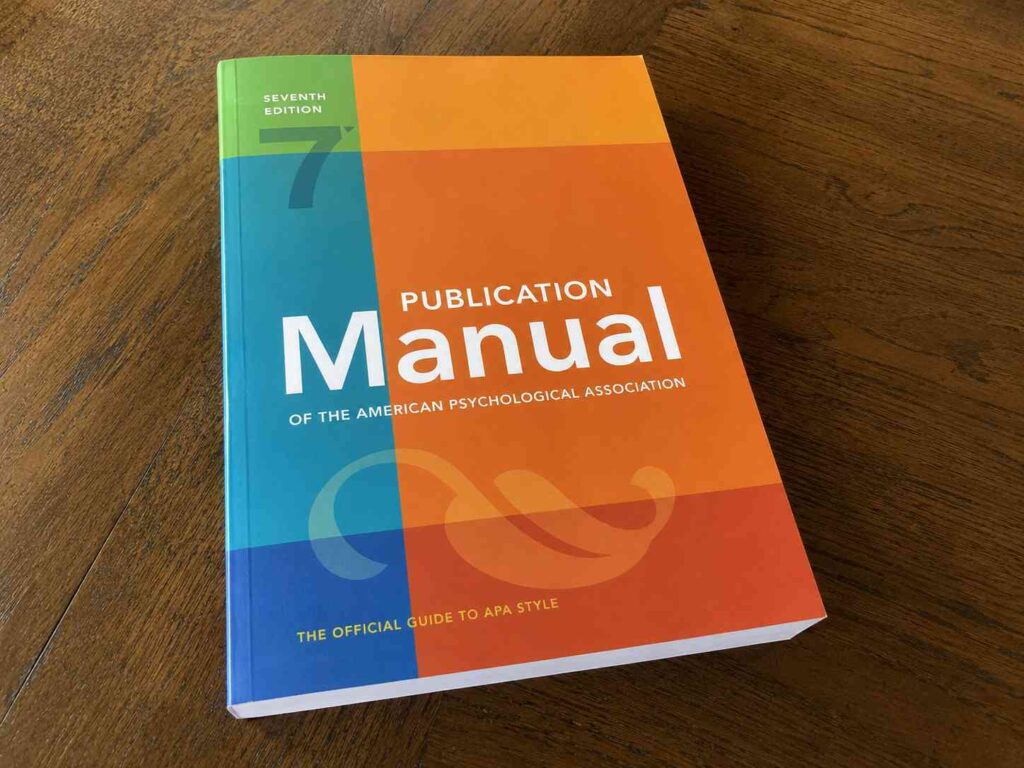
The 7th edition of the APA style manual was published in 2019 [1]. The APA style guide provides a template that authors can directly use for formatting research papers. Here are a few basic pointers you should be taking care of when formatting your research paper as per APA style:
- Keep 1-inch margins on all 4 sides.
- Use 12-point Serif font (e.g., Times New Roman) with double line spacing.
- First line of paragraphs should be indented by 0.5 inch.
- Page numbers must be written in the top right-hand side corner.
- Provide a running head (abbreviated paper title) of 50 or fewer characters, including spaces, on the top left-hand side corner of all pages.
Layout and Formatting in APA Style
Fonts and Sizes: Recommended Fonts (Serif and Sans Serif)
The APA style guide wants authors to use legible, accessible, and consistent font throughout the manuscript. The recommended fonts include Serif fonts like
- Times New Roman (12 pt)
- Georgia (11 pt)
- Computer Modern (10 pt)
You may also use Sans Serif fonts like
- 12-pt Aptos,
- 11-pt Arial or Calibri, and
- 10-pt Lucida Sans.
Ideally, the choice of font type and size depends on your submission requirements. For example, journals sometimes mention limits for the number of pages during initial submissions, and different font types/sizes occupy different page lengths. So, depending on submission guidelines, you may choose the font best suited for your manuscript.
Margins and Line Spacing: 2.54 cm (1 inch) on all sides, double-spacing
The APA style manual requires authors to maintain 1 inch (2.54 cm) margin on all four sides of a page. However, note that for thesis and dissertation submissions, this rule is flexible. If, for instance, your supervisor asks for a 1.5-inch margin on the left side of the page to accommodate binding, then the page layout should be modified accordingly.
The APA style guide recommends double-line spacing for most sections of the paper:
- the abstract
- main text
- block quotations
- table and figure legends
- reference list
However, there are a few exceptions. For example, content within table cells may be single spaced or double spaced, depending on which format looks the most appropriate for the information presented. Similarly, text within figures may be single spaced if needed. If footnotes are used, follow the default setting of the Word document: single spaced smaller font.
Page Numbers and Running Heads: Rules for top-right placement
All pages must be numbered; insert the page number on the top right-side corner of every page starting with the title page.
The APA style guide also requires authors to include running heads, which are nothing but abbreviated versions of your paper’s title, on all pages. If the title is already short, it need not be abbreviated. Students are to use running heads at the discretion of the supervisor, instructor, or university guidelines. Here are some basic guidelines for writing running heads in APA style:
- It should be written in all capital letters
- Keep it within 50 characters, including spaces
- It should appear on all pages, including the title page
- Align it with the left-side margin, in the same line as the page number on the right-hand side
Components and Writing of APA Style
The APA style manual considers seven key sections in an academic document. For each section, the style guide outlines specific formatting and writing instructions.
Title Page (Cover)
Both student submissions and journal papers must have a separate title page at the start of the manuscript. The format and contents of the title page differ for the two.
Student title page components
- Paper title: centered, bold, major words capitalized.
- Author name: centered below the title after a one-line gap. Use “and” if there are two authors; for three or more authors, use commas between author names.
- Author affiliation: centered below the author name. Write the department name as well as the name of your college, institute, or university.
- Course details: centered below the affiliation. Mention the course number and name.
- Name of the instructor: centered below the course information.
- Due date for submission: centered below the instructor’s name. Use a standard date format followed in your region/country to indicate the assignment’s due date.
- Page number: insert page number on the top right-hand side corner using Word’s page number function.
Professional paper title page components
- Paper title: centered, bold, major words capitalized.
- Author name: centered below the title after a one-line gap. Use “and” if there are two authors; for three or more authors, use commas between author names. When authors have different affiliations, place superscript numerals next to the names to indicate the correct affiliation.
- Author affiliation: this is the institution at which the research was conducted. If there are multiple authors with different affiliations, each one should be centered and written on a separate line after the corresponding superscript number.
- Author note: write “Author Note” centered and bold near the bottom half of the title page. Include author ORCID details wherever available.
- Running head: left-aligned in the page header, must appear on all pages.
- Page number: right-aligned in the page header in line with the running head. Insert using Word’s page numbering function on all pages.
Abstract
The 7th edition of the APA style guide sets clear guidelines for abstract and keywords [2]. While student assignments may not require abstract and keywords, do check with your instructor or supervisor regarding the university guidelines.
The APA style abstract should be less than 250 words. It should provide a comprehensive overview of your research, briefly covering
- The research background (key points of the literature review)
- The research problem you’ve identified
- Methods used with a description of the study design and samples
- Key results and findings of your research
- Study implications
You can use any of the recommended fonts mentioned above to write the abstract. The abstract is always placed after the title page; so it’ll be on the second page of your manuscript. The page layout in terms of margins and line spacing remains the same as the rest of the document. Start by centering “Abstract” written in bold on the first line of the page. The text follows one line below, written as a single paragraph without indents.
The list of keywords must be included below the abstract. The heading is italicized like “Keywords:” and the keywords are written in the same line, lowercased (except proper nouns), non-italicized, and separated by commas. DO NOT include a period after the last keyword in the list.
Introduction
In APA style, the Introduction is one of the critical sections that sets the tone of your research manuscript. Here are some pointers to note when writing the Introduction section:
- It should evaluate the existing knowledge in the field, and the text should transition towards the main research problem identified.
- Do include citations to previous works. But avoid presenting detailed explanations of all literature works.
- Paraphrase content from previous works rather than directly quoting information.
- The aim is to direct the reader’s attention to the problem at hand and how your study identifies the solution.
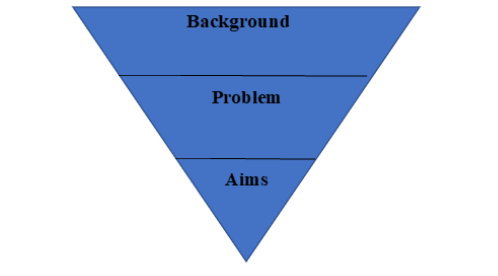
The structure of the Introduction is like an upside-down triangle. Start with a broad explanation and narrow down the reader’s interest towards your research problem.
Method
The Method section in the APA style should focus on presenting precise details of how the study was conducted.
- What study design was employed?
- What sample size was considered?
- What equipment were used?
Include the steps with sufficient clarity and detail to make it easy for other researchers to reproduce the research process.
Describe the materials and equipment used along with information of procurement. If there was lab support enlisted, specify how the support was provided. Any protocol followed during the experimental procedure must be explained. You may divide this section into sub-sections with suitable sub-headings to make it easy for the readers to consume.
Results
In APA style, the Results section should highlight all findings of your analysis. Here too you can use sub-sections to divide the findings into corresponding data analysis methods. Some important things to consider when writing the Results section in APA format:
- Use tables and figures as appropriate; but make sure you do not repeat information. For example, if a graph explains the correlation between data from samples collected over different periods, the same data need not be provided in a table.
- If you’re dividing the section into sub-sections, try and link the findings with the sub-sections used in the Method section to describe the study design. For example, if a sub-section in the Method section described the statistical techniques used, let there be a sub-section under Results summarizing the findings from that statistical analysis.
- Focus on ONLY presenting the study findings objectively. DO NOT discuss the inferences of the findings under the Results section. That information goes in the Discussion section.
Discussion
In the Discussion section, you should explain and interpret the study findings. This helps readers understand how your results connect to the research hypothesis stated in the Introduction section. Think of the Discussion section as the opposite of the Introduction:
- Start with your research problem and then provide broader understanding of your study implications.
- Clarify how your analysis and obtained findings support your research hypothesis.
- Use the references you mentioned in the Introduction. How do your findings differ from the results reported in these previous studies? Highlight the improvement.
- If there were any unexpected or interesting results, mention this and theorize the potential explanations.
- Specify the limitations of your study. What could not be achieved? What was beyond the scope of the study? Will it be explored in future research? This is an excellent way of laying foundation for your upcoming studies.
References
In APA, the list of references should start on a separate page with the heading “References” written in bold and centered on the page. The works should then be alphabetically sorted with a hanging indent of 0.5 inch and double line spacing. Be sure to list all works cited in the main text under References.
Rules for Creating the Reference List
Basic Format: Order of Author, Date, Title, and Source
The reference list should list all works that have been cited in the main text. APA style manual instructs authors on how to format each reference list entry. The basic format includes four key elements: author, date, title, and source.
Author
- Author can be single, multiple, or an institution.
- Mention the surname first followed by the initials (e.g., Author, A. A.).
- For two authors, separate the names by “&” (e.g., Author1, A. A. & Author2, B. B.)
- Format for three authors is: Author1, A. A., Author2, B. B., & Author3, C. C.
- For more than 21 authors, write the names of first 19 authors, include an ellipsis without the ampersand symbol, and then write the last author’s name.
Date
- Date can be just the publication year; year and month; year, month, and day.
- Place the year of publication within parentheses followed by a period (e.g., (2025).)
- Format when year and day are known: (2024, July 1) or (2024, July) if only month is known
- If the work is accepted for publication but not yet published, write (in press).
Title
- Write the title in sentence case, capitalize the first letter of only the first word and proper nouns.
- Use a period at the end of the title.
- When works are a part of a greater whole (e.g., journal article, book chapters), do not italicize. For other works that are stand-alone like webpages, reports, and books, you must italicize the title.
- For book titles, the edition and volume number should be mentioned in parentheses immediately after the title.
Source
- Source represents from where your work was retrieved (e.g., journal, website, report, thesis, dissertation).
- Usually, you should mention the volume, issue number, page range, and DOI.
To see specific examples of reference by material type like books, journal articles, websites, social media posts, refer to the blog here.
Key Changes in the 7th Edition: Omission of publisher location, DOI formatting, removal of “Retrieved from” for URLs
The 7th edition of the APA style manual has presented some notable changes in the reference page format:
- List up to 20 authors; for more than 20 authors, add ellipses (…) between the 19th and the last author.
- DOIs must be added as hyperlinks; do not prefix the URLs with “DOI:” For example, doi: 10.1080/20260506.789.345 should now instead be written as https://doi.org/10.1080/20260506.789.345
- You no longer need to write “Retrieved from” before URLs, unless a retrieval date or date of access is specified.
- Publisher location need not be mentioned for books.
- Titles are written in title case (capitalize only the first word and proper nouns in the title).
Rules for Including Tables and Figures
Table Components: Number, Title, and Note
The basic components of an APA style table include: number, title, headings, body, and note.
- The table number is left-aligned, written in bold above the table title
- The title is double line spaced after the table number; write it in title case and italicize. DO NOT use a period after the table title.
Example:
Table 1
This is a Table Title
- The column headings in the table must be centered.
- The text within the table cells should be left-aligned. They may be single-spaced, one-and-a-half-spaced, or double-spaced.
- Notes appear below the table ONLY if needed to describe table contents to give additional clarity on the information given in the table (e.g., definitions of abbreviations, asterisk next to a p value).
Figure Components: Caption placement and clarity
In APA, any display item that is not a table is deemed a figure. Common types of figures include
- Graphs (e.g., line graphs, bar graphs)
- Charts (e.g., flowcharts, pie charts)
- Pictorial captures (e.g., drawings, maps, plots)
- Images (e.g., photographs, infographics)
The basic components of a figure in APA include figure number, title (or caption), image, figure legend, and note. The figure setup is similar to that of a table setup.
- The figure number must be left-aligned, written in bold above the figure title
- The title is double line spaced after the figure number, italicized, and written in title case. There is NO period after the title.
Example:
Figure 1
This is a Figure Title
- Next, the image should be placed below the title. Any text within the figure should be written using a Sans Serif font (Aptos, Lucida Sans, Calibri, Arial) between 8 and 14 pt.
- A figure legend can be used to explain the symbols used in the figure.
- Notes are to be placed below the figure, if necessary, to describe figure contents.
Tips to create effective figures in APA style
1. Make sure images are clear, with the elements appearing sharp and smooth.
2. The font must be easily legible. Use only APA-recommended font type and size.
3. Provide units of measurement when necessary.
4. Clearly label all elements within the figure.
5. Place figures either closest to where it is first mentioned in the text or at the end of the manuscript after the Reference list.
Points for Improving Academic Writing Quality
Selecting Objective and Concise Language
In scientific writing, one of the challenges is to remain objective when presenting your analysis. It may also be difficult to write concisely, especially if you’ve collected a vast amount of data and investigated the topic in depth. How to maintain conciseness in language while remaining objective? Here are a few tips:
- Make evidence-based claims. Let your data and citations speak rather than your personal beliefs and opinions. Supporting your arguments with phrases like “the data suggest” instead of “I feel” or “we believe” adds more weight to your claims.
- If allowed by the journal/university, use active voice in your writing. For example, “the data was analyzed” is too wordy and can be replaced with “we analyzed” to maintain conciseness.
- Minimize unnecessary wordiness. For instance, “due to the fact that” can be “because of”; “performed a study to investigate” can be “investigated”; “final result” can be “result” or “outcome”.
- The vocabulary used should be field-specific, depending on the research topic and the subject area. Avoid using vague jargon.
- Maintain consistency in term usage. If you’ve used “study participants,” do not replace it with “subjects” or “individuals” to sound synonymous. It could confuse readers.
Avoiding Biased Language (Gender, Race, Disability, etc.)
APA style manual instructs against using biased language [3]. It may be related to gender, disability, racial and ethnic identity, age, or socioeconomic status—APA outlines guidelines for using precise language.
- Choose words that encompass all categories. For example, don’t say “men” when referring to all humans in a study; instead, use “individuals,” “persons,” “participants,” or “subjects.”
- Use person-first language. For example, say “patients with diabetes” instead of “diabetic patients.”
- Be appropriately specific and sensitive to issues of labeling when describing racial and ethnic groups. Take care to capitalize terms correctly (e.g., “Blacks,” “Whites,” “Native Americans”).
- APA encourages authors to explicitly highlight gender identities of study participants (e.g., whether participants are transgender, cisgender, or other gender identities) if relevant to the study rather than assuming cisgender identities.
- In the Method section of your paper, specify age ranges rather than using a broad term like “under 18” or “over 65.”
Utilizing Efficiency Tools (Reference Management Software, Auto-generation Sites)
Because APA style manual provides formatting guidelines for citations and references, it is better to use tools to manage and format them.
- Tools like Zotero, EndNote, Mendeley can help manage references efficiently.
- During literature search, tools like RDiscovery and ResearchRabbit can significantly simplify the process of tracking the works referenced.
- Use automatic APA reference and citation generators to avoid making formatting mistakes.
Frequently Asked Questions (FAQs) about APA Style
Q1. How should in-text citations be written when there are 3 or more authors?
For three or more authors, write the first author’s surname followed by “et al.” when citing them within the text.
Example of parenthetical citation: (Author1 et al., year)
Example of narrative citation: Author1 et al. (year)
Q2. What should I do if the publication date of a paper is unknown?
If a paper has no publication date, you can use “n.d.” for “no date” in the reference list entry as well as in the in-text citation.
Reference list entry: Author. (n.d.). Title. Source
In-text citation: (Author, n.d.) or Author (n.d.)
Q3. Is the access date required when citing a website?
When citing a website, an access date (or a retrieval date) is required if the content is dynamic. In other words, if the website or online article is designed to change over time altering its content, then you should write “Retrieved <Date> from <URL>”. Here’s an example:
Retrieved September 9, 2025, from https://www.riken.jp/en/
Q4. When citing Japanese literature, should it be written in English?
The 7th edition of the APA style recommends transliterating non-English works into English. This means the title of any Japanese work must be transliterated into English in the reference list entry as well as in the in-text citations (if titles are being cited). Transliterating means to write the letters from the Japanese alphabet in English alphabet to help avoid character errors.
Q5. Is there a specific order for the reference list?
Yes, the reference list should be ordered alphabetically as per the author names.
Q6. Is “Times New Roman” the only specified font?
No, the APA style guide gives authors the option of choosing between Serif and Sans Serif fonts like Times New Roman (12 pt), Georgia (11 pt), Arial (11 pt), Aptos (12 pt), and Calibri (11 pt) among others. The font size varies for each font type, which is also recommended by the style guide.
Summary
Formatting your research paper as per APA style is quite straightforward as long as the guidelines are clearly followed.
- When submitting to journals, simply download the template (if there is one) provided by the journal to adhere to their instructions.
- Students, on the other hand, must consult university submission guidelines and reach out to supervisors/instructors for clarity on any unclear aspects of the submission.
If there are no specific guidelines outlined by the journal or the university, then the APA style manual is a great starting point to prepare your submission in a professional way.
References
1. American Psychological Association (APA)’s style manual https://apastyle.apa.org/style-grammar-guidelines/citations/basic-principles
2. 7th Edition Abstract and Keywords Guide https://apastyle.apa.org/instructional-aids/abstract-keywords-guide.pdf
3. Bias free language https://apastyle.apa.org/style-grammar-guidelines/bias-free-language