How to Avoid AI Plagiarism in Research Papers
TL; DR
- Plagiarism and AI detection are two different concepts. Plagiarism denotes close resemblance between two content pieces, indicated by a similarity score. AI detection score signals whether the writing shows possible use of AI tools based on pattern analysis.
- The best way to avoid AI plagiarism is to rewrite AI-generated output in your own voice rather than copying the text as is. Use AI for brainstorming and outlining the structure and not for generating research-related content.
- Always verify the works cited by AI tools. Since generative AI is notorious for fabricating citations, double-check whether the references mentioned are genuine.
- Clearly disclose how you have used AI in preparing your manuscript. Be specific about the tool name, version, the purpose of using AI, the task that was performed using AI, the extent to which AI contributed to your work, and confirm that a human validated all AI-generated output.
When generative AI tools like ChatGPT made their debut, I don’t think anyone anticipated it to eventually result in concepts like AI plagiarism.
“I used ChatGPT to just get some ideas and used them in my paper! How is that plagiarism?”
Hm, where do you think ChatGPT got those ideas from? Large language models (LLMs) are trained on existing datasets, and any output generated would have referenced existing works. So, if you copy-paste the output spit by an AI tool in your paper and fail to cite proper references, that counts as AI plagiarism.
This blog takes you through the key differences between plagiarism and AI detection, underscores the importance of human validation of AI-generated content, and explains how authors can avoid being flagged for AI plagiarism.
AI Detection vs. Plagiarism
Why Human Validation Matters
How to Avoid AI Plagiarism in Research Papers
FAQs on AI Detection and Plagiarism
AI Detection vs. Plagiarism
What is Plagiarism?
Plagiarism is intentionally (or unintentionally) using someone else’s work and claiming that it’s your original work without providing credit to the original author. Often, when researchers build on existing scientific investigations, research papers could unintentionally contain different types of plagiarism like direct, indirect, paraphrasing, and mosaic plagiarism.
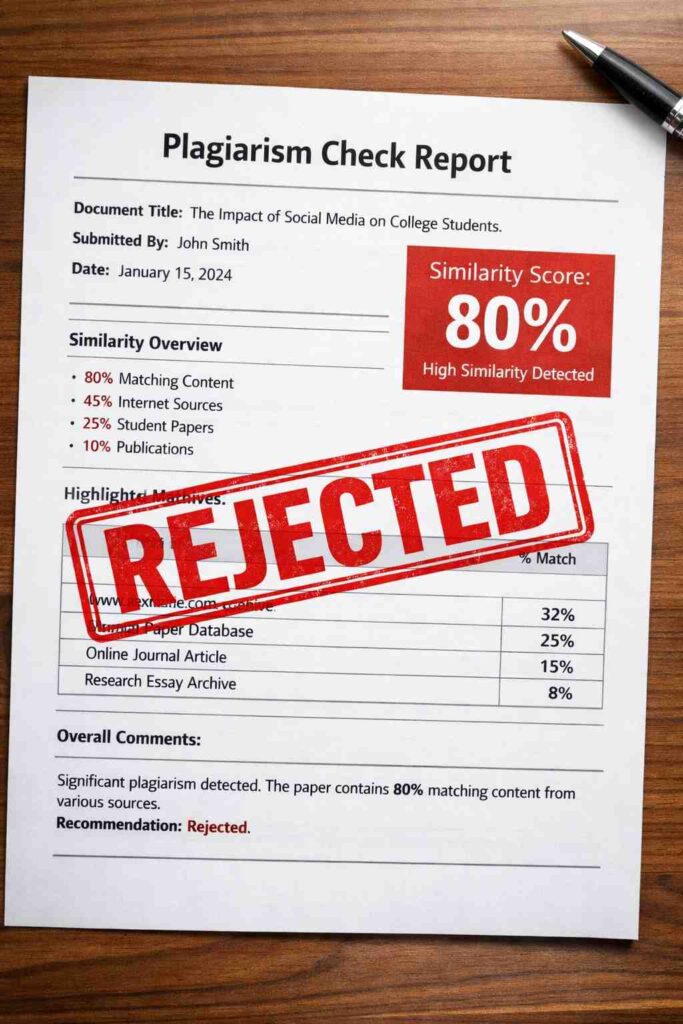
Journals consider plagiarism as a highly unethical practice. They use plagiarism checkers to determine how closely your work resembles previously published papers. This is determined by means of a similarity score.
What is AI Detection?
Recently, with the increasing use of gen AI tools for writing, AI detection tools have been on the rise. AI detectors analyze the writing pattern and evaluate factors like variations in sentence length, perplexity, burstiness, and range of vocabulary to then provide a score depending on how robotic or formulaic your writing sounds.
AI detection scores are mere estimations of whether the content sounds AI. They do not guarantee that an AI writing tool was used to generate the content, and therefore requires human interpretation.
Why Human Validation Matters
One thing that nearly all AI users agree on: Humans MUST validate AI output. Yes, AI offers suggestions, improves your writing, fixes basic grammar errors, helps brainstorm ideas, and even generate content. But regurgitating AI outcomes without any intervention and validation whatsoever is extremely risky. Editage’s post-AI risk assessment service addresses this problem by having an expert validate your work before journal submission.
But why does human validation matter?
- AI fabricates sources. Topaz et al. (2026) audited over 2.5 million papers (subject area biomedicine) published from January 2023 to February 2026 in PubMed Central’s Open Access and not only confirmed the existence of fabricated references in peer-reviewed papers but also reported a concerning escalation in the rate at which these citations were fabricated [1]. This means that without appropriate human intervention, scientific research could face serious ramifications.
- Raw AI output is robotic. AI generates text output in a highly mechanical manner. The transitions between ideas, the use of connecting phrases, the rhythm in the flow of writing—they follow a certain fixed pattern that makes it very non-human-like. Although there are now tools to spot these patterns, seasoned editors could recognize that the writing underwent no human review even without the help of tools, simply based on their experience of evaluating research papers.
Moreover, generative AI reiterates definitions and summaries picked up from datasets or publicly available information on the internet. Who’s to say that the wording is not an exact match to the original? And if you regurgitate the same in your paper, without modifying it in any way, it results in plagiarism.
- Presenting surface-level information shows lack of understanding on your part. Research papers require details. Editors need to know that you as an author have a clear idea of the concepts you are describing. And this comes with appropriate and relevant exemplification and interpretation.
For instance, an AI tool like R Discovery helps in literature search by collating relevant papers, summarizing research details, and recommending other related published materials. Yet, when you draft the Literature Review section or the Introduction and Background sections, your interpretations of these existing research become crucial. What did you understand from it? Are you challenging any of the existing claims? Does your investigation refute some findings? Or does it support those results in a much stronger way to solidify research in the right direction? This is why human intervention is key.
So, if you are someone who extensively uses AI in preparing research papers, validating and verifying AI output should be a natural practice that’s incorporated in your workflow. Here’s a short checklist that can help avoid AI plagiarism.
How to Avoid AI Plagiarism in Research Papers
1. Restrict the use of AI to brainstorming and outlining
Considering that reproducing AI-generated text can lead to plagiarism, the best way to avoid AI plagiarism is to NOT use it for writing/generating papers for you! Let AI give you the initial outline. A foundational structure for you to start from. You may even use key terms involved in your research methodology to brainstorm ideas. In fact, that’s what tools like Paperpal do without overriding author’s originality in writing.
Avoid using AI for drafting entire sections or paragraphs in a research manuscript. The input should come from you and AI should only serve as an assistant.
2. Rewrite and paraphrase
Do not directly copy text that you’ve read, especially during literature search and review. Instead, synthesize and summarize them in your own words before drafting your manuscript. If AI was used, treat the AI-generated text as a rough comment and not as the final copy. Rephrase those sentences in your own style and voice to retain the originality and minimize machine-writing-like patterns.
3. Check for text overlaps with cited works
Even though you have credited original authors’ works through citations, a string of text matching exactly the same with previously published literature is deemed plagiarism. A few phrases matching, for example “results indicate that” or “we confirmed that” could be ignored and considered coincidental. But full-length sentences? It makes editors question as to why they were not paraphrased and wonder whether there’s any original contribution in your work. So, check whether sentences have been sufficiently paraphrased to avoid plagiarism.
4. Disclose AI use transparently
Most publishers allow the use of AI tools as long as you adhere to journal AI policies. And one of the key requirements of compliance is to disclose the use of AI using clear statements. Mind you, this does not absolve you if plagiarism is detected! But using proper AI disclosure statements during journal submission shows that you’ve taken cognizance of journal guidelines rather than misuse AI.
5. Use pre-submission checks to eliminate doubts
Finally, if you are still unsure of whether AI may have overlooked important aspects, run expert pre-submission checks to minimize the risk of AI detection. Editage’s post-AI risk assessment service helps identify the potential risk of compliance and integrity in your AI-assisted manuscript before submission so you can address them before journal submission.
Such risk checks can help authors eliminate unintended plagiarism and text overlap while maintaining citation accuracy, verified references, originality, and scientific meaning, all of which AI tools may have overlooked during manuscript preparation.
FAQs on AI Detection and Plagiarism
1. What’s the difference between plagiarism and AI detection?
Plagiarism occurs when your research paper closely matches previously published content. Plagiarism checkers use databases and other journal repositories to look for exact matching of text or strings of text that match with minor variations in sentence structure and word placements, and then arrive at a similarity score.
AI detectors function differently. They look for writing that sound robotic or formulaic, which resemble AI writing patterns. They check factors like perplexity (how predictable the text is) and burstiness (variations in sentence length, phrases & vocabulary used, and structure of sentences). AI detection scores are not always accurate and should be interpreted with discretion.
2. Does using ChatGPT count as AI plagiarism?
It depends on what you are using ChatGPT for. If you use ChatGPT to generate content, copy the same in your research paper, and then claim that you wrote it, it will be deemed AI plagiarism because the work is not originally yours. Falsely taking authorship credits, even from an AI tool, counts as plagiarism.
3. What percentage of plagiarism is okay in research papers?
Plagiarism is not tolerated in research papers. Authors are expected to write their own papers and provide proper citations to works they have referenced.
The percentage denoted by plagiarism checkers like iThenticate or Turitin represents the similarity score. Usually, a score of 15% to 25% is considered acceptable. There can also be journal-specific guidelines on how much score is acceptable for particular sections of a manuscript. For example, the Methods section could show high overlap in text because of the names of equipment, methodology used, and commonly used phraseology when describing research methodology. But say in a Discussion section, where you interpret your findings, there should be lower overlap in text as it is supposed to be unique to your study.
4. How to reduce AI detection score?
Reducing AI detection score should not be the aim of your writing. Humanizers (or humanizing tools) that assure of giving you a 0% AI detection score are also, at the end of the day, tools! When these tools rewrite and rephrase the sentences, the originality of author’s voice is still not retained.
What authors should instead focus on is to write their own research papers with minimal AI assistance. Avoid using generative AI tools like ChatGPT for research paper writing as they are not truly meant for academia. Use tools like Paperpal that are developed for academic writing and be transparent in disclosing the use of AI to comply with the journal’s AI use policy.
Reference
1. Fabricated citations: an audit across 2.5 million biomedical papers https://www.thelancet.com/journals/lancet/article/PIIS0140-6736(26)00603-3/fulltext